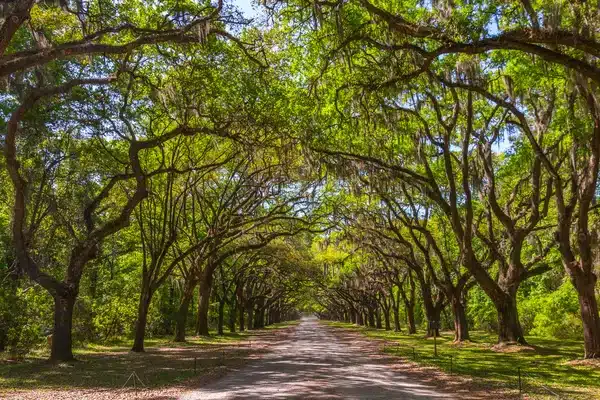
Trees are real-life superheroes. They give us oxygen, shade, and fruits bursting with vitamins. They can even reduce stress, purify the air, and absorb CO2 from the atmosphere. And now scientists have discovered that centuries old oak trees can lock extra CO2 within themselves, helping battle climate change. But don’t start rejoicing until you read the end of this article.
🎧 Listen While You Read
How does co2 contribute to climate change?
Much like trees are superheroes, we can think of CO2 as an anti-villain. Carbon dioxide has always been an essential part of the Earth’s atmosphere. Along with other greenhouse gases and water vapour, CO2 traps some of the Sun’s heat close to the Earth, giving it a stable range of weather. This has been important for life to thrive on Earth.
Different natural carbon sources (like human and animal respiration, the decaying of organic matter and volcanic eruptions) and carbon sinks (like the ocean, trees and the soil) keep the CO2 levels in our atmosphere balanced. However, artificial sources, like burning fossil fuels to generate heat and electricity, have doubled the C02 in our atmosphere since the Industrial Revolution. As carbon levels rise, so does the heat trapped in our atmosphere, and the gas that was once necessary for life is now what is killing it.

How are oak trees locking up co2?
Trees need carbon to grow. They use sunlight, water, carbon dioxide and minerals from the soil to produce carbohydrates and oxygen. The oxygen is released into the atmosphere, while carbohydrates are used to make cellulose and starch. Starch is stored in seeds and other parts as a food source, while cellulose provides rigidity to the plant, helping it grow vertically and maintaining its shape. So, trees remove CO2 from the atmosphere simply by living. But as CO2 levels rise, can trees also use more carbon to help with climate change? For trees to effectively lock up carbon long-term, they must use it to produce woody mass, like stems, branches or bark. While carbon also makes up leaves and roots, they die much quicker, decaying and releasing CO2 back into the atmosphere. A tree’s bark, on the other hand, can survive for decades.
Because mature trees have stopped growing vertically, scientists didn’t think they could store extra carbon long-term. But this was just a guess. So, in 2016, the scientists at Birmingham’s Institute of Forest Research Free Air CO2 Enrichment (BIFoR FACE) facility set out to experiment to see how oak trees as old as 180 years would react to the CO2 level of 2050. Seven years of readings taken throughout the year showed a 37% increase in photosynthesis, which resulted in an astonishing 10% increase in woody mass. Oak trees, as it turned out, had learnt to store away extra carbon in response to additional CO2.
But not so fast. Extra carbon dioxide doesn’t simply equal extra growth. Other aspects also need to be considered. For example, less sunlight or water meant less photosynthesis by the trees, reducing their ability to store extra CO2. A similar experiment in Sydney, Australia, on old Eucalyptus trees showed a 20% increase in photosynthesis in the same futuristic circumstances. But instead of woody growth, these trees grew more leaves and roots. Scientists realised this was because trees need certain nutrients, like phosphorus, to produce wood, which wasn’t abundant enough in Sydney’s soil.
So are trees enough to help with climate change?
The ocean already absorbs at least 30% of our carbon emissions, while trees and soil absorb an additional 30%. Now that we know that elevated carbon dioxide increases the ability of oak trees to lock up extra CO2, is nature enough to slow down climate change? Unfortunately, no.
Trees need extra nutrients to absorb more carbon. Microorganisms in the soil release these through microbial activity. Trees can increase this activity by providing these organisms with extra carbon through roots, leaves and secretions, thus forming a symbiotic relationship. However, this is a cyclic process. Microbial activity produces CO2; unfortunately, an increase in the former leads to a rise in the latter.

So, while trees may be trying to help us, even superheroes have their limits. If we want to save our planet, we, humans, need to make better choices. And not just the humans in charge of big industries. Reducing plastic waste, eating local and seasonal food, buying responsibly made products and using public transportation may seem meaningless in the grand scheme of things. Still, if enough of us try, we can make a huge difference. By making these small but significant changes, you and I can join forces with our green heroes instead of being damsels in distress and save our planet. We could be superheroes, too. Now, wouldn’t that be marvelous?
References
https://papers.ssrn.com/sol3/papers.cfm?abstract_id=4601406
https://etheses.bham.ac.uk/id/eprint/11835/
https://academic.oup.com/treephys/article/42/1/130/6326847
https://news.climate.columbia.edu/2019/07/30/co2-drives-global-warming/
https://eucface.hieresearch.org/index.php/about/
https://www.csiro.au/en/news/all/articles/2023/june/oceans-absorb-emissions
https://news.stanford.edu/stories/2021/03/one-earths-biggest-carbon-sinks-overestimated
https://www.frontiersin.org/journals/microbiology/articles/10.3389/fmicb.2024.1347745/full
Copyright @smorescience. All rights reserved. Do not copy, cite, publish, or distribute this content without permission.
SUBSCRIBE TO OUR NEWSLETTER
.......... ..........Subscribe to our mailing list to get updates to your email inbox.
Monthly Newsletter