Living organisms in nature depend on each other for their survival. The first example that may come to mind is the predator–prey relationship. The predator hunts the prey for food. In this case, the prey is the loser.
An ideal situation would be one where everyone benefits. This type of relationship is called symbiosis . A symbiotic relationship works out for both parties involved. They provide each other with something the other lacks. This way, both cannot survive without the other. A lichen is an example of symbiosis. A lichen is an association of a fungus and an alga. The alga provides food, while the fungus provides a stable living habitat.
Lichens are symbiotic associations of algae and fungi Credit: wikimedia/Cbaile19
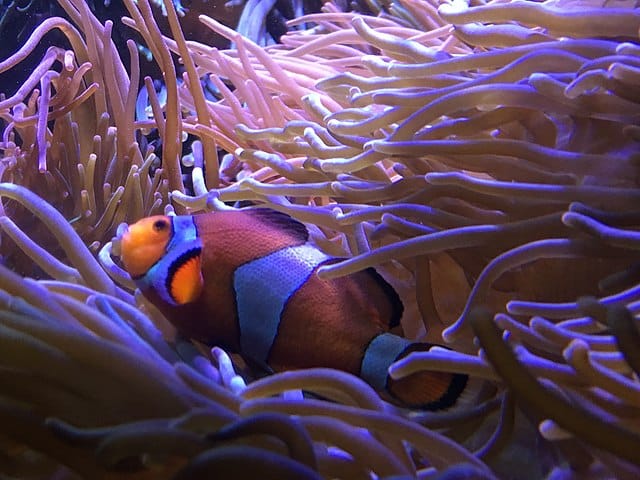
Clownfish and sea anemone symbiotic relationship
Clownfish are fascinating creatures. They are found in the Pacific Ocean near Australia, Southeast Asia, and southern Japan. Not only do they live in sea anemones, they also help them out.
A clownfish Credit: wikimedia/Pocout2
Sea anemones may look like plants, but they are actually animals. Moreover, they are also predators. They have specialised cells in their tentacles called nematocysts , and they sting and paralyze the anemones’ prey. How, then, did Marvin and Nemo (of Finding Nemo fame) live in sea anemones?
Sea anemones come in different shapes and colors Credit: wikimedia/jrtaylor8
Most fish think of anemones’ tentacles as food, and attack them. The anemone then paralyzes the attacker with its nematocysts. Clownfish, however, completely avoid the tentacles. In the off-chance that they do come in contact with the tentacles, they are protected by a thick mucus layer on their body. As the fish grow older, the mucus layer thickens. In this way, anemones make a stable home for clownfish, while also protecting them from predators.
Clownfish living in an anemone Credit: wikimedia/Wuchrist
The mucus layer on the clownfish has inspired many scientists to come up with diving gear for humans that could protect them underwater. Such gear could avoid the minor cuts and scrapes that divers have to deal with.
In return, clownfish protect anemones from their predators, like butterflyfish. Clownfish also keep anemones safe from parasites.
Butterflyfish are natural predators of anemones Credit: wikimedia/ Bernard E. Picton BernardP
Recently, scientists have found out that the poop (yes, poop!) of clownfish is extremely useful to anemones. Anemones are filter feeders. This means they filter the water flowing around them to get food. What this means for anemones is that if the water flowing around them is too fast or lacking in food materials, they cannot eat. Clownfish poop is rich in a chemical called ammonia. It helps anemones grow, reproduce, and even breathe. It essentially makes up for the unstable nutrition that water provides.
Flesch Kincaid Grade Level: 7.5
Flesch Kincaid Reading Ease: 60.9
Glossary
Symbiosis: a relationship between two species in which both benefit
Nematocysts: stinging cells that inject poison, present in jellyfish, corals, and anemones
Sanjana is doing her masters in biochemistry. She loves all things biology and truly believes that dogs make the world a better place. She enjoys playing basketball and spends most of her evenings on the court. Writing for Smore Science gives her the creative freedom to write about science in a fun and relatable way.