For a long time, scientists had no idea what had happened to the dinosaurs. From 230 million years ago, to 66 million years ago dinosaurs dominated the fossil record. For these 165 million years, far far longer than humans have existed on the planet, the Earth was filled with primordial lizards. They took every shape from the massive Tyrannosaurus rex to winged Pterodactyls. Dinosaurs were the main carnivores on the planet, and the world was far away from the age of warm, cuddly mammals.
In 1980, father-son paleontologist team Luis and Walter Alvarez first proposed that the extinction may have had an “extraterrestrial cause”. This meant that the driving force for the extinction came from outside of Earth. At the time, their hypothesis wasn’t well accepted. Everyone thought disease or a series of natural disasters was a more likely cause. In 1991, researchers discovered the Chicxulub crater in New Mexico. It is a massive 360 kilometer wide crater. Suddenly, the possibility of an extraterrestrial cause seemed more likely indeed.
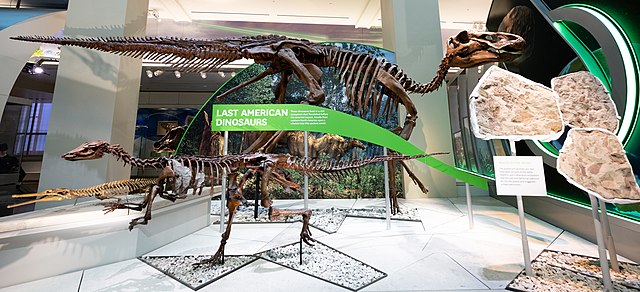
The last dinosaurs found in the U.S , Credit: Wikimedia/Mark Baylor
Now, the asteroid-impact hypothesis is widely accepted. The asteroid was probably between 10 to 15 kilometers wide when it first slammed into the Earth. This impact would have caused immediate destruction, triggering wildfires, tsunamis, and a massive shockwave near the site. Scientists estimate the energy released by the impact would be able to power all of Earth’s civilizations for 230 years. However, the impacts didn’t stop here. The debris launched into the atmosphere rapidly covered the Earth and blocked out sunlight. This led to rapid cooling, altering ecosystems around the world and causing mass extinctions.
How do scientists figure out where asteroids come from?
One of the best tools scientists have in their arsenal is chemistry. All celestial bodies have a chemical signature. Earth has a specific blend of chemicals that’s unique to Earth – so does Jupiter, Mars, and more distant parts of the Solar system.
The signature is made up of two parts. First, they identify the elements that make up each celestial body. Elements also have multiple forms, known as isotopes. Even when two signatures have the same mix of elements, it’s extremely unlikely that all the elements will be the same isotopes. Isotope analysis gives scientists an extra tool to make specific signatures for specific celestial bodies.
Scientists figure out these signatures with two tools. The first one by using chemistry to test actual materials. This is why artifacts like moon rocks are crucial for advancing our understanding of the universe. The second is light. Every mineral and chemical absorbs light in a specific way. Using telescopes, they can identify the light absorption and reflectance of different celestial objects.
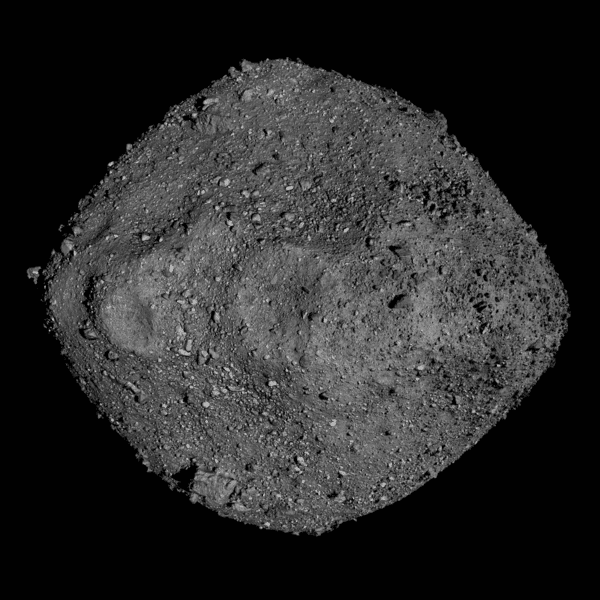
A telescope image of the Bennu asteroid , Credit: Wikipedia/NASA/Goddard/University of Arizona
Iridium is an element that is exceedingly rare on Earth. Analysis of more recent asteroids and comets revealed that iridium is fairly common inside them. The Earth is made up of different layers stacked on top of each other like an onion. Older layers are deeper. Luis and Walter Alvarez discovered that the layer corresponding to 66 million years ago was very rich in iridium. Iridium was found in this layer across the world, from New Mexico to Italy to New Zealand. Since the iridium likely came from an asteroid, the Alvarezes were able to identify that an asteroid likely wiped out the dinosaurs.
Where did the asteroid that killed the dinosaurs come from?
Ruthenium is another element like iridium that is extremely rare on Earth. There are seven isotopes of ruthenium, and each celestial body has its own signature of common and rare ruthenium isotopes. Mario Fischer- Gödde is an isotope geochemist at the University of Cologne in Germany. His team identified the 66-million-year old layer of the onion in three sites, and collected rocks from them. They also compared this with rocks from other asteroid impact sites, both older and more recent.
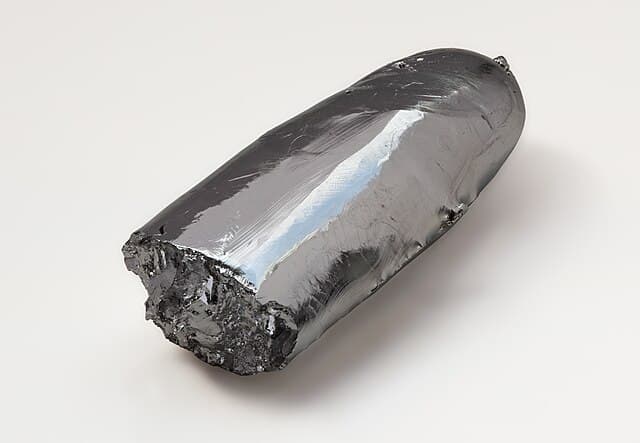
A bar of Ruthenium, Credit: Wikipedia/Alchemist-hp
Asteroids formed in the inner solar system have very little carbon and a specific blend of ruthenium isotopes. Asteroids formed beyond the asteroid belt have a lot more carbon, and their own signature of ruthenium isotopes. While some of the older and more recent asteroid impact sites had an “inner solar system blend” of less carbon and ruthenium, the Chicxulub asteroid didn’t. It’s more likely that the dinosaur-killing asteroid came from the outer solar system, beyond Jupiter.
This fascinating discovery answers a lot of questions. Some researchers think that a comet killed the dinosaurs, but Ruthenium isotopes suggest that an asteroid is far more likely. We’re one step closer to building a timeline from 66 million years ago to know, and understanding exactly what happened to the ancient dinosaur giants.
FAQ:
Are asteroids dangerous?
Very few asteroids reach the Earth. Even if they do reach here, they mostly burn up in the atmosphere. Asteroids large enough to cause harm are one in a million events
Where is the asteroid belt?
The asteroid belt is a region between Jupiter and Mars. It contains a great many asteroids and minor planets.