The world around us is changing faster than we can keep up with. Humans in every corner of the globe are altering environments in ways both big and small. If we think about the history of the Earth, humans are an eyeblink – we’ve been around for only 200,000 years. For a long time, progress was slow. Major changes came with new tools made of stone, iron and bronze, but the biggest revolution was agriculture! Humans went from foragers to farmers. Between 12,000 and 10,000 years ago, farming began in Northern Africa, the Middle East, and China.
Agriculture meant that early humans had enough food for the very first time. Instead of spending all their time and energy on foraging, we could settle down, innovate and invent.
As much as these changes improved human lives, the same changes meant a new world for plants, animals and ecosystems that we existed alongside. Agriculture led to the destruction of rainforests, grasslands and savannas. Fishing has altered coasts and oceans.
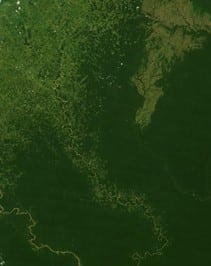
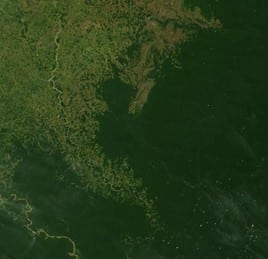
A section of the Amazon rainforest in 2000
The same area of the Amazon rainforest in 2017, with much forest being converted to agricultural land
Conservation aims to reverse these changes. It’s a field of research that focuses on protecting what’s left and restoring habitats to their former states.
Conservationists are now using the same innovation ! New technology has enabled scientists and researchers to conserve nature much more effectively.
How can technology help us understand animals better?
Genetics in the 21st century has allowed us to understand animals from the inside out. Many important animals like lions, tigers and wolves exist only within protected areas. These species are often endangered, and made up of very small populations. By figuring out the genetic makeup of these animals, we can identify individuals and pick out family trees. Since animals are restricted to these small sanctuaries, they can alsoe inbreed. Genetics can aid in identifying whether they are inbred , and inform scientists about potential diseases.
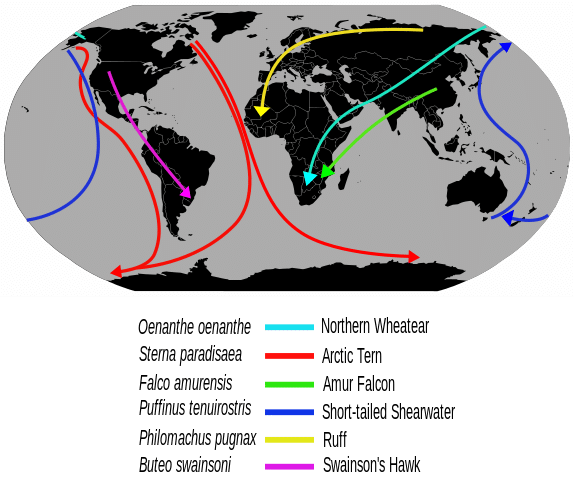
Radio collars, satellite tracking and GPS trackers have allowed researchers to track animal movements. Animal movements tell us where individuals spend time, what kind of habitats they live in, and what paths they like to take. Large-scale patterns like migration can also be tracked. Scientists who study birds have found “flyways” – like highways, but for migrants! By protecting the regions we know animals use, we can do a lot to protect their lives.
Routes taken by some migratory birds, Credit: Wikimedia/L. Shyamal
How do you find an animal that can’t be seen? Tigers, fishing cats and leopards prowl forests in the night, out of sight. Camera traps are one of the most useful tools biologists have when studying stealthy animals that are hard to track.
Innovators came up with a new, creative camera. It works similarly to a motion sensing light. When nobody is there, the camera is off. When there’s motion, the lens switches on. A laser beams out from beneath the lens. When an animal moves through the beam, it interrupts the path, triggering the camera to click a pic.
A camouflaged camera trap, Credit Wikimedia/Flappy Pigeon
As useful as camera traps are, they can’t work under the water in the oceans. There’s too much movement from waves, and the ocean is simply too vast. To track animals like whales and dolphins that make noise, biologists deploy microphones. These recorders pick up animal
How can technology help track changes?
As vital and fascinating as animals are, conserving animals without protecting their habitat only fixes half the problem. Satellite imagery is one of the most important tools people use to monitor and protect habitats. Earth observatory agencies like NASA deploy satellites which orbit around the globe. These satellites pass over each point on the Earth every twenty four hours and take a snapshot of what they see below. Satellites that are deployed for years or even decades provide valuable information of the same areas over a long period of time. Processes like habitat loss or changes in vegetation can be mapped via satellite imaging.
Satellites are also vital in tracking climate change. Since they are so high up and can capture so much of the Earth, satellites can monitor rain, changes in ocean current, temperature and drought. We can see how the weather and climate has changed over time.
It’s not just scientists and researchers who can make use of satellites! Native tribes from the Amazon have partnered with conservation organizations to map and monitor the health of the rainforest. They’ve marked individual trees, tracked the changing courses of rivers, and even used satellite phones to report illegal logging of trees in sanctuaries.
How can you help conservation efforts?
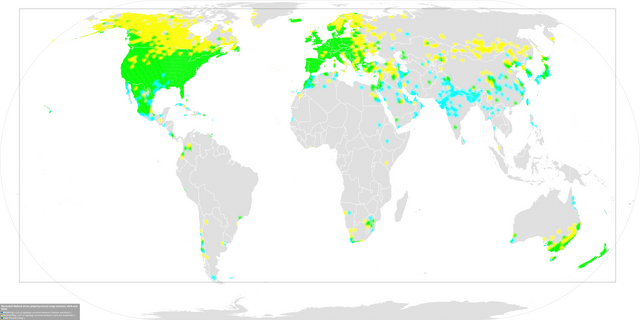
Even if you don’t live in the Amazon or Antarctic, you too can help researchers! Citizen science platforms like iNaturalist and eBird have enabled researchers to gather an incredible amount of information. Ordinary citizens from around the world report animals they come across and upload photographs. Hundreds and thousands of people contribute, creating so much more data than scientists could gather by themselves. Using this information, scientists have identified long term trends. Indian scientists used eBird data to monitor the condition and population of dozens of Indian birds!
The global range of the Mallard duck, created from citizen science data, Credit: Wikimedia/Imagesincommons
Technology is a tool like any other. With creativity and good intent, researchers, scientists and citizens around the world have used technology andcome together to protect nature.
Flesch Kincaid Grade Level: 54.9
Flesch Kincaid Reading Ease: 8.9
Glossary
Genetics: Using DNA to understand animal populations
Inbred: A decline in health caused by closely related individuals reproducing with each other
Yamini's (he/they) interests lie in environmental education, science communication and trying to build a better world. When not languishing in front of his laptop, they can be found outside, poking at any insect, bird or plant. They love making science accessible, especially to those who aren't encouraged to pursue it. Yamini hopes that the young women who read Smore love learning from their articles and get just a little bit more excited about science!