It feels refreshing to start your day with the melodic ripples of birds chirping in the morning sky. But these aerial symphonies are not limited to the daylight – the ecosystem consists of a variety of birds that sing at night. Which are the birds that sing at night and moreover why do these birds sing at night?
Let’s explore the nocturnal singing of these aerial creatures in detail.
Five Burrowing Owls, Credit; Wikimedia/travelwayoflife
Why do birds sing at night?
While there is no definite answer to this question, there could be a couple of factors, that trigger night-time warbling in birds.
Mating: Male birds often sing during the breeding seasons to get the attention of willing females, for mating. The tones get quite complex and loud while attracting females. Most birds practice singing at dusk because of the quiet and undisturbed state of nature, as well as because it is less competitive.
Territory Marking: Another common practice during breeding season is territory marking in birds. They do this to drive away any intruder in their nest and habitat and protect their territory.
Migration Behavior: Birds migrate in flocks across the geographic hemispheres, due to changing seasons, in search of food, and to protect their younger ones. To maintain communication at night and to avoid getting separated from their flock during flight, birds often chirp. They also tweet to protect themselves from predatory species, to take a break, and to feed themselves.
Urban Light Pollution: With increasing light pollution, it gets confusing for birds to tell the difference between day and night. Raised natural levels of illumination through bright lights from buildings and traffic, are the reasons why birds interpret them as daylights, and sing.
Which birds sing at night?
The biodiversity hosts several varieties of birds as nocturnal singers. They together form a playlist of ‘birds that sing at night.’ Let’s check out who the lead artists in this album are.
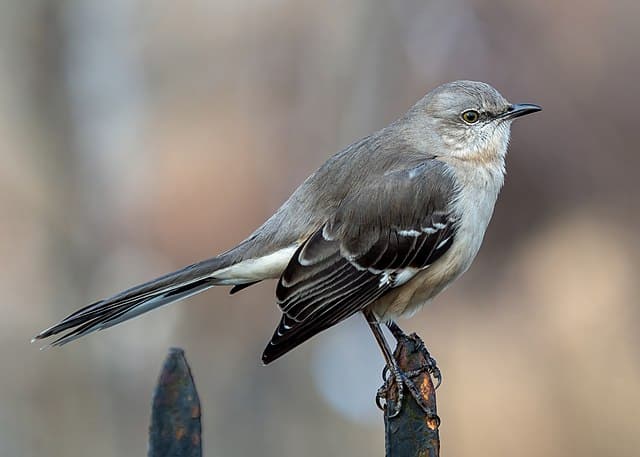
5. Northern Mockingbird (Mimus polyglottos)
Found across the United States, the Northern Mockingbirds are among nature’s best mimic artists. They can learn and memorize about 200 different songs throughout their life. They find inspiration and can imitate the voices of other birds, frogs, insects, car alarms, croaks, and much more. Their songs are mostly whistled but also contain sharp rasps, scolds, and trills.
Although singing is persistent in both genders, it is more conspicuous in males. The singing is most insistent in unmated males, who continue their hymn from dusk till dawn, and beyond.
These medium-sized songbirds can be identified by their long tails and white wing patches. They are generally gray-brown in color, paler on the breast and belly, with two white wingbars on each wing. They’ve small heads, long legs, and thin bills.
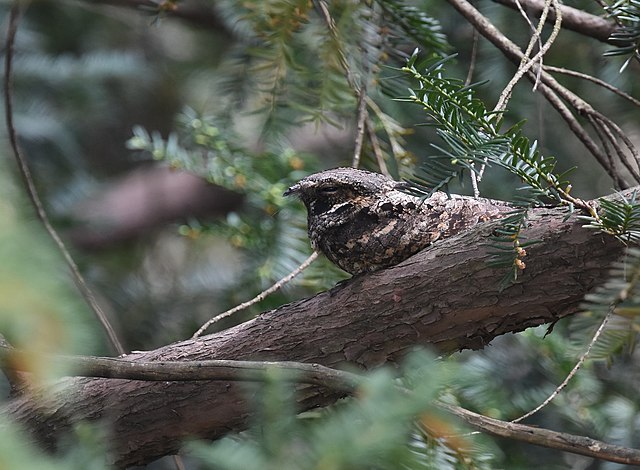
4. Eastern Whip-poor-will (Antrostomus vociferus)
Sheltered in the eastern deciduous pine forests of North America, the eastern whip-poor-will are nocturnal birds that are fabled for their endless chanting on summer nights. They are master at camouflaging, which is why they’re more often heard than seen. Their chants are frequently heard during their breeding seasons on spring and summer evenings. A study done by the Audubon Society accounts that, “a patient observer once counted 1,088 whip-poor-wills given rapidly without a break.”
Their songs are rhythmic with the second call immediately starting after the last syllable, creating a circular rhythm. Whenever they feel a threat or spot any predator near their nest, they throw a sharp cackles to contact their mates. This behavior is common in both genders.
These avian creatures are patterned with an intricate mottling of gray and brown, with males having a white corner to their tails. They are medium-sized with a front-heavy look, a large rounded head, and a stout chest.
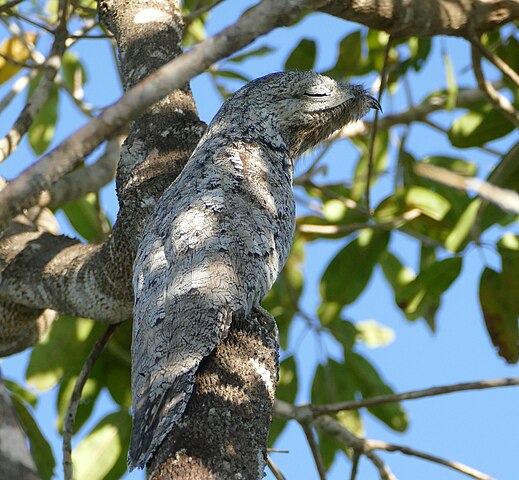
3. Great Potoo (Nyctibius grandis)
The Great Potoo’s unsettling appearance is mirrored by its unsettling voice. In the book “Birds of Venezuela,” zoologist Steven Hilty mentions that the Great Potoo produces a “fairly loud, gruff BUAAaa” at well-spaced intervals, during its moonlight singing. These nocturnal insect-eaters sounds like an angry cat with a slow, guttural groan. Owing to their mottled gray feathers, they are ace at camouflaging, and are seen roosting on a horizontal limb during the day.
Great Potoo (Nyctibius grandis), Credit; Wikimedia/ Bernard DUPONT
Unlike other potoos, they lack a dark moustache strip. Their iris is brown to yellow in color. With a large head, and short, broad beak, they can be found in dense forests, meadows, and other plantations. Geographically their population spans across southern Mexico, northeastern Guatemala, Central America, and South America as far as southeastern Brazil and Bolivia.
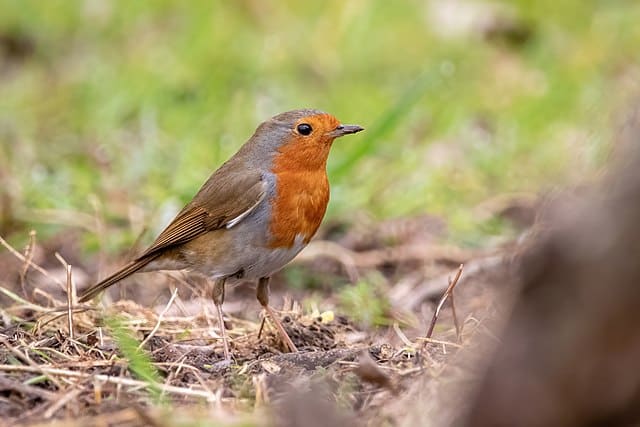
2. European Robin (Erithacus rubecula)
Famed as the first birds singing at dawn and the last to stop after dusk, the European Robin are typical nocturnal birds that have a high-pitched tone. It is one of UK’s most beloved birds that brighten backyard gardens with its vibrant orange breast and frequent songs. They sing in a rambling warbling series of tones that often incorporate odd fizzing and twittering notes. These cute playful robins make other noises when mobbing a predator, or feeling agitated. They are also known to sing at the time they molt. They can be found in versatile habitats such as forests, gardens, farmlands, heathlands, and other kinds of wooden landscapes.
European Robin (Erithacus rubecula), Credit: Wikimedia/Alexis Lours
Since these little bird’s singing is mainly based on light levels, they can be easily deceived by artificial light, which in turn would result in excessive singing. This can cause a risk of exhaustion. Thereby it is advisable that light pollution must be reduced so that there is no intervention in the natural singing pattern of these aerial beings. Daytime city noises are other factors that can trigger untimely singing by these chirpy robins.
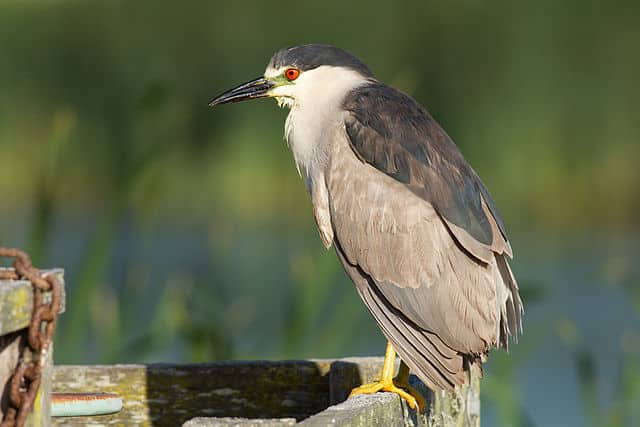
1. Black-Crowned Night Heron (Nycticorax nycticorax)
Belonging to the heron family, the Black-Crowned Night Heron is a distinctive night singer that is scattered throughout Eurasia and America. There are a couple of sounds that these stocky herons produce. When disturbed, they give a barking squawk. To attract females, these birds give a hissing tweet. At times, they give harsh screams and hoarse clucks. A series of guttural notes followed by a raspy woc-a-woc call is given by the baby herons when their parents arrive at the nest with food.
Black-Crowned Night Heron (Nycticorax nycticorax), Credit: Wikimedia/Frank Schulenburg
With broad and rounded wings, these squat creatures usually have thick necks, large, flat heads, and heavy, pointed bills. An adult Black-Crowned Night Heron is grey in color, with a neatly defined black back and black crown. The younger ones are brown with large white spots on the wings and blurry streaks on the underparts, complementing their yellow and black bills. You can find these social birds dwelling mostly in wetlands, including streams, lakes, marshes, etc.
Conclusion
Despite darkness, these night singers play a crucial role in the nocturnal symphony of nature. As urbanization is increasing, it becomes important that we safeguard the voices of these birds, by reducing light and noise pollution. By being responsible, and adapting conservative practices, we can preserve the mesmerizing melodies of these fluent nature singers.