Migrating Waders in Australia, Credit: Wikimedia/Mdk572
Have you ever seen a flock of birds flying high in the sky and wondered where they were going? You might be witnessing the incredible phenomenon of bird migration. Every year, millions of birds travel thousands of miles across the globe, crossing oceans, deserts, and mountains to reach their destinations. In this article, we will explore the amazing journey of birds that migrate.
What is bird migration?
Bird migration is the seasonal movement of birds from one place to another. It is usually associated with the changing seasons and the availability of food and shelter. Birds migrate to breed, to escape harsh winter conditions, or to find better feeding grounds. Some birds, such as swallows and swifts, migrate to avoid the rainy season, while others, such as the Arctic Tern, fly between the Arctic and Antarctic regions to follow the summer season.
How do birds migrate?
Birds use various navigational tools to find their way during migration. One of the most important tools is their ability to sense the Earth’s magnetic field. Many birds have tiny magnetic crystals in their beaks that help them navigate. They also use the sun and stars to navigate, and some birds have even been observed using landmarks such as mountains and coastlines.
Types of migratory birds
There are two main types of migratory birds: passerines and non-passerines. Passerines are perching birds, such as sparrows, finches, and warblers, and they make up the majority of migratory birds. Non-passerines include waterfowl, shorebirds, and raptors. Let’s take a closer look at some of the most fascinating migratory birds:
Arctic Tern, Credit:Wikimedia/Dunpharlain
Arctic Tern: This bird holds the record for the longest migration of any bird. It travels between the Arctic and Antarctic regions, covering a distance of about 44,000 miles.
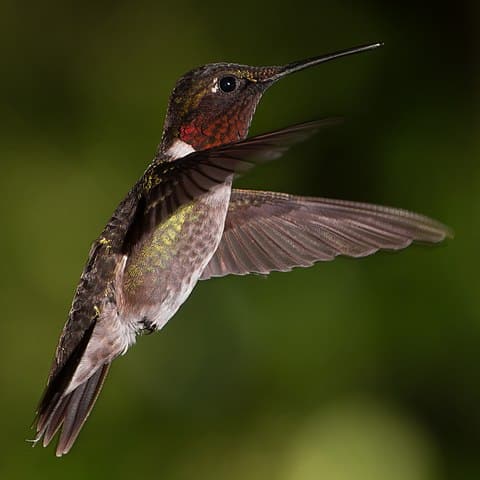
Ruby-Throated Hummingbird: This tiny bird travels from North America to Central America, crossing the Gulf of Mexico in a non-stop flight of over 500 miles.
Sandhill Crane, Credit: Wikimedia/Justin Lebar
Sandhill Crane: This bird travels from Alaska and Canada to the southern United States and Mexico, covering a distance of up to 3,000 miles.
Why do birds migrate?
So why do these birds undertake such an arduous journey? There are many reasons, but the primary one is food. In the summer months, many birds breed and raise their young in the high latitudes where food is abundant. But as the winter approaches and the days get shorter, food becomes scarce, and the birds are forced to fly to warmer regions where food is more plentiful.
Another reason that birds migrate is to avoid harsh weather conditions. Many birds cannot survive the extreme cold and snow of the winter months, so they fly south to warmer areas where they can find food and shelter.
Some migratory birds also travel to mate with others of their species. In some cases, the breeding grounds may be located far from the wintering grounds, and the birds must undertake a long journey to find a mate.
Bird migration is a vital part of the ecosystem . It helps to spread seeds and nutrients across different regions, and it also provides food for predators along the way. However, many migratory bird populations are declining due to habitat loss, climate change, and other human activities. That’s why it’s important to protect and conserve the habitats that these birds rely on.
Flesch Grade Level: 8.8
Flesch Reading Ease: 61.2
Glossary
Ecosystem: a community of living organisms and their non-living environment interacting with each other
Navigation: the process of determining a position and planning a route for travel