Orcas are the largest oceanic dolphins, and are commonly known by the misnomer of “killer whales”. Although known best as fearsome hunters, they are also intelligent, vocal, and fascinating creatures. Orcas are found in oceans around the world from the Arctic to the Antarctic, though they mostly reside in higher latitudes. Orcas in different regions are so distinct that some researchers consider them to be three species.
Orcas are indeed apex predators in marine ecosystems. Different populations specialize in eating different prey – there are fish eating populations, whale and bird eating orcas, and even seal eating orcas. They hunt in groups known as pods, and even play together and take care of each other. Although there are many groups of orcas worldwide, they are endangered. They compete with humans for vital prey like salmon. In the Puget Sound, only 75 whales remain, starving without salmon. As apex predators, they are also particularly affected by pollution.
Orcas also play an important role in many human cultures. Indigenous communities of the Pacific Northwest regard orcas highly, featuring them in art, history, spirituality and religion. The Haida, Nuu-chah-nulth and Kwakwaka’wakw regarded Orcas as rulers of an underwater world. They were also important to the Siberian Yupik people and Japanese Ainus. Now, Orcas in captive aquaria like SeaWorld have sparked important discussions about whether intelligent, social animals should be kept captive.
A sculpture of an Orca by Bill Reid, an artist from the Haida community, Credit; flickr.com/Ahisgett
How do orcas learn?
In the animal kingdom, it’s rare for animals to live past the age of reproduction. Very few mammals live very long past their reproductive age, with the notable exception of humans, and other extremely long-lived species like elephants and orcas. For a long time, scientists didn’t know why this was the case. Evolutionarily, it doesn’t seem to make much sense – why continue living if not reproducing? What’s more interesting is that only females reached this old age. Very rarely did the males survive.
When examining the history of human evolution, scientists came up with the matriarch hypothesis. What if the matriarch, or older grandmother with offspring of their own, were indirectly helping their families. Free of the risks of reproduction, older females could focus their energy on passing down vital knowledge that could increase the chances of survival for their descendants.
An adult female swimming with her calf near Southern Georgia, Credit: Wikimedia/ Christopher Michel
Female orcas usually stop reproducing between 30 to 40, but can live until 90 years old. Orcas live in “pods”. Adult females, their calves, and their mothers (the matriarchs) live together in family groups. Male travel between groups, feeding alone and mating with different pods. The matriarchs carry with them decades of experience. This can help in times of scarcity, with the matriarchs leading the pod to feeding grounds. They even teach descendants hunting techniques.
Learning within social pods is one of the ways new behaviors go from one orca to another, eventually spreading to an entire population.
Why are Iberian Orcas attacking boats?
Iberian orcas live around the Iberian peninsula, Morocco and the Portuguese coast. They migrate annually, following schools of Atlantic bluefin tuna. Every spring, different pods gather in the Strait of Gibraltar to hunt bluefin tuna. This population is thought to be endangered.
Since 2020, there have been 650 interactions between this tiny population and boats. Usually, orcas don’t undertake these attacks alone. Entire pods swim up stealthily behind the boats. They then focus on the rudder, nudging it with their heads and trying to lever boats. In some cases, the boats have even been flipped or sunken. Once the boat stops moving, the orcas seem to give up. Orcas also seem to mainly target sailing boats.
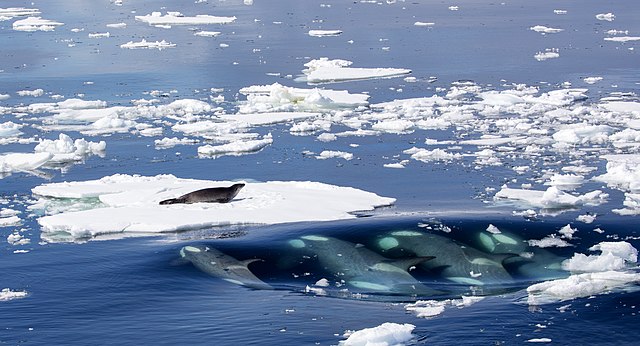
A pod of orcas targeting a crab eating seal. This behavior is similar to how they cooperate to attack boats, Credit; wikipedia/Callan Carpenter
Initially, scientists thought the behavior was linked to an orca named White Gladis. She had been injured by a sailing vessel, and was the first to attack a boat in retaliation. She didn’t only teach her calves how to do the same, but other adult members of her pod too. Now, it seems around 20 orcas have caught onto the behavior.
Other scientists seem to think the behavior is mostly playful.
“It’s only a game. It isn’t revenge [against boats], it isn’t climate change, it’s just a game and that’s it,” said Dr Renaud de Stephanis, for the BBC.
It could even be an orca trend. Once, orcas in Puget Sound carried dead salmon on their heads for a while, probably just for fun.
Now, research is emerging that it could be stress that’s driving this behavior. Orcas aren’t the only animals eating bluefin tuna. Humans do too, and are far better at catching it than orcas are, leading to a decline in tuna abundance. The pressure of being hungry might be increasing stress hormones for orcas, particularly pregnant females. The sensory overload of a noisy boat, along with this increased stress and aggression, might be one trigger for the boat attacks.
Regardless of what the reason might be, the solution is clear. As humans with boats eating their fish, it’s clear that orcas are in a tight spot. If we want to reduce the number of interactions, we need to decrease fishing pressure and boat traffic. Avoiding fish like bluefin tuna during orcas’ migratory season can help relieve pressure.
FAQ
Do orcas attack humans ?
Orca attacks are extremely rare and even more uncommonly fatal. They usually only occur when orcas mistake humans for seals, or with orcas in captivity.
Are there still orcas in captivity?
As of 24 March 2024, around 55 orcas are in captivity worldwide, 33 of which were captive-born