Eat or be eaten: the mantra of the animal kingdom is nothing but a reflection of the food chain . At the bottom of the food chain are plants, known as producers . The herbivores that eat the plants are known as primary consumers. Animals that eat herbivores are secondary consumers .
The consumer at the very top of the food chain is known as the apex predator . Nothing eats the apex predator. The population of an apex predator is limited only by how much food is available. These top-tier predators play a critical role in regulating ecosystems by controlling the populations of other animals, which in turn affect the entire food chain. For example, when the population of grey wolves dwindled in Yellowstone National Park, it raised a domino effect. The wolves were the apex predators, and they hunted down elks. Without the wolves, the elk population grew. As a result, elks overgrazed on aspen and willow. The local beaver population depended on willow, and as a result, their population was reduced. The elk population was brought in check only after introducing grey wolves back to Yellowstone National Park in 1995. Apex predators are characterized by their size, strength, speed, and hunting prowess, making them a force to be reckoned with in their respective habitats. Here are the most notable of apex predators.
Anomalocaris
Never heard of this animal? Don’t be surprised! Scientists believe that this was the very first apex predator to ever exist. Anomalocaris fed on trilobites, another group of invertebrates, and other soft-bodied animals.Anomalocaris lived between 520 and 499 million years ago, during the Cambrian. Unlike the apex predators of today, Anomalocaris was an invertebrate without a spinal column. Invertebrates do not have a circulatory system, so they are inefficient at transporting oxygen around their bodies. This limits how big they can get. During the Cambrian, the atmosphere and oceans were oxygen-rich, allowing animals like the Anomalocaris to reach massive sizes of 38 centimeters! This might not sound very big… until you imagine a mosquito of that size.
An illustration of Anomalocaris, based on the fossils, Credit: Wikimedia/Junnn11
Komodo Dragon
This lizard is truly massive, clocking in at an average of 150 pounds (70 kilograms) The largest recorded specimen was 10.3 feet (3.1 meters) long and 366 pounds (166 kilograms). If that wasn’t enough to make it the apex predator in its habitat, it can briefly attain speeds of 13 mph (20 kph), and packs a venomous bite, full of bacteria that can infect the wound. Komodo dragons are the largest lizards by far, due to a phenomenon known as island gigantism . Animals on islands sometimes evolve to be larger than they would otherwise due to the absence of natural predators. Komodo dragons are the opposite of picky eaters! They eat dead animals, water buffalos, and even each other! Female Komodo dragons can also clone themselves, reproducing without a mate of the same species.
A Komodo dragon, Credit: Wikimedia/Charles J. Sharp
Dhole (Cuon alpinus)
The dhole is the smallest apex predator on this list. Dholes are wild dogs that live in packs, all across South and Eastern Asia. Despite their wide distribution, dholes are highly endangered. There are only 1000–2000 left in the wild. They are incredibly athletic creatures, racing across scrub, jungle, and plains to hunt down their prey. Although they don’t look very different from the feral dogs of this region, their evolutionary lineage is distinct. Unlike other apex predators, which rely on size, dholes rely on teamwork. Packs of between 5 to 12 animals work together to bring down prey many times their size. The social nature of dholes has allowed them to become apex predators in their habitat.
The dhole, Credit: Wikimedia/Davidvraju
Orca (Orcinus orca)
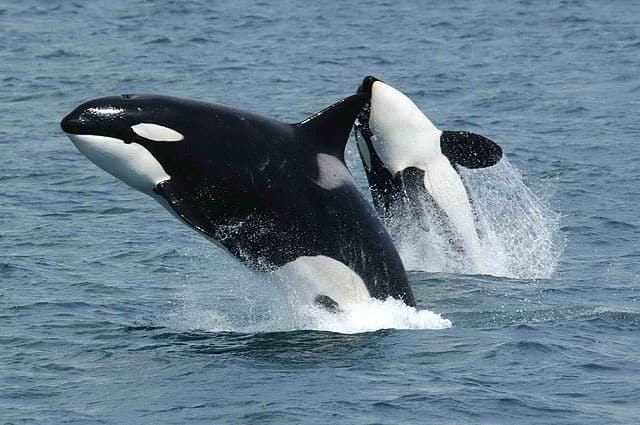
Orcas are the largest apex predators on this list, with a body size of 8800 pounds (4000 kilograms)! The orca, or killer whale, is actually not a whale at all. It is the largest member of the dolphin family. Orcas have a very diverse diet, eating everything from salmon to rays, and even other, smaller dolphins and whales! Their distinctive coloring makes them instantly recognizable. Like dholes, orcas have complex social structures. They live in pods, and each pod has its own dialect of clicks and calls. The language of orcas is tremendously complex, and they even seem to have specific calls they use for hunting and coordination among pod members.
Orcas photographed off the coast of Alaska, Credit: Wikimedia/Robert Pittman
Orcas have been well studied for their effects on the food chain. During the last few decades, hunting bans have allowed orca populations to recover. This has reduced the number of sea otters drastically, as orcas eat them. Sea otters are one of the few animals that eat sea urchins, and sea urchins feed on kelp. Without sea otters, the numbers of sea urchins increased dramatically, depleting kelp forests! In short, the increasing numbers of orcas changed the entire food chain all the way from the top (orcas) to the producers (kelp).
Snow Leopards (Panthera uncia)
Snow leopards prowl the mountains of Afghanistan, Siberia, Mongolia, central Asia, and the Himalayas. This big cat is a strict mountain specialist. Its large and wide paws distribute its weight over the snow, acting like snowshoes. Its thick fur retains heat close to the body. Snow leopards are perfectly camouflaged in the rocky, snowy terrains for which they are named. They mainly feed on goats and deer which are native to their regions. Unfortunately, snow leopards are threatened for many reasons. In the areas it is found, livestock herding is the main profession. Herders may kill snow leopards for fear of losing their livestock. It is also hunted for its distinctive fur.
A snow leopard balanced on a mountainside, Credit: Wikimedia/Irbis1983
Leopard Seal (Hydrurga leptonyx)
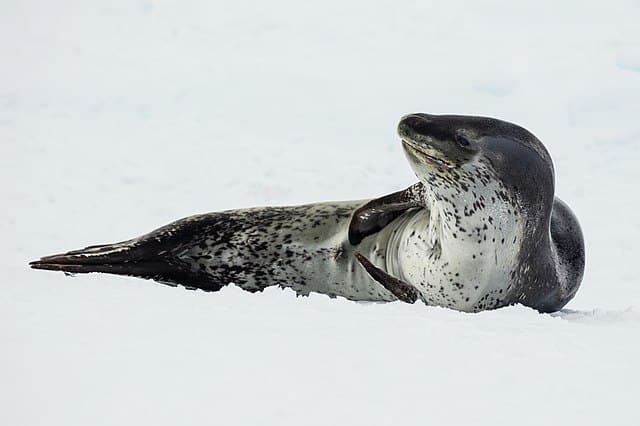
Leopard seals occupy the waters all around Antarctica. They are best known for hunting penguins, though they will feed on other birds and mammals when the opportunity arises. The nickname “leopard” seal comes from the spots they have underneath their throats. Leopard seals spend most of their lives in the water, but come ashore to have their pups. Like orcas, seals are very vocal underwater and make a wide array of sounds. Leopard seals are highly threatened by climate change, as their habitats will change dramatically.
A leopard seal photographed in the Antarctic Sound, Credit: Wikimedia/Godot13
Apex predators are keystone species
The grey wolves, or purple sea starfish, function as keystone species. Keystone species are animals that define an ecosystem. Without keystone species, the ecosystem would cease to exist or be completely different. Apex predators have often fulfilled that role, as they prey on different animals and keep their population in check. Purple sea starfish are a major predator of sea urchins, monitoring their population. Grey wolves hunt elks and keep their population under control. They maintain the balance of the ecosystem, and if they go missing, the subtle balance in the ecosystem will bypass a tipping point.
Across the world and in habitats, apex predators are some of the most threatened animals on the planet. Their populations can be negatively affected by factors such as habitat loss, climate change, and human hunting. The loss of an apex predator can have far-reaching consequences for the ecosystem, often leading to an overpopulation of prey species. Losing apex predators can also have ripple effects on the food chain below them. So it is crucial to conserve apex predators.
Flesch Kincaid Grade Level: 56.4
Flesch Kinkaid Reading Ease: 8.2
Glossary
Apex predator: A consumer which is not eaten by any other animal
Food chain: A link between producer, primary consumer, secondary consumers, and apex predators
Island gigantism: An increase in size of an island animal compared to its mainland relatives
Primary consumers: Animals that eat producers
Producers: Plants, which take energy from the sun to create biomass
Secondary consumers: Animals that eat primary consumers