Imagine our solar system. At the center lies the Sun, massive and full of energy. All around the Sun, we have planets—like Earth. An atom resembles our solar system in structure, but just much, much, much smaller. Invisible to the naked eye, the atom is the smallest fundamental particle that something can be divided into without releasing electrically charged particles.
Instead of planets, the atom has electrons . These are the smallest component of the atom, having a negligible mass, but with a negative charge. Electrons are arranged in orbitals . At the center of all the orbitals lies the nucleus . The nucleus contains two components: the proton and the neutron . Both the proton and the neutron have a significant mass. The proton is positively charged, whereas the neutron is neutral—it has no charge.
The structure of the atom, Credit: Wikimedia/CNX OpenStax
Who discovered the neutron?
The discovery of the neutron is attributed to James Chadwick at the Cavendish laboratory in Cambridge. He worked under Ernest Rutherford, and published his findings about the neutron in 1932. Rutherford was another revolutionary physicist, who had discovered the proton through the gold foil experiment in 1913. Electrons were discovered in 1897
The Cavendish laboratory , Credit: Wikimedia/Science Museum London / Science and Society Picture Library
James Chadwick was born in Cheshire and grew up and studied in Manchester. It’s said that he originally intended to enroll in math, but enrolled in physics by mistake! Chadwick was in Berlin during the First World War, and spent four years in an internment camp.
The late 1800s was a time of great change in the field of particle physics, due to the work of Pierre Curie and Marie Skłodowska-Curie. As radioactivity and fundamental particles were understood, so was the potential to weaponize them. Chadwick eventually joined the Manhattan project, and the tools he used to discover the neutron were deployed in the first atomic bomb.
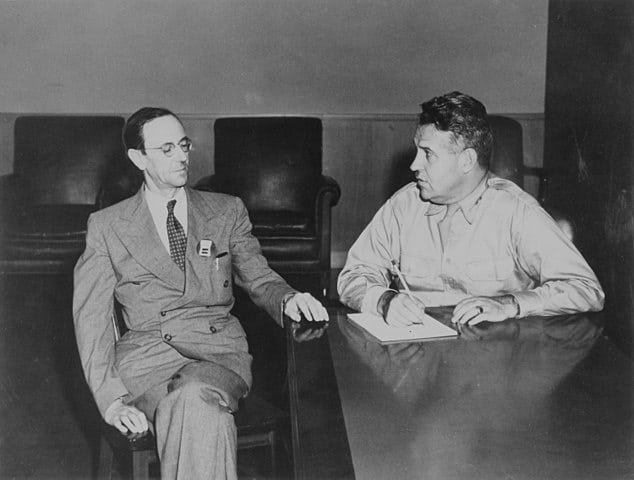
Chadwick with the director of the Manhattan project, Leslie Groves, Credit: Wikimedia/Los Alamos National Laboratory
How was the neutron discovered?
The discovery of the neutron was built on two key previous discoveries: the understanding of the proton and the electron, and the discovery of radiation. Radiation was divided into three types, with two very well understood. The third type, beta radiation, caused something unusual.
When the beta radiation (from a material called polonium) landed on paraffin wax, it caused the release of protons. Protons themselves could not do this, and electrons do not have sufficient mass to dislodge a proton. Thus, a new explanation was needed for this mysterious new radiation and its interaction with protons. Chadwick realized this phenomenon implied the existence of a particle that had heavy mass, but was electrically neutral, and he termed it the neutron.