Who Discovered The Atom?

Table of Contents

What is an atom?

Atoms are the smallest building blocks of everything in the universe. They consist of protons, neutrons, and electrons. They are too small to see, even with a microscope.


Many atoms of the same type make up an element. These are listed in the periodic table. Elements are pure as they are only made of one type of atom.


When different types of atoms chemically bind together, they form molecules. Water is an example of a molecule. It is made of two hydrogen atoms and one oxygen atom. These atoms are bound together. That is why the chemical formula for water is H2O.

Who discovered atoms?

In 1803, John Dalton came up with the idea that all matter was made of tiny particles. He called these particles “atoms.” At the time, he believed that atoms couldn’t be broken down any smaller.


Almost 100 years later, J. J. Thomson found that atoms had both a positive charge and a negative charge. He believed that atoms were made of positively charged material with negatively charged electrons embedded into them.


This model, known as the Plum Pudding model, was disproved in 1911 by Ernest Rutherford.

A diagram of an atom with protons and neutrons inside the central nucleus and electrons circulating
A diagram of an atom with protons and neutrons inside the central nucleus and electrons circulating, Credit :wikimedia/AG Caesar

Rutherford set up a simple experiment to test the structure of atoms. He placed a piece of thin gold foil in a vacuum  and fired alpha particles  at it. Some shot straight through the gold, some dispersed in other directions, and some bounced directly back.


The piece of gold was only 1000 atoms thick. It was a bit like the gold that’s sprinkled on posh desserts, or the gold that lines some book pages or is painted onto sculptures.


He placed it in a vacuum so that there were no air particles for the alpha particles to collide with. Any deflection that was detected was due to collision with the gold.


Because most alpha particles went straight through the gold, he concluded atoms are mostly empty space.


The deflections told him that atoms contained positive particles. Rutherford knew the alpha particles were positively charged. Like charges repel each other, therefore there must have been some positive charges inside the gold atoms.


The number of particles being deflected straight back was minimal. Rutherford concluded that they had hit something that had a concentrated mass, the nucleus.


Ernest Rutherford’s experiment is explained in this video:

Why are atoms important?

Atoms make up everything in the universe. Everything is made of these tiny particles. Without atoms, nothing would exist. Every cell in our body is made from atoms or elements which form molecules.


Molecules can join together to make cells and ultimately tissues and organs. All life is made from atoms. Everything we see, hear, smell, taste, and touch is made from atoms.

What can atoms be used for?

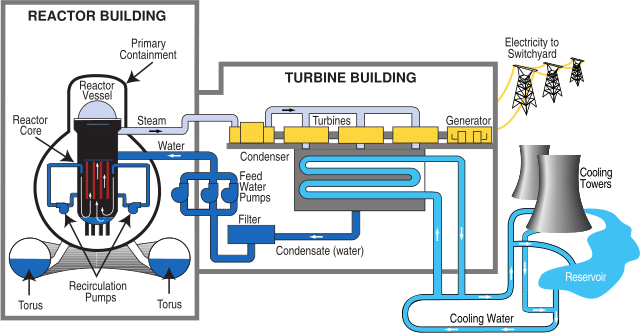
Atoms can be used to create power. This is called nuclear power. When an atom’s nucleus is broken apart, it releases a lot of energy. This is called nuclear fission . It can be used to make electricity, but it is not a renewable form of energy.

The atomic energy created inside the reactor heats up water, turning it to steam, which turns turbines to create electricity,Credit:wikimedia/Tennessee Valley Authority

Atoms can also be fused together to create energy. This process is called nuclear fusion. This process is entirely renewable and produces no radioactive waste.


Atoms can also be used in medicine, nanotechnology, and warfare.


Flesch Kincaid Grade Level: 7.2


Flesch Kincaid Reading Ease: 61.3

Glossary

vacuum: a space completely without matter


alpha particle: a positively charged particle emitted by some radioactive substances


nuclear fission: the splitting of an atom’s nucleus into two or more pieces. The energy produced from one gram of radioactive material is equal to that produced from three tons of coal

1. Britannnica (2022) Thomson atomic model. https://www.britannica.com/science/Thomson-atomic-model Accessed on March 1st 2023


2. BBC Bitesize (2023) Atoms and Molecules. https://www.bbc.co.uk/bitesize/topics/zstp34j/articles/zc86m39 Accessed on March 1st 2023


3. Johnson, A. (2022) What is an atom and why is it important?

https://scienceoxygen.com/what-is-an-atom-and-why-is-it-important/ Science Oxygen. Accessed on March 1st 2023


4. Brazier, Y. (2017) What is nuclear medicine? https://www.medicalnewstoday.com/articles/248735#diagnosis Medical News Today. Accessed on March 1st 2023


5. Igini, M. (2022) An Easy Guide to Nuclear Energy for Kids. https://kids.earth.org/climate-change/what-is-nuclear-energy/ Kids Earth Org. Accessed on March 1st 2023


6. Nuclear Wall Chart (2000) Nuclear Fission Energy.

https://www2.lbl.gov/LBL-Programs/nsd/education/ABC/wallchart/chapters/14/1.html Accessed on March 1st 2023

Copyright @smorescience. All rights reserved. Do not copy, cite, publish, or distribute this content without permission.


Join 20,000+ parents and educators
To get the FREE science newsletter in your inbox!