When you flick a switch, a light comes on at the other end of the room. It seems so magical and almost instantaneous, but how does it work, exactly? Even Ancient Greek philosophers knew that static electricity existed, noting that combs made of amber attracted bits of straw after the combs were used to brush hair.
Electricity is nothing but the flow of electrons. Electrons are a component of atoms, the fundamental particles that make up all stuff. Electrons are negatively charged and are arranged in orbits around the edge of the atom, like a miniature solar system. In some substances, electrons are held more tightly and don’t leave the atom, like in wood or plastic. In other substances, they are free to move out of the orbit, like in most metals. This is why metals are good conductors , but wood and plastic do not conduct electricity well.
What is a circuit?
Electrons are much smaller than the atom and can easily slip between tightly packed atoms. Imagine rocks in a stream. The rocks are like the atoms, and water joins together and flows between, around, and even underneath some rocks—just like electrons can!
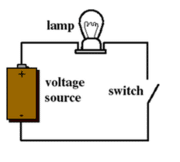
If you wanted the water to come to a house on the bank of a stream, what would you do? A set of pipes to carry water from one place to another is very similar to how an electrical circuit works. Wires are like miniature streams that electrons flow through. In order to flick the switch at one end of the room and have a light turn on at the other, you need a wire connecting the two, so that electricity flows. A circuit usually consists of some kind of power source, like a battery or a main power line. It is connected by wires to what needs to be powered, like a lamp or motor.
A simple electric circuit. The terms voltage and power source are interchangeable in this context. Credit: Wikimedia/Kvr.lohith
Water flows along the path of least resistance . If you have a narrow channel right next to a very broad one, most of the water will flow along the very broad one. Similarly, electrons take the shortest, easiest path through a circuit. Resistance is the opposition to the movement of electrons.
A short circuit occurs when an unintentional shortest path becomes available. Instead of passing through the path that it should, the electricity is able to flow through a different route. The most common cause is when an insulated wire loses its insulation, and metal comes into contact with metal. Instead of flowing through the wire, the electricity jumps to another wire.
Lots of other things can cause a short circuit. The one thing they all have in common is they involve a conductor. Water conducts electricity very well, so a flood or heavy rain causing home circuits to get wet can result in a short circuit. Nails or screws made of metal that pierces through walls can join two circuits and cause a short circuit as well.
Why is a short circuit dangerous?
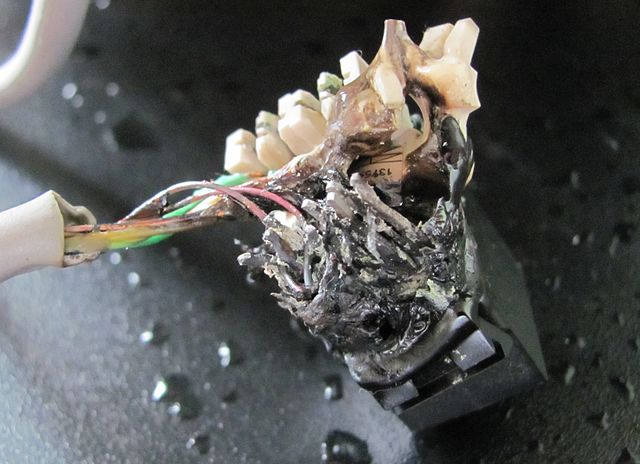
Short circuits can be dangerous because the new, shorter pathway usually is not built to handle the current. When a large amount of electricity flows through a narrow path, it can release a lot of heat. This can corrode and damage the circuit, which could potentially lead to further short circuits. The heat can also have unintended consequences, like electrical fires.
Short circuits can happen by accident if you’re trying to do a little DIY project for yourself, but unfortunately, this can sometimes happen with professionals or professional-made tools, too. In PCB Assembly, short circuits can happen when soldering is done incorrectly, parts are placed wrongly, or the design of the circuit board isn’t perfect. Fortunately, this isn’t too common, but nonetheless, it can be dangerous. If you’re doing a project yourself, be incredibly careful, but don’t always expect that something that’s manufactured will always be 100% safe either.
A corroded wire junction. The short circuit was caused by flooding. Credit: Wikimedia/Gabriel Acquistapace
Short Circuit Experiment
Under controlled conditions, and with the help of an adult, you can test out creating a short circuit.
What you’ll need:
A 9V battery (do not use a battery with a higher voltage)
A crocodile clip wire
A thin steel wire, about 8 centimeters (3.14 inches) long
How to do the experiment:
Connect one end of the crocodile clip to the battery
Mark lines 1 centimeter (0.4 inches) apart on the wire
On the other battery terminal, loop the steel wire around the terminal
Connect the clip to the first line (furthest from the battery) for no longer than 15 seconds
Disconnect the clip and carefully touch the steel wire. Note how hot it feels
Perform step (5) along each line until you reach the end of the wire
What to look for:
Temperature changes
The final, dramatic effect!
Why does this happen?
The copper that makes up crocodile clips is a much better conductor of electricity and has a lower resistance than steel. Steel has a high resistance and does not allow electricity to flow very easily. When the clip gets closer to the end of the wire, more and more electrons flow through a shorter path with a higher resistance. When electricity cannot flow, the energy is converted to heat, which is where the final flash of light comes from.
Building a short circuit in PHET
Launch the PHET simulation lab:
What you’ll need:
Wires
Two AA batteries
A lightbulb
A switch
How to do the experiment:
Start with two batteries and connect them to each other:
Place the lightbulb at the top left corner of the screen. You want it to be off-center so the short circuit is easier to visualize. Add a switch before the negative terminal of the battery.
When the switch is open, current can’t flow through the circuit.
Turn on the switch and watch current flow through the circuit.
Attach a new wire across the lightbulb and see what happens.
Although a short circuit sounds scary, it’s just a new junction and an unintentional path for electricity to take. With proper electrical maintenance and thoughtful circuit building, it is nothing to worry about!