The Belt of Orion & Hydrogen 21 cm Line

Table of Contents

The Orion Constellation

Every child’s first constellation -101 lesson includes the constellation that needs no introduction—Orion: The Hunter. It holds a lot of religious significance. And the reason it is so famous amongst the astronomer’s community is because of its use as a guide to help locate other interesting objects. Additionally, some of the brightest stars in the sky, like Rigel (Beta Orionis) and Betelgeuse (Alpha Orionis), are a part of this constellation.


This constellation is easy to locate and is present on the celestial equator . The celestial equator is an imaginary equator that lies in the same plane as the earth’s equator.

Stars in the Orion Belt

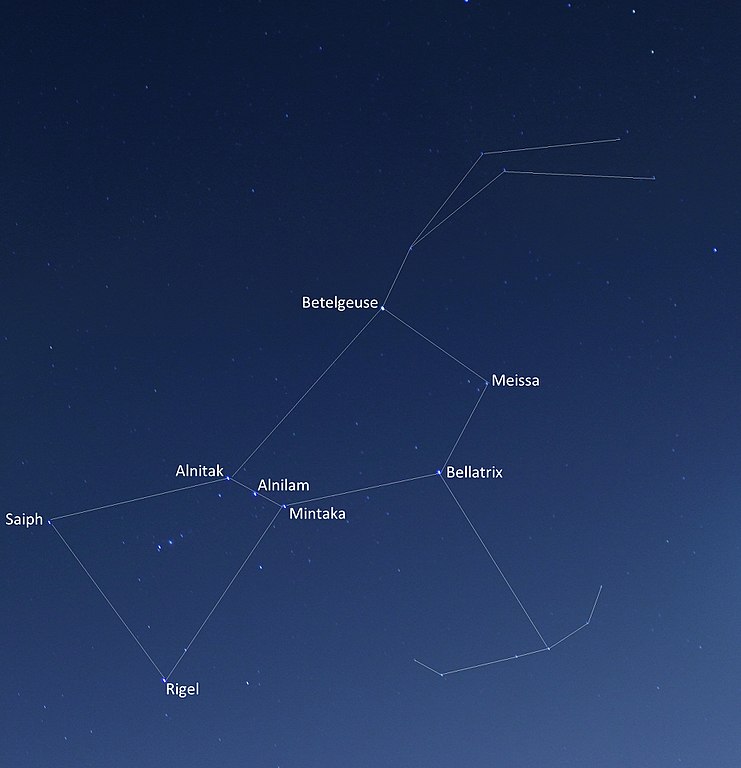
Orion’s belt is called an asterism . An asterism, like a constellation, is a recognizable pattern formed by stars, but it is smaller than a constellation. The hunter’s belt is made up of three important bright stars: Alnitak, Alnilam, and Mintaka.

Orion_constellation_with_star_labels
The constellation Orion with the major stars labelled. Credit: Wikimedia/Anirban Nandi

Astronomers use some fancy words to describe the brightness of a star. The Apparent Magnitude is a measure of how bright the star appears to us on earth. The Absolute Magnitude is the Apparent Magnitude of the same star at a distance of 10 parsecs (32.6 light-years ). The lower the magnitude, the brighter the star.


Alnitak is the fifth brightest star in the Orion constellation. Although we have previously described it as a “star,” it is actually a star system consisting of three stars: Alnitak Aa, Alnitak Ab, and Alnitak B.

  1. Alnitak Aa: Apparent Magnitude: 2.0, Absolute Magnitude: −6.0, Temperature: 29,500 K

  2. Alnitak Ab: Apparent Magnitude: 4.3, Absolute Magnitude: −3.9, Temperature: 29,000 K

  3. Alnitak B: Apparent Magnitude: 4.21, Temperature: 29,000 K

Alnilam (Absolute magnitude: −6.89, Temperature: 27,500) is the 4th brightest star in Orion and the brightest of the three stars of Orion’s belt. Alnilam is the only single-star system in the belt.


Delta Orionis or Mintaka (Apparent magnitude: 2.25, Absolute magnitude: −4.99, Temperature: 29,500 K) is the 7th brightest star in Orion. Mintaka is a three-star system. It consists of the three stars Mintaka Aa1, Mintaka Aa2, and Mintaka Ab. Recent observations by the Chandra telescope have found that Mintaka Aa1 and Mintaka Aa2 form an eclipsing binary . Aa1 is the primary star in the binary and weighs about 1.5 times more than Aa2. When these two stars align, one of the stars passes in front of the other as viewed from earth. The reason this phenomenon is significant is that it gives scientists a chance to examine and record the mass and size of the stars.


Unfortunately, our belts only have holes and no stars.

How are stars classified?

Although every star is unique and beautiful, for the sake of our convenience we can group them into seven categories. They are categorized as per their temperatures. These are: O, B, A, F, G, K, and M in order of decreasing temperature.


O-type stars glow the hottest, and with blue color. Their temperature exceeds 30000 K. An example of this type of star is Mu Columbae.


B-type stars glow with blue or bluish-white color. Their temperature ranges from 10000 to 30000 K. An example of this type is the star Rigel.


A-type stars glow with blue or white color. Temperature ranges from 7,500 to 10,000 K. Example of this type is the Sirius star.


F-type stars glow with a yellow-white color. Their temperature varies from 6,000 to 7,500 K. Procyon is an F-type star.


G-type stars glow with yellow-white color. Temperature is between 5,200 to 6,000 K. Our own Sun is an example of this type of star.


K-types glow with an orange or red color. Their temperature lies between 3,700 to 5,200 K. An example of this type of star is Arcturus.


M-type stars are the coolest stars and glow with a red color. Their temperature ranges from 2,400 to 3,700 K. Betelgeuse of the Orion constellation is an example of this type.


This type of classification of stars based on their temperature is called the Morgan-Keenan classification system . We normally don’t think of temperature as colors, but when massive and extremely hot objects like the stars come into the picture, their extreme temperatures can emit colors. In summary, the hottest objects give off a blue color, less hot ones are responsible for white, orange, or yellow color, and the coolest ones emit red color.

Hydrogen 21 cm Line

The neutral hydrogen atom consists of one proton and one electron. The electron, as we know, is negatively charged, and the proton is a positively charged particle. Hence, the charges balance each other out and become neutral. In space, usually, these hydrogen atoms float around with very low energies. But collisions between the particles occur. When this happens, some hydrogen atoms acquire some amount of energy. The hydrogen atom having this acquired energy is said to be “excited.” But the atoms do not retain this energy permanently. Often, this acquired energy is lost in the form of light. The light that we humans see is only a tiny part of electromagnetic radiation . Quite rightly, it is called Visible Light. There are many kinds of “light” that we as humans can never see.


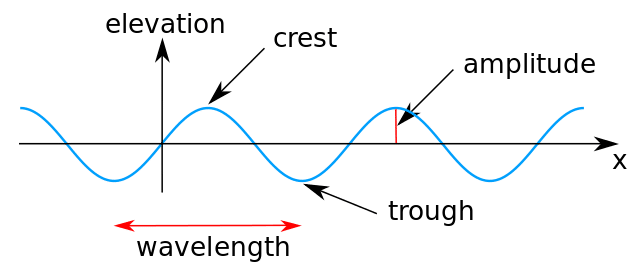
When we think of light, we usually don’t think of it in terms of distance. But light actually travels in the form of waves. The topmost point on a wave is called the crest and the bottommost point is called the trough. The distance between two adjacent crests or two adjacent troughs is called the wavelength of the light wave. The light emitted when the hydrogen loses energy has a wavelength of 21 cm, hence the name Hydrogen 21 cm line.

Sine_wave_amplitude
Sine wave, with annotations. Credit: Wikimedia/Kraaiennest

The Magic of the ‘21’

Usually, visible light is affected by dust particles in space. It gets scattered by the presence of minute particles. But unlike visible light, the hydrogen 21 cm line remains unaffected. The presence of this hydrogen 21 cm line allows scientists to analyse the properties of hydrogen gas in space. This information can, in turn, helps them understand other important phenomena, like the formation of stars and the structure of galaxies.

Glossary

Constellation: A known pattern formed by stars.


Celestial Equator
: An imaginary equator in the same plane as earth’s equator.


Asterism
: A known pattern formed by stars, but smaller than a constellation.


Apparent magnitude
: A measure of the brightness of stars, as seen from Earth.


Absolute magnitude
: The Apparent Magnitude of the star at 10 parsecs (32.6 light years).


Eclipsing binary
: A two-star system, one star passes in front of the other at times.


Morgan–Keenan system of classification
: Classification of stars based on temperature and color.


Electromagnetic radiation
: A form of energy; visible light is a type of electromagnetic radiation.


Light-year
: The distance that light travels in a year.

Flesch Kincaid Grade Level: 7.3


Flesch Kincaid Reading Ease:
63.2

Wall, W. F., Reach, W. T., Hauser, M., Arendt, R. G., Weiland, J., Berriman, G. B., Bennett, C. L., Dwek, E., Leisawitz, D., Mitra, P. M., Odenwald, S., Sodroski, T. J., & Toller, G. N. (1996). COBE/DIRBE Observations of the Orion Constellation from the Near- to Far-Infrared.
The Astrophysical Journal.
https://doi.org/10.1086/176680


Kubiak, K., Alves, J., Bouy, H., Sarro, L. M., Ascenso, J., Burkert, A., Forbrich, J., Großschedl, J., Hacar, A., Hasenberger, B., Lombardi, M., Meingast, S., Köhler, R., & Teixeira, P. (2016). Orion revisited III. The Orion Belt population.
ArXiv (Cornell University).
https://doi.org/10.1051/0004-6361/201628920


Jaschek, C., Condé, H., & De Sierra, A. C. (1964). Catalogue of stellar spectra classified in the Morgan-Keenan system.
Observatory Astronomical La Plata Series Astronomies, 28, 1.


Field, G. B. (1958). Excitation of the Hydrogen 21-CM Line.
Proceedings of the IRE, 46(1), 240–250.
https://doi.org/10.1109/jrproc.1958.286741
Contributors

Copyright @smorescience. All rights reserved. Do not copy, cite, publish, or distribute this content without permission.


Join 20,000+ parents and educators
To get the FREE science newsletter in your inbox!