Plants have a fascinating arsenal of tools to repel bugs. Credit: Deposit Photos/Vpardi
What do you do when you’re under attack?
Fight them off physically? Maybe. Run away? That sounds like a really good idea. But imagine this: you can’t move at all!
How do you resist your predators? Can you really do anything at all? For a human being, this seems like quite an unlikely scenario. For plants, however, this is their every day.
While they might lack locomotion, don’t be fooled! Plants have a fascinating arsenal of tools at their disposal to survive and thrive!
Today, let’s journey through the plant world and tease apart the ingenious ways that plants have employed to repel bugs.
So, why do plants repel bugs?
When you think about it, life on Earth can look like an intricate dance to maintain the balance of an ecosystem. While some organisms have found ways to attract their prey, others have built fascinating strategies to not become prey!
From one beautiful plant to the next, the entire kingdom is full of diversity. And with each unique plant comes its own predator. Some animals may have a mutualistic or friendly relationship with a certain group of plant species. Plants like the fig tree even depend on bugs like the wasp to pollinate their flowers! But for other insects, we might hear a different story.
Insects can pose a threat to the survival of a plant. Credit: Deposit Photos/Valerii Honcharuk
For plants like lavender or lemongrass, insects pose a threat to their existence. Like other herbivores, some insects turn to plants as a source of food. Insects that tend to feed on plants can be ravenous, leading to a huge amount of tissue damage for the plants. Not only does this impact their survival, but it also pulls a lot of the plant’s resources to repair these ruptures, making them unable to compete for other resources they need, like sunlight or nutrients from the soil!
vectors for diseases. Aphids, whiteflies, or leafhoppers might not seem to do too much harm to the plants they visit, but they secretly bring with them a plethora of plant pathogens that are responsible for spreading some of the most devastating plant diseases!
Given the different ways insects can damage a plant, it’s no wonder that over time plants have evolved mechanisms to keep themselves safe. Of course, plants have a great defense system when they’re already under attack, but they also have efficient methods to prevent these pests from setting foot anywhere near them!
And how exactly do plants repel bugs?
In an evolutionary arms race, where insects evolve new ways of attacking, plants have turned to biochemical tools to fight on their side. Plants can synthesize chemical compounds called allelochemicalsthat are used to keep insects in check. These compounds, sometimes called secondary plant compounds, come in different forms and each plays a specific role to protect their plants against a range of threats, from microbial attacks to pest and herbivore predation.
There are many plants that you might see on a daily basis that are actually experts at using these allelochemicals to keep bugs pests away. Let’s see how they get the job done!
Lavender’s terpenoids
The scent of lavender keeps insects away. Credit: Deposit Photos/zigzagmtart
If you’ve ever stuck your nose into a lavender bush, you must already be familiar with its sweet calming scent. Lavender, or Lavandula sp., like many other plants, produces essential oils that are concentrated liquids of volatilearomatic compounds. While you might love the smell of it, smelling nice is not its only purpose! These compounds do wonders at keeping pests away, too! Found within these essential oils is a diverse aromatic class of compounds called terpenoids. In lavender, the essential oil has compounds like eucalyptol and linalool. These potent molecules can interact with receptorsin insects like mosquitoes, flies, and even occasional moths that keep them away! Who knew fighting off your adversaries could smell so sweet?
Thyme’s thymol
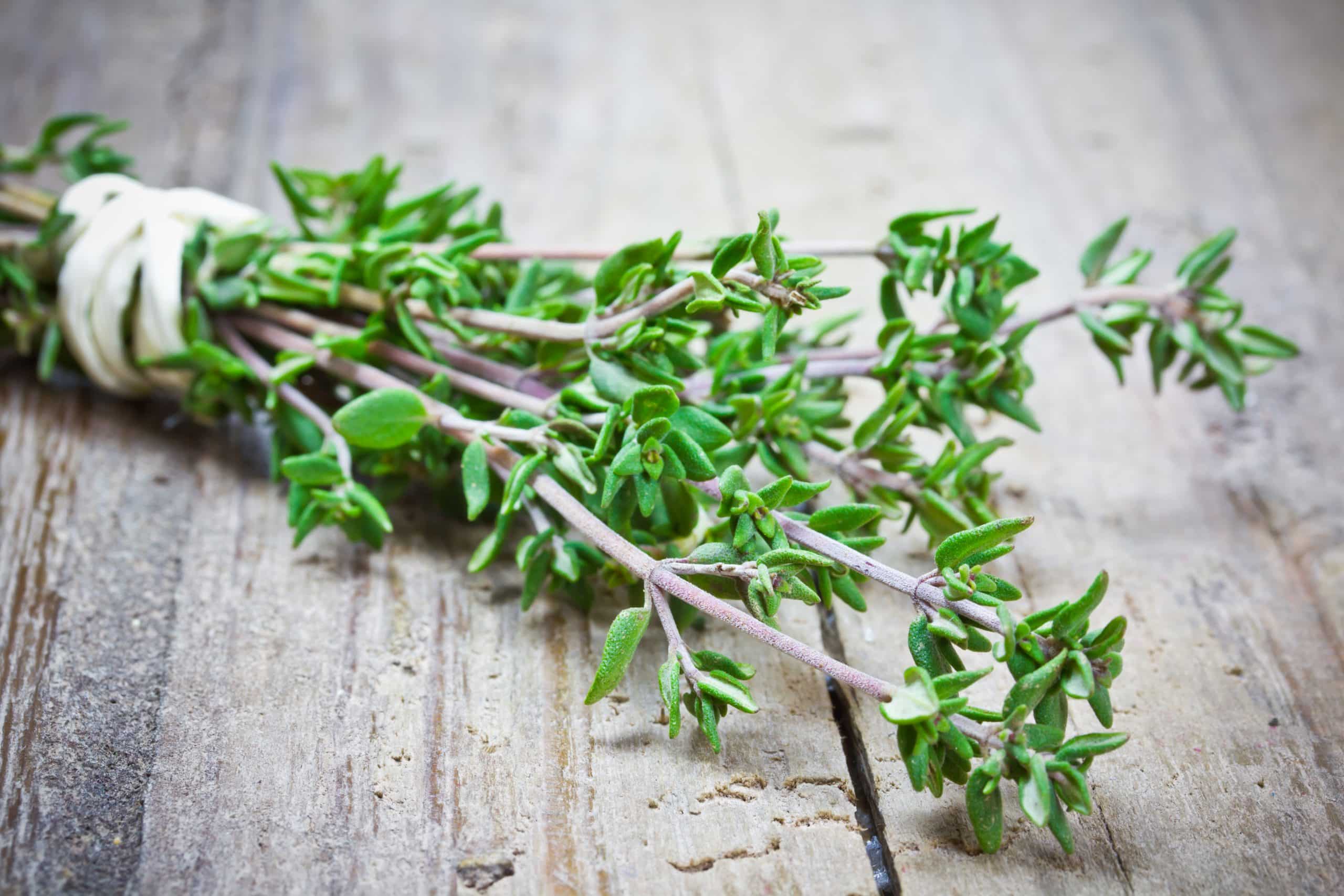
Thyme is especially good when it comes to deterring mosquitoes, earworms, whiteflies, and even maggots. Credit: Deposit Photos/Katyjay
Another plant with a great aroma is thyme, or Thymus sp. You might be familiar with this scent in your kitchens already! You can credit much of this scent to another group of secondary metabolite compounds called phenolics, especially one called thymol. Thymol not only gives the plant its characteristic pungent scent, but it also disrupts the insect’s nervous system and thereby affects its feeding behavior! Like lavender, thyme is especially good when it comes to deterring mosquitoes, earworms, whiteflies, and even maggots!
Chrysanthemum’s pyrethrins
Underneath their pretty exterior, chrysanthemums make a powerful insectide. Credit: Deposit Photos/Angel a
Chrysanthemums make such a pretty addition to your garden, but underneath their pretty exterior is a powerful insecticide. Chrysanthemums synthesize compounds called pyrethrins—compounds that contains nitrogen. When insects like mosquitoes consume this compound, they quickly become immobilized! Why? Well, pyrethrin acts on the insect’s nervous system, and for most bugs, this is highly toxic!
The amazing ability of plants to repel insects is a beautiful example of how complex interactions in the world really are, and just how adaptable life on Earth really is!
While there is still a lot of debate on how effective essential oils and plant-derived compounds can be, there is no doubt that if we’re looking for a sustainable way to keep those pesky pests out of our homes, we might need to take a tip or two from the plants in our backyards!
Glossary
Locomotion: The ability to move around
Ecosystem: a group of all organisms that live and interact with each other in a specific environment
Vectors: Any organism that can transmit a disease from one organism to another
Allelochemicals: Compounds produced by an organism which are not used for basic functioning
Volatile: A substance that evaporates at relatively low temperatures
Receptors: Cells or organs that can respond to a signal or stimulus
Swarna Ramakrishnan has been fascinated by the natural world ever since she was a young girl! She graduated from Azim Premji University, India with a Bachelor’s in Biology and a minor in applied mathematics. During her research, she trekked through the beautiful forests of the Western Ghats in India to answer questions about stomata and climate change. Currently, she is pursuing her Master’s in Biophysics from Ulm University, Germany. Swarna writes for Smore magazine to spread stories of nature in hopes of inspiring the next generation of scientists!