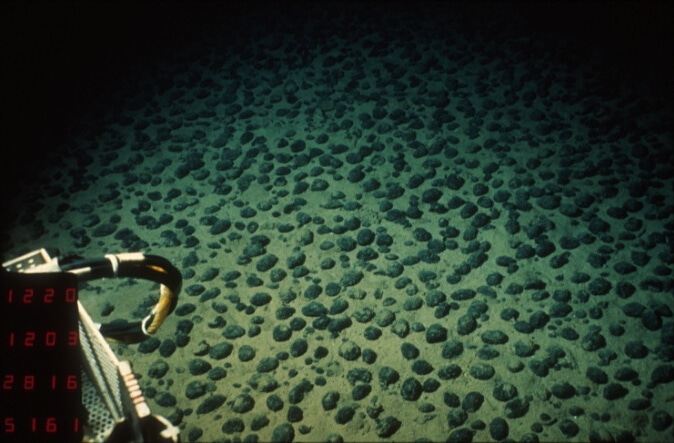
Scientists found more than 4,100 tiny animals living in cracks and holes inside 244 deep-sea rocks. One rock held an astonishing 245 animals! The rocks are called polymetallic nodules. A new study shows that they are not just lumps of metal. They are also homes for small ocean life.
What Are These Mysterious Deep-Sea Rocks?
Polymetallic nodules are hard lumps that grow on the ocean floor. They contain metals such as iron and manganese. They can also contain nickel, copper, and cobalt.
These rocks grow extremely slowly. They can take millions of years to form. Many lie thousands of meters below the ocean surface in a part of the Pacific Ocean called the Clarion-Clipperton Zone.
From above, a nodule may look like an ordinary rock. But inside, it has tiny cracks and spaces. Small animals can hide in these narrow gaps.
What Did Scientists Find Inside?
The research team studied 244 nodules collected from the deep Pacific. They carefully processed the rocks and removed the tiny animals hiding inside them.
Here is what they discovered:
Scientists counted 4,139 animals in total. One single nodule contained 245 animals!
Most were tiny worms called nematodes and small crustaceans called copepods. Many were smaller than a grain of rice.
Imagine finding an entire tiny animal community inside a single rock!
But the number of animals was not the most surprising result.
These Rocks Have Their Own Hidden Ecosystems
Scientists also compared the animals inside the nodules with those living in the soft mud nearby.
They used DNA analysis to study the tiny creatures. The results showed that the animal communities inside the rocks were different from those in the surrounding mud.
This means the nodules provide a special habitat for marine life.
Think of the cracks as tiny apartments. Different animals can use these spaces as shelter in an otherwise muddy environment.
The researchers also found that larger nodules generally contained more animals. This suggests that the size and structure of a rock can affect how much life it supports.
How Did Scientists Explore These Tiny Worlds?
Collecting samples from the deep ocean is not easy. These rocks lie several kilometers below the surface, where sunlight cannot reach.
Scientists used special equipment to collect nodules from the ocean floor. They then examined the rocks under microscopes.
They also used DNA tools to identify and compare some of the animals.
By studying hundreds of rocks, the team could look beyond individual discoveries. They could investigate whether these rocks supported a special community of life.
Why This Discovery Matters
These rocks contain valuable metals such as nickel, cobalt, and copper. These metals are important for many modern technologies.
Because of this, companies and countries are interested in deep-sea mining. This means collecting mineral-rich rocks directly from the ocean floor.
But there is a problem.
Removing the nodules also removes the tiny habitats inside them. The rocks grow so slowly that replacing them could take millions of years.
The study does not prove that every animal found inside these rocks lives nowhere else. However, it shows that nodules support a different community of life that scientists need to understand.
Protecting the deep ocean means protecting small creatures too, even those we cannot see without a microscope.
What Scientists Still Don’t Know
The team studied 244 nodules from parts of one large Pacific region. That is a useful start, but it does not tell us everything about life inside deep-sea rocks around the world.
Scientists still need to learn how many different species depend on these rocky homes. They also need to find out whether the same animals can survive in other habitats.
The deep ocean remains one of Earth’s least explored environments.
And sometimes, even a small rock can hide a world full of life!
Test Your Science Knowledge!
Try these three questions to see what you learned.
Show Quiz Answers
- B. Polymetallic nodules are hard, mineral-rich lumps found on the ocean floor.
- C. Scientists counted 4,139 tiny animals in the 244 nodules.
- A. Mining removes the nodules and the small habitats they provide.
Explore the Original Research
Read more about the discovery and the research behind this story: