Pet owners often wonder which houseplants they can use to decorate their indoor spaces without risking the health of their furry friends. Even the most well-behaved cats and dogs are tempted to chew on plants they can reach. We understand that a happy home includes happy and safe pets, so here we are with a carefully curated list of popular pet-friendly indoor plants to create a pet-safe oasis without compromising your home’s decor.
Top 10 Pet Friendly Indoor Plants
Chlorophytum comosum (Spider plant, airplane plant), Credit: Wikimedia Commons/Forest and Kim Starr
1. Spider Plant (Chlorophytum comosum)
Growth Habit: Trailing, arching leaves with plantlets on long stems
Water Demands: Water when the top inch of soil is dry
Light Needs: Prefers bright, indirect light but tolerates low light
Care Level: Easy; highly adaptable, forgiving of missed waterings
The spider plant has long, ribbon-like leaves that create a beautiful cascading effect. The non-toxic nature of the plant ensures that it poses no danger to pets. Plus, its ability to purify the air (it’s great at removing formaldehyde!) makes it an ideal houseplant. Spider plants produce small offshoots, or ‘spiderettes’ which can easily be propagated into new plants.
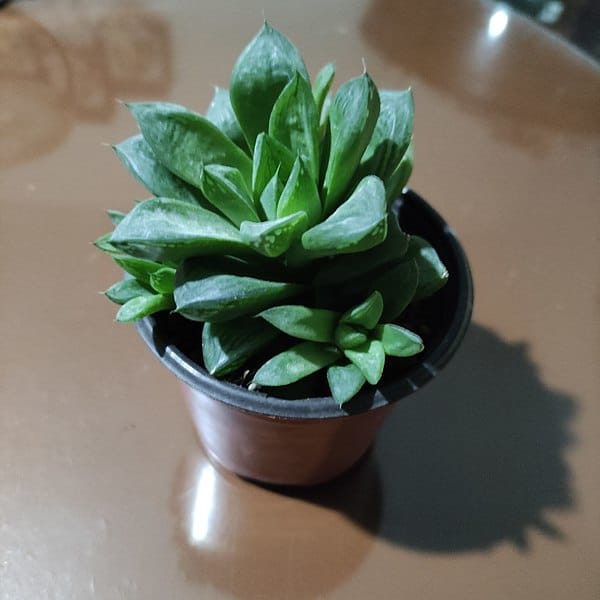
Growth Habit: Compact, rosette-shaped with thick, fleshy leaves
Water Demands: Water sparingly; allow soil to dry out completely between waterings
Light Needs: Prefers bright, indirect light
Care Level: Easy; drought-tolerant and low-maintenance
Resembling the aloe plant, Haworthia is a compact succulent known for its spiky, rosette-shaped leaves. Like most succulents, it is incredibly low-maintenance, requiring very little water to thrive. More importantly, it is non-toxic to pets, so there is no need to worry if your dog or cat decides to take a nibble!
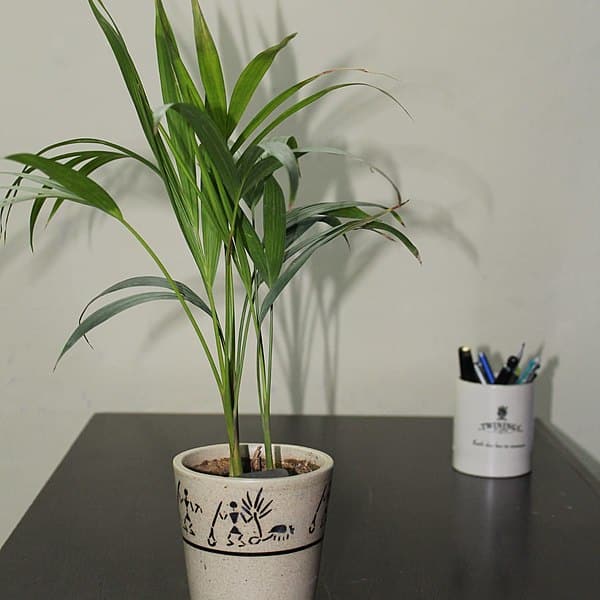
Areca palm in Ceramic Pot, Credit: Wikimedia Commons/ RJ Raawat
3. Areca Palm (Dypsis lutescens)
Growth Habit: Tall, feathery fronds with an upright, bushy structure
Water Demands: Water when the top 2-3 inches of the soil is dry
Light Needs: Prefers bright, indirect light
Care Level: Moderate; requires consistent watering and bright light for optimal growth
As one of the popular pet-friendly indoor plants, the areca palm offers a tropical vibe to any living space. This plant can reach impressive heights, with healthy indoor areca palms reaching 7 feet and outdoor areca palms touching 30 feet.
In addition to being a great choice for larger rooms, it can also help maintain humidity levels and filter out harmful pollutants, which can benefit the overall indoor environment.
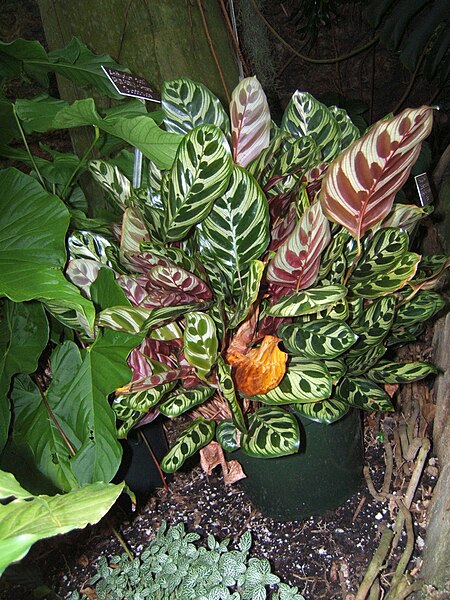
Calathea makoyana at the US Botanical Garden, Credit: Wikimedia Commons/ Mangostar
4. Peacock Plant (Calathea makoyana)
Growth Habit: Bushy with broad, oval patterned leaves
Water Demands: Keep soil evenly moist; avoid letting it dry out completely
Light Needs: Thrives in bright, indirect light; avoid direct sunlight
Care Level: Moderate; requires humidity and regular watering for healthy growth
Safe for both cats and dogs, the peacock plant can brighten up any home with its distinct foliage. The plant’s large, oval leaves are decorated with patterns that look similar to the feathers of a peacock. The deep green, light green, and purplish undersides of the plant are perfect for adding color to the indoor space while maintaining pet-safe greenery.
Growth Habit: Upright, slender stems with narrow, arching fronds
Water Demands: Water when the top 2-3 inches of the soil is dry
Light Needs: Thrives in bright, indirect light but tolerates low light
Care Level: Easy; low-maintenance and adaptable to different environments
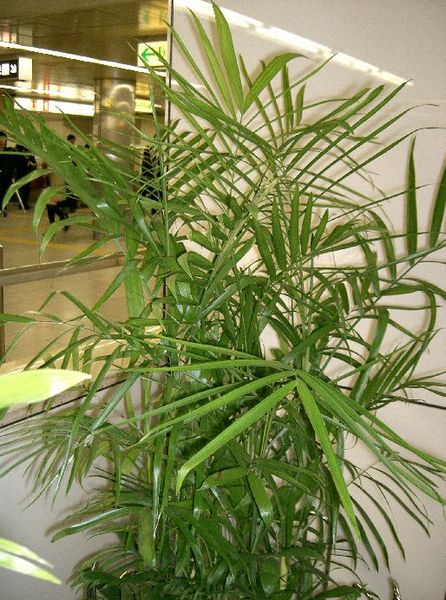
The bamboo palm, one of the top pet friendly indoor plants, has slender stems and feathery fronds that can lend a graceful touch to any room. Not only is it safe for pets, but this plant is also known for its air-purifying qualities. Bamboo palms can tolerate a range of lighting conditions and minimal care needs and thus are an excellent choice for beginners new to tending houseplants.
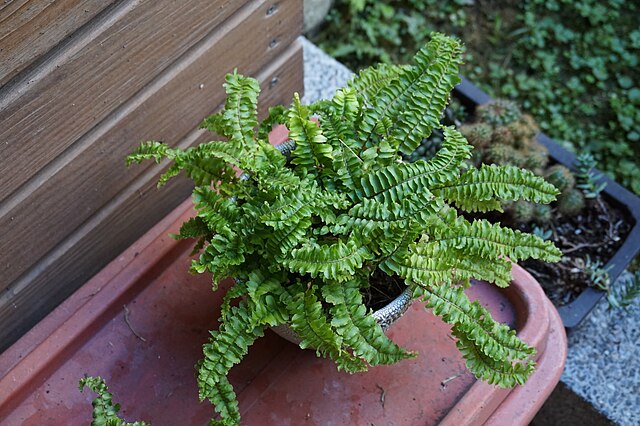
The potted Nephrolepis exaltata, Credit: Wikimedia Commons/ Tbatb
6. Boston Fern (Nephrolepis exaltata)
Growth Habit: Dense, bushy with arching, feather-like fronds
Water Demands: Keep soil consistently moist; avoid drying out
Light Needs: Thrives in bright, indirect light; prefers higher humidity
Care Level: Moderate; needs regular watering and humidity
The Boston Fern is also known as the ‘Sword Fern’ due to its sword-shaped fronds growing from its central crown. Besides being a beautiful and safe plant for pets, the indoor houseplant helps improve air quality by removing pollutants like formaldehyde and xylene from the air. Boston ferns are suitable for bathrooms or kitchens as they prefer indirect light and high humidity.
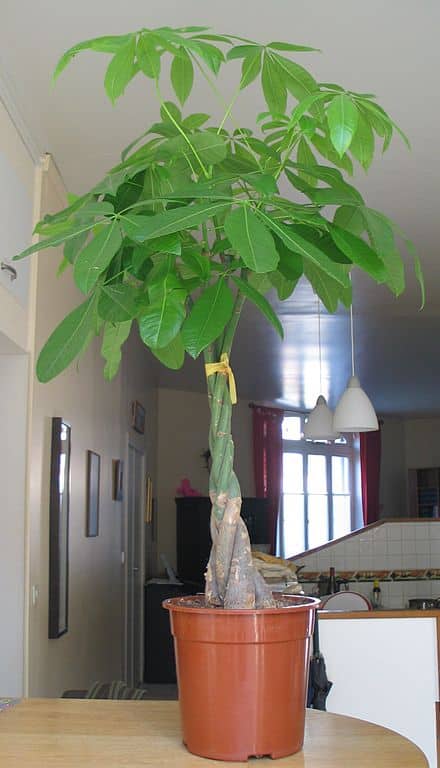
Pachira aquatica, Credit: Wikimedia Commons/ DC
7. Money Tree (Pachira aquatica)
Growth Habit: Braided trunk with broad, glossy leaves
Water Demands: Water when the top 2 inches of soil is dry
Money Tree is a safe choice for homes with pets and easy to care for. This pet friendly indoor plant has a braided trunk and large, glossy leaves. The Money Tree is believed to attract positive energy and prosperity, making it an auspicious addition to any home.
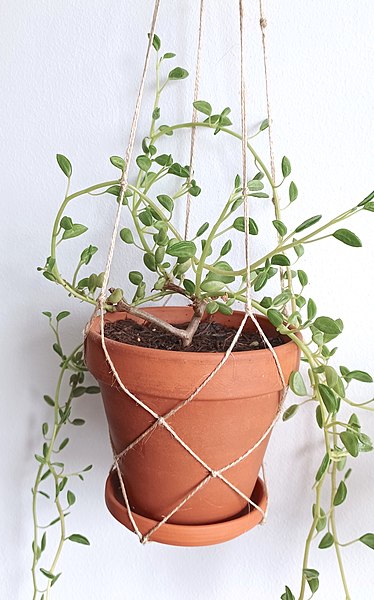
Peperomia nivalis var. lepadiphylla as a houseplant, Credit: Wikimedia Commons/Gemena
8. Peperomia (Peperomia spp.)
Growth Habit: Compact, bushy, with varied leaf shapes and textures
Water Demands: Water when the top inch of soil is dry
Light Needs: Thrives in bright, indirect light; tolerates low light
Care Level: Easy; low-maintenance and adaptable
Peperomia plants are non-toxic for cats, dogs, and other pets. With its wide range of leaf shapes and colors, it is a great choice for people looking for pet friendly plants that are low maintenance as well as unique in appearance.
Many varieties of Peperomia plants are also known for their ability to store water in their leaves. This feature makes them quite drought-tolerant and forgiving if you occasionally forget to water.
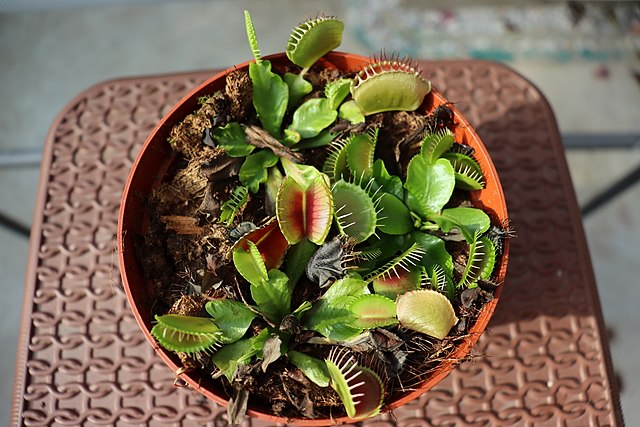
Dionaea muscipula at the Botanical Garden of the Institute of Biology, Faculty of Natural Sciences and Mathematics, Skopje, Macedonia. Credit: Wikimedia Commons/ Dandarmkd
9. Venus Fly Trap (Dionaea muscipula)
Growth Habit: Small, rosette-shaped with hinged, trap-like leaves
Water Demands: Keep soil consistently moist; prefers distilled or rainwater
Light Needs: Thrives in bright, direct light for 4-6 hours daily
Care Level: Challenging; requires specific water and light conditions
The Venus Fly Trap is an interesting plant with jaw-like leaves that snap shut to trap insects. Despite its predatory nature, the plant is safe for pets. Although it requires more specialized care than your average houseplant, its unique bug-catching ability makes it an exceptional addition to any indoor space.
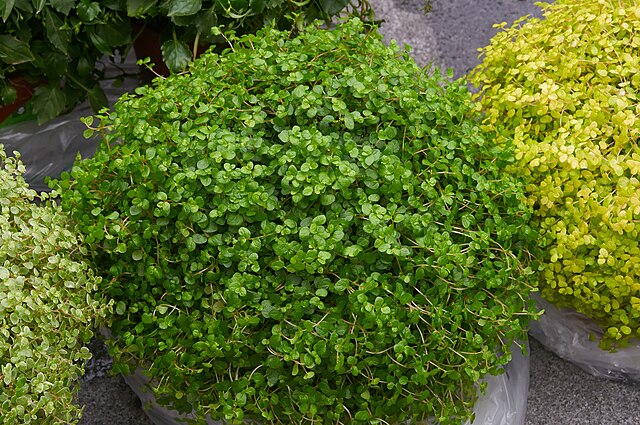
Growth Habit: Low-growing, mat-forming with small, round leaves
Water Demands: Keep soil consistently moist; avoid letting it dry out
Light Needs: Thrives in bright, indirect light but can tolerate low light
Care Level: Moderate; requires regular watering and humidity
The Baby Tears plant is another excellent option for pet owners. It is a delicate, low-growing plant with a dense mat of tiny leaves. The plant can be a great addition to terrariums, hanging baskets, or as a ground cover in potted arrangements. It is also known for its rapid growth and can quickly green up indoor spaces.
References
Siroka Z. Toxicity of House Plants to Pet Animals. Toxins (Basel). 2023 May 19;15(5):346. doi: 10.3390/toxins15050346. PMID: 37235380; PMCID: PMC10220692.