If you think Aloe vera is the only star of the Aloe genus, you’re in for a big surprise. With 500 plus species, the types of aloe plants include the ones as small as 8 inches to as tall as 18 feet or more if left unpruned; from those with fiery red foliage to those decorated with tiny white spots. And let’s not forget the stunning spiral aloe while counting the names, a Fibonacci wonder among aloe plants.
10 Popular Types of Aloe Plants: Facts and Fun Details
Here, we present a curated selection of 10 popular types of aloe plants with their unique characteristics.
Green and Gray Bird Perching on Aloe Vera Plant, Credit: Pexels/Jean van der Meulen
1. Aloe Vera
Botanical Name:Aloe barbadensismiller
Height: 1-2 feet (30-60 cm)
Flower Color: Yellow or orange-colored tubular flowers
Watering Demands: Low; requires watering when the soil is completely dry
Soil Needs: Well-draining, sandy, or loamy soil (soil made of sand, silt and clay)
The word ‘vera’ in Aloe vera is derived from Latin, meaning true or genuine. So, Aloe vera actually means true aloe. The name was given to this particular species because it was considered the most authentic and beneficial type of aloe plant.
It’s a low-maintenance plant with long, pointed leaves (often serrated) arranged in a rosette form. The thick, fleshy leaves of Aloe vera are filled with a cooling gel that has soothing properties.
Fun Fact: Over 2,000 years ago, the Greeks believed Aloe vera was a cure-all and called it the universal panacea. The Egyptians went one step ahead, naming it the ‘plant of immortality’.
Aloe juvenna. Credit: Wikimedia Commons/ Peter A. Mansfeld
2. Tiger Tooth Aloe
Botanical Name:Aloe juvenna
Height: 1 foot (30.5cm)
Flower Color: Orange-red
Watering Demands: Low; prefers to be watered infrequently (make sure to allow the soil to dry out completely between waterings)
Soil Needs: Well-draining soil with a slightly acidic to neutral pH
Native to South Africa, this beautiful aloe plant forms dense rosettes that can reach up to 18 inches tall. Its leaves have a greenish to grayish hue and are decorated with small white spots. Like most aloes, Aloe juvenna thrives in warm to hot conditions. It can change color to reddish-brown when exposed to full sun.
Fun Fact:Aloe juvenna or tiger tooth aloe, gets its name from its spiky, tooth-like leaves. But don’t worry—these spikes are actually soft and won’t prick you!
View from Mount Chuala with flowering Aloe cameronii and Encephalartos. Credit: Wikimedia Commons/ Ton Rulkens
3. Red Aloe
Botanical Name:Aloe cameronii
Height: 1-2 feet tall (30-60 cm)
Flower Color: Orange-red
Watering Demands: Minimal
Soil Needs: Well-draining soil; sandy or gravelly mix; pH 6.0 to 7.0
Red aloe (Aloe cameronii) is another popular aloe plant with coppery-red leaves. During the cooler months or with less sun exposure, the leaves may turn green. In late fall to winter, red aloe produces bright orange to red tubular flowers that attract pollinators like bees and hummingbirds.
Fun Fact: Red aloe is a natural chameleon. Its leaves can shift from green to a fiery red depending on sunlight and water conditions.
Aloe polyphylla (spiral aloe) in a garden in San Francisco. Credit: Wikimedia Commons/ Sam
4. Spiral Aloe
Botanical Name:Aloe polyphylla
Height: 1 foot (30 cm)
Flower Color: Red to salmon pink (occasionally yellow)
Watering Demands: Moderate watering during its growing season
Soil Needs: Well-draining soil; a mix of sand, gravel, and organic matter
If you are searching for a spiral succulent, then Aloe polyphylla is your plant. Native to the mountains of Lesotho in southern Africa, this aloe plant is a visual feast due to its perfectly symmetrical spiral leaf pattern. The triangular leaves of spiral aloe twist either clockwise or counterclockwise to make a distinctive rosette.
Fun Fact: The spiral leaf pattern of spiral aloe follows the Fibonacci sequence, a mathematical pattern found in nature, art, and architecture.
Aloe arborescens. Credit: Wikimedia Commons/ Carlo Brescia
5. Krantz Aloe
Botanical Name:Aloe arborescens
Height: Can grow up to 6.5 feet (2 m)
Flower Color: Red-orange
Watering Demands: Low
Soil Needs: Well-draining, sandy or gravelly soil
Krantz aloe (Aloe arborescens), also known as the torch aloe, is noted for its dramatic, branching flower spikes that produce brilliant red to orange blooms. The dense rosettes of fleshy, green leaves can develop a reddish tint in full sun.
Fun Fact: Besides Aloe vera, Aloe arborescens is the only other Aloe species that is commonly used in the cosmetics and pharmaceuticals sector.
Prickly Aloe brevifolia plant growing in pot. Credit: Pexels, Lachlan Ross
6. Short-Leaf Aloe
Botanical Name:Aloe brevifolia
Height: 1-2 feet
Flower Color: Orange to red
Watering Demands: Low water requirements and tolerance for drought
Soil Needs: Well-draining, sandy or gravelly soil
The short-leaved aloe, also known as the Jewelled Aloe, Blue Aloe, or Crocodile Plant, is a compact succulent with thick, fleshy leaves. Aloe brevifolia produces clusters of vibrant orange to red tubular flowers on tall spikes in the late winter or early spring.
Fun Fact: The grey-green leaves of Aloe brevifolia form neat rosettes, with each leaf having creamy-white spines. This gives this aloe plant a jeweled appearance resembling fine brooches.
Photo of Aloe dorotheae at the University of California Botanical Garden. Credit: Wikimedia Commons/ Stan Shebs
7. Sunset Aloe
Botanical Name:Aloe dorotheae
Height: 1 foot (30 cm)
Flower Color: Orange, Pink
Watering Demands: Drought-resistant but prefers supplemental water during hot seasons
Soil Needs: Well-draining, sandy or loamy soil
Aloe dorotheae is one of the popular types of aloe plants that is native to southern Africa. The succulent has a clumping growth and features spotted leaves with deeply serrated edges. Sunset aloe can eventually reach a width of 2 feet and a height of 1 foot.
Fun Fact: Sunset aloe’s leaves color changes to bright orange or red when stressed by intense sun or drought.
A small Aloe perfoliata AKA Aloe mitriformis, Cape Town. Credit: Wikimedia Commons/ Abu Shawka
8. Rubble Aloe
Botanical Name:Aloe perfoliata
Height: Up to 60-100 cm in optimal growth conditions
Flower Color: Bright red to orange
Watering Demands: Water when soil is completely dry
Soil Needs: Well-draining, sandy or gravelly soil
This plant forms dense clusters of triangular leaves which are bluish-green in color. Rubble aloe is well-suited for xeriscaping, rock gardens, or containers. It does well in dry conditions and should be watered only when the soil is completely dry.
Fun Fact: The leaves of rubble aloe often curve inward during drought, making the plant’s rosette look like a mitre (ceremonial headdress of bishops). Because of this resemblance, it used to be called Aloe mitriformis.
Aloe ferox in the Botanischer Garten, Berlin-Dahlem. Credit: Wikimedia Commons/ Krzysztof Ziarnek, Kenraiz
Cape aloe (Aloe ferox), also known as bitter aloe, is native to South Africa. It can grow up to 10 feet tall at maturity. With its towering flower spikes, it can reach a total height of 14 feet. It spreads about 6 feet wide, with the leaves forming a dense rosette.
Fun Fact: Cape aloe has been used for centuries in traditional medicine to help prevent cancer and treat tumors. It also has a well-documented history of use as a laxative.
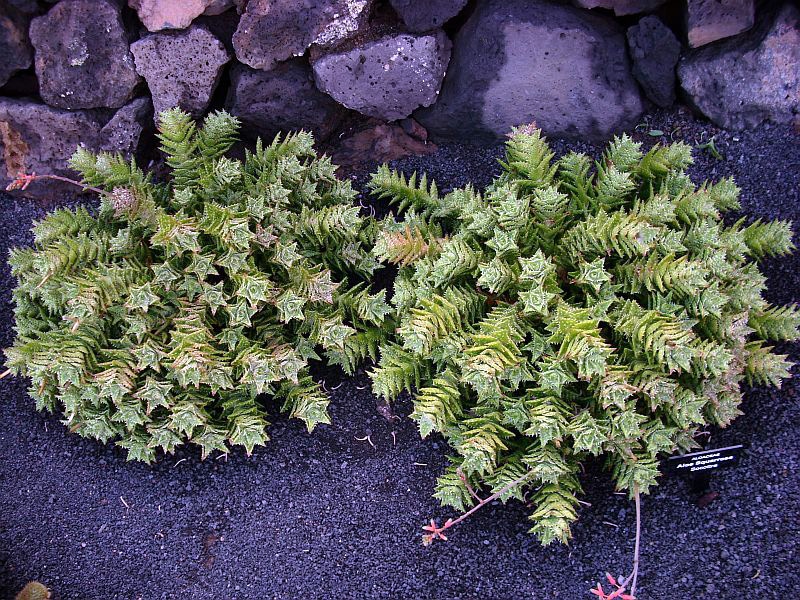
Aristaloe aristata rosette showing Fibonacci phyllotaxis, and sets of 5, 8 and 13 leaf-ranks. Credit: Wikimedia Commons/ Abu Shawka
Watering Demands: Low; allow soil to dry out between waterings
Soil Needs: Well-draining, sandy or gritty soil
Lace aloe is a dwarf succulent ideal for edging, ground covers, or container gardening. It grows well in well-draining soil and is easy to care for. This compact plant typically grows between 6 and 12 inches tall, with leaves lined with small, white, tooth-like spines.
Fun Fact: Lace aloe gets its name from its uniquely patterned rich dark green leaves edged with white spines, which look like delicate lacework.
FAQs
Q1. How many types of aloe species are there?
There are over 500 species of the genus aloe.
Q2. Are there any poisonous types of aloe plants?
Most aloe plants are not toxic to humans, but some species can be mildly toxic if ingested. The most commonly used and safest species are Aloe vera and Aloe arborescens. However, three Aloe species, Aloe ballyi, Aloe elata, and Aloe ruspoliana, are known to be poisonous and produce a strong, unpleasant odor from their leaf sap.
Q3. Which aloe species is best for skin?
Aloe vera is the most commonly recommended aloe species for skin care.
Q4. What are the side effects of aloe vera?
Aloe vera can cause allergic reactions in some people, such as redness or itching. When ingested, it may lead to digestive issues like diarrhea or abdominal cramps in certain cases.
Q5. Can you eat aloe vera raw?
Yes, aloe vera can be eaten raw. But only the inner gel of the leaf is edible. The outer skin and the yellow latex (found just beneath the skin) can be irritating and should be avoided.
References
Surjushe A, Vasani R, Saple DG. Aloe vera: a short review. Indian J Dermatol. 2008;53(4):163-166. doi:10.4103/0019-5154.44785
Andrea, B., Dumitrița, R., Florina, C. et al. Comparative analysis of some bioactive compounds in leaves of different Aloe species. BMC Chemistry14, 67 (2020). https://doi.org/10.1186/s13065-020-00720-3
Chen, W., Van Wyk, B. E., Vermaak, I., & Viljoen, A. M. (2012). Cape aloes—A review of the phytochemistry, pharmacology and commercialisation of Aloe ferox. Phytochemistry Letters, 5(1), 1-12.