Migration is a fascinating natural process in birds. Birds shift to a different place for livelihood during unfavorable conditions, twice a year. Technology advancement and research on bird migration over the years have paved the way to better understanding of this behavioral trait. Here, we aim to discuss and provide insight on basics of avian migration – What, Why, When, Where and How?
Why do birds migrate?
Migration is often referred to as the pattern of movements of birds, occurring between breeding and seasonal cycle changes. Sources say, a popular theory involving migration, could have evolved from extended smaller yearly movements that birds do in search of improved food and breeding options. Just like humans, successful bird migrations, which gave them better opportunities to survive and breed, have passed along this behavior to their younger ones. Ultimately, what started as a short distance survival skill, over the years has become a behavioral habit in birds.
Another aspect, which may have caused birds to migrate, is the changes in our environment. Especially those that occurred in the last 2.5 million years; where earth would have seen at least 20 glacial cycles. Typically, birds migrate when there is a reduction in resources, to places that provide best ecological conditions for them to have a natural habitat in terms of steady supply of food, breeding and nesting their offspring.
Credits- Wild bird resources; Annie Krug
Where do birds migrate?
The change in day length and the onset of winter are clues for the birds to prepare for migration. This often varies between each type of bird or sometimes even individuals. If not all, most of the birds travel in flocks. Migrating birds travel a stretch of over 100 to 1000 miles before their summer and winter breeding lands. The birds breed during summer and migrate from North to South during fall/winter; they travel back to North from South during spring and land for breeding in summer.
Credits- nationalzoo.si.edu/migratory-birds
Female birds and their little ones travel farther south than adult males. Sometimes, individuals may even decide not to migrate The Gold finch is one such example. Other birds prefer migrating fewer miles in terms of altering altitudes. They either move up high in the mountains during summer or reside lowland in winters. Just like how we plan our trips, birds also have to make decisions on navigation routes, where to pitstop and refuel.
How to birds prepare for migration?
Migrating for many miles can be tedious and birds require a lot of strength and agility to make this possible. Migration can be exhausting even for birds that are innately built to fly fast and long distances. When flying long distances, birds lose almost half of their body weight. This is why migratory birds rarely fly non-stop and they usually take breaks to rest and feed or pause due to bad weather.
Physiological adaptation is a prominent key factor for the bird to prepare oneself for migration. When birds get the cues, their brain triggers to produce hormones that support in molting new feathers that can keep up with strong winds and support in long flight. Their hormones also activate a bigger appetite; so they eat in excess and gain weight.
A balanced diet of nutrition required for their body to fly is achieved from different sources of foods like insects, fruits, berries and grains. All these foods burn down to fat and get stored to provide energy during migration.
People have also observed that there is a behavioral change in birds when it’s time to take off during spring and fall every year. Birds in natural habitat and even the caged ones display increased restlessness especially during the night time. Caged birds exhibit repeated fluttering of wings towards one direction as a sign. Showing readiness varies between different species and even groups among the same species.
How do birds navigate?
The captivating theory behind the navigation of migratory birds still remains relatively unknown. Interestingly, it is found that first time migrating birds somehow find their new home suitable for them and fly back to where they were born after the season change. The sun, stars, earth’s magnetic field- all play a major role in mapping routes for their flight. Studies also reveal that young birds upon birth have an innate genetic programming to adapt to this behavior.
Ornithologists believe that day time migrating bird’s watch out for locations to land such as rivers and mountains. Night time migrating birds focus more on the rivers to effectively settle on the land nearby. On the other hand, a study done in 2017 on the bird “Scopoli’s shearwaters” reveals that seabirds navigate using the sense of smell.
To aid in navigation, physiologically, a cryptochrome protein is released in the bird’s eye which pairs up with the brain to signal other sensory organs to locate the ground and land. Multiple factors combining to create this navigation, for a successful migration is nothing short of magic!
Types of avian migrations
Bird migration can be categorized based on traveling distance and pattern, the birds follow.
Long Distance Migration – Birds that travel longer miles (100 – 1000’s) fall in this category. The best example is the Artic Tern, the longest migratory bird in the animal kingdom. This bird travels around 55,923 miles – pole to pole every year, from Greenland in the north to Weddell Sea in the south. Most North American birds are long distance migratory birds including – geese, flycatchers, orioles.
Short Distance Migration – Birds that travel shorter miles (10 – 100’s) belong to this category. In general birds breeding at lower heights, travel south over short distances. Red- winged Blackbirds, robins and waxwings are some examples.
Latitudinal – The most common pattern used by birds, because of the weather change. Birds travel from north to south during winter.
Longitudinal – Less commonly used pattern by birds. Some birds fly east to west or the other way around. European birds are a classic example.
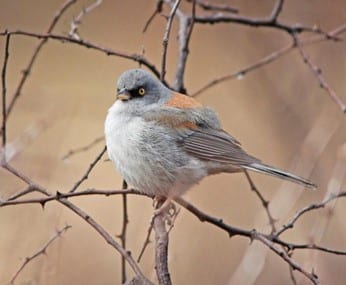
Altitudinal – Birds that move from higher to lower heights (from mountains to valleys). Yellow-eyes junco is an example.
Yellow-eyed junco; Credits- chirpforbirds.com
6. Seasonal- Though can happen at any time of the year, seasonal factors cause this migration mostly in winters. Canadian geese are seasonal migratory birds.
7. Irregular- they migrate if and when there is reduction in resources and are also termed as nomadic migration. Blue Jays and Clark’s Nutcrackers are an example.
8. Loop – Birds that take different routes to travel to and fro. Many sea birds, shorebirds are “Loopers”. Rufous Hummingbird is an example.
9. Irruptive – Birds when traveling in large flocks find the resources less in the migrated region as well and tend to search beyond the migration range. This could be because of environmental changes. 2020 was one such “irruptive year”.
10. Leapfrog- Birds that migrate ahead of other birds farther north or south within the same species. Finches, starlings and Golden Eagles are some examples.
11. Reverse- This pattern is just as it sounds. Birds that are first timers or forget their direction or get blown away by strong currents of winds fall in this category. They usually travel independently.
12. Drift- Large number of birds that get drifted and detour in a different path due to storm winds. This is common during coastal migration.
Bird migration plays a prominent role in survival of birds irrespective of the difficulties, threats and hazards involved. However, this natural phenomenon is essential for balancing our ecosystem. Migratory birds are important for maintaining our biodiversity along their routes. They help in analyzing climate change, act as farmers’ friends and add income to the economy. To give back to the bird community, we must support and improve their journey by providing them a safe environment to co-exist.