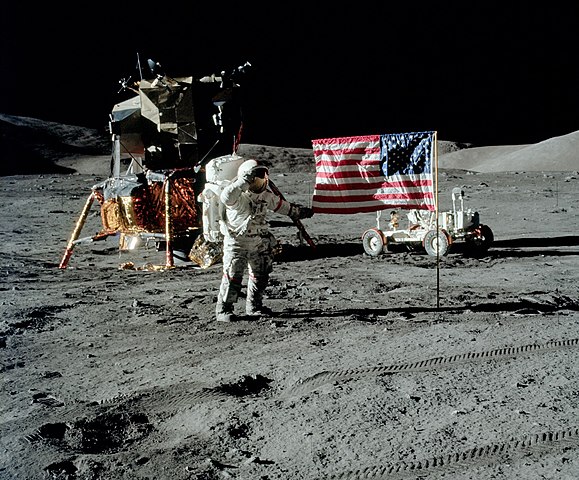
Apollo 17 mission on the Moon, Credit: Wikimedia/Harrison Schmitt
Imagine if you could travel to the Moon! It’s a fascinating idea to explore our nearest celestial neighbor. But have you ever wondered how long it would take to reach the Moon? Is it a short trip or a long journey? Let’s find out!
Distance to the Moon
The Moon is located about 384,400 kilometers (238,900 miles) away from Earth. That’s a tremendous distance! To put it in perspective, if you could drive a car at a speed of 100 kilometers per hour (62 miles per hour), it would take you more than 4,000 hours or around 166 days to reach the Moon! That’s a little over five months of non-stop driving!
Traveling to the Moon
But of course, we can’t drive to the Moon in a car. We have to rely on space travel. Currently, the only way to reach the Moon is by using a spacecraft, like the ones used by NASA and other space agencies around the world. These spacecrafts are specially designed to travel through the vacuum of space and withstand the harsh conditions of the journey.
The time it takes for a spacecraft to travel to the Moon depends on various factors, such as the type of spacecraft, its speed, and the trajectory it follows. On average, it takes about 3 to 4 days for a spacecraft to travel from Earth to the Moon. This includes the time it takes for the spacecraft to escape Earth’s gravity, travel through space, and enter the Moon’s gravitational pull.
Spacecrafts travel at incredibly high speeds to reach the Moon in a relatively short amount of time. The average speed of a spacecraft traveling to the Moon is around 38,000 kilometers per hour (23,600 miles per hour)! That’s more than 10 times the speed of sound.
Spacecraft Trajectory
The trajectory or path that a spacecraft follows also affects the time it takes to reach the Moon. Spacecraft usually take a curved path, known as a transfer orbit , to reach the Moon. This allows them to use the gravitational pull of both Earth and the Moon to conserve fuel and travel more efficiently. The exact trajectory depends on the mission requirements and the specific goals of the spacecraft.
Animation of Spacecraft transferring from Earth orbit to the Moon, Credit: Wikimedia/Phoenix7777
Space Missions to the Moon
Over the years, there have been numerous space missions to the Moon by various space agencies, including NASA, the European Space Agency (ESA), and others. These missions have involved sending spacecraft and astronauts to orbit, land, and explore the lunar surface . Some of the most famous space missions to the Moon include the Apollo missions by NASA, which successfully landed astronauts on the Moon and brought them back to Earth.
Future Missions
In recent years, there has been renewed interest in exploring the Moon, with plans for future missions to send humans back to the Moon and even establish a permanent human presence on the lunar surface. These missions will likely involve advanced spacecraft and technologies, and scientists and engineers are continuously working on developing new ways to make the journey to the Moon faster and more efficient.
So, how long does it take to get to the Moon? While it’s not as quick as hopping in a car and driving, it’s still a relatively short journey considering the vastness of space. With spacecraft traveling at incredibly high speeds and following carefully planned trajectories, it takes about 3 to 4 days to reach the Moon. As technology continues to advance, we may see even faster travel times in the future, opening up new possibilities for lunar exploration and beyond!
Flesch Grade Level: 9.5
Flesch Reading Ease: 62.8
Glossary
Trajectory: The path followed by an object, such as a spacecraft or a projectile, as it moves through space. It refers to the planned route that a spacecraft would take to reach the Moon.
Transfer orbit: An orbit used to transfer a spacecraft from one celestial body, such as Earth, to another, such as the Moon.
Lunar surface: The outer layer or the surface of the Moon.