Mars, the “red planet,” has been irresistible to us for many years. It captures our attention because it’s visible in the night sky, being the third brightest planet. Scientists debate the idea of living on Mars, and movies with extra-terrestrials fascinate us. NASA’s Mars Mission spent years on research and sent five mars rover there to explore its rugged geography and thin atmosphere.
This Mars Explorer poster shows the rovers that have been sent to Mars to explore the planet.
But just how far away is Mars, and is it really a viable option for humans to visit? The distance from Earth to Mars depends on their orbits around the Sun, so determining travel time can be a bit tricky.
According to NASA, the closest recorded distance to Mars from Earth was 34.8 million miles (54.6 million kilometers) in August 2003. When Mars is behind the Sun, the farthest distance, the two planets are 249.1 million miles (401 million kilometers) apart.
Changing orbits
Mars and Earth don’t have circular orbits , which is the reason for the discrepancies in distances. Mars has an elliptical orbit . An elliptical orbit is a path that revolves around another object in an oval-shape. The planets in our solar system orbit around the Sun on elliptical paths.
As a result of its orbit, Mars comes closer to the Sun and other planets at certain moments. Mars is closest to Earth approximately every 26 months.
Despite advances in space travel, it would take anywhere from nine months to a few years to reach Mars. Scientists estimate it would take longer for astronauts to reach Mars because oxygen, food, supplies, and gas to refuel would hamper the spacecraft’s speed.
Discoveries from Rover explorations
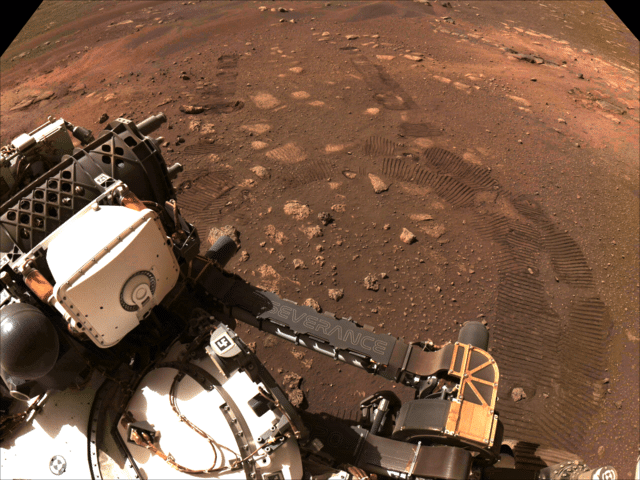
This image was taken during the first drive of NASA’s Perseverance Rover on Mars, Credit: Wikimedia/NASA/JPL-Caltech
The NASA Rovers took seven months to get to Mars. The Rovers gave scientists a wealth of data about the planet by collecting samples of rocks. They have used witness tubes to collect molecular and particulate contaminants. Some examples are:
• The raw ingredients for life were found (sulfur, nitrogen, oxygen, and carbon)
• Methane (from chemical reactions) was detected
• Two types of radiation are a health risk to humans. One is galactic cosmic rays , and the other is solar energetic particles .
Obstacles to living on Mars once humans get there
Mars’ bleak environment is dangerous and unsustainable for human life. The amount of oxygen in Mars’ atmosphere is 0.16 percent, which is drastically lower than Earth’s 21.0 percent. Carbon dioxide comprises 96 percent of Mars’ atmosphere, with argon and nitrogen contributing minor amounts.
At night, the temperature can drop to −195 degrees Fahrenheit (−125 degrees Celsius) and at day it can reach 70 degrees Fahrenheit (20 degrees Celsius).
Mars is inhospitable for farming as it lacks water, sunlight, and oxygen. Mars’ soil contains perchlorate , a toxic chemical that would make consuming plants grown there toxic.
Even though Mars would be a long journey from Earth, the intrigue of traveling there does not dwindle. Faster trips will be made possible with investments in modern spacecraft designs and technology.
Readability: 58.7
Flesch Kincaid Grave Level: 8.4
Glossary
Orbit: an orbit is a regular, repeating path that one object in space takes around another one
Elliptical orbit: an elliptical orbit is an oval-shaped path, like a slightly elongated circle
Mars Rover: a robotic vehicle that explored the surface of Mars
Witness tubes: sample tubes that will hold Martian rock and sediment, except they have been preloaded with a variety of materials that can capture mole contaminants. This will help scientists tell which materials in the Martian materials may be of Earth origin.
Particulate: consisting of extremely small particles of a substance or substances
Galactic cosmic rays (GCR): the slowly varying, highly energetic background source of energetic particles that constantly bombard Earth. GCR originate outside the solar system and are likely formed by explosive events such as supernova.
Solar energetic particles: high-energy, charged particles originating in the solar atmosphere and solar wind. The solar wind is a stream of energetic particles ejected by the Sun.
Perchlorate: a naturally occurring and manmade chemical that can affect the functioning of the thyroid gland at sufficiently high doses
Atmosphere: an atmosphere is made of the layers of gases surrounding a planet or other celestial body
Argon: a colorless, odorless gas that is totally inert (not chemically reactive) to other substances