Even before the invention of the compass, the North Star, also known as polaris , has helped sailors at sea to navigate. This reliable beacon, which remains steady and almost fixed in the sky, has offered a reference point to those trying to find their way. Whether you’re navigating a ship at sea or finding your way in the wilderness, the North Star points the way to the North. That’s pretty cool, isn’t it?
North star vs Compass
The North Star is seated almost at the North Pole. If you could pass a stick through the Earth, straight through the middle, the point at which the stick comes out, is the North Pole. In scientific terminology, we call it the axis of rotation as the Earth rotates around this axis.
As the North Star was positioned at the North all year round, it seemed like all other stars and constellations were moving around the North Star. In fact, the North Star gives the exact direction of the North, compared to a compass, which is always a few degrees off (true North is 0°). However, the North Star can easily get shrouded by clouds or overcast sky, and is also not visible during daytime. These drawbacks eventually led to the invention and use of compass.
What’s important about the Big Dipper for our star quest is that it has two stars that act as a guide, pointing directly to the North Star. These two stars are called the ‘pointer stars ‘. If you can locate the Big Dipper, then find these pointer stars, you’re on the right track. Just imagine a line extending from the pointer stars out into the night sky, and that line will lead you straight to the North Star.
The big dipper pointing towards polaris, Credit: Wikimedia/Steve Ryan
How does north star look in the sky?
Congratulations, you’ve found the Northern Star! Or as it’s officially named: Polaris. You might be surprised to know that Polaris is not a lone star in the sky but rather the bright end star of the handle of the Little Dipper constellation.
Polaris might not be the biggest or brightest star in the sky, but its unique position makes it very important. Being almost directly over the North Pole of Earth, it seems like it hardly moves at all through the night. This has made it a steadfast guide for centuries.
While the rest of the stars wheel around in the night sky, Polaris stays put. The star is also a combination of three stars that appear as one.
Constellation ursa minor (little dipper), Credit: Wikimedia/Torsten Bronger
Can the north star change its position?
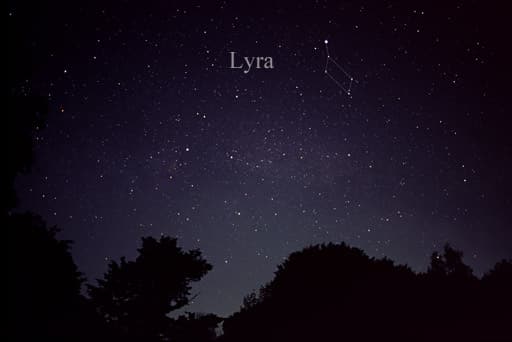
You see, the Earth wobbles very slowly on its axis, like a spinning top, completing a full wobble every 26,000 years or so. This wobble means that which star is directly over the North Pole changes over time. In about 13,000 years, the Northern Star will be vega , a bright star in a different part of the sky. But don’t worry! After another 13,000 years, Polaris will once again take its place as the Northern Star.
Constellation lyra with star vega, Credit: Wikimedia/Till Credner
Glossary
Constellations: A group of stars forming a recognizable pattern that is traditionally named after its apparent form or identified with a mythological figure.
Polaris: Also known as the North Star, it is the brightest star in the constellation Ursa Minor, and is located almost directly overhead when viewed from the Earth’s North Pole.
Vega: The fifth-brightest star in the night sky and the brightest star in the constellation Lyra. In about 13,000 years, due to the Earth’s axial precession, Vega will become the North Star.
Pointer Stars: In the context of this article, the two bright stars in the Big Dipper constellation that form a line pointing to Polaris.