Table of Contents
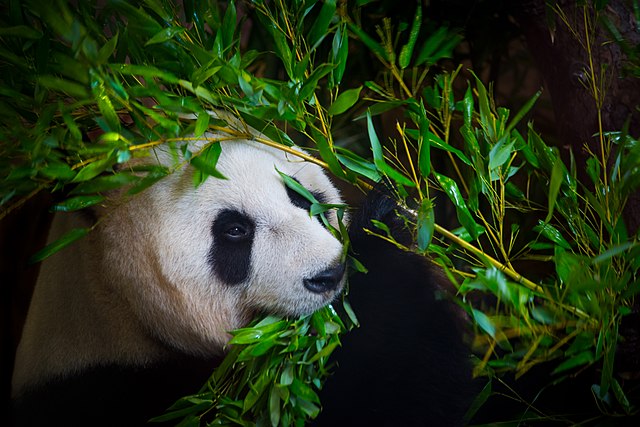
Giant pandas are stars of the animal kingdom. They definitely have the looks of a celebrity, with their unique black and white fur coat drape, and the ears to match. It’s no wonder there are entire movie franchises dedicated to them!
While they might be easy to spot on the big screen, they are some of the rarest animals on planet Earth. These creatures have a reputation that precedes them, and it’s time to figure out why. Buckle up for some fun facts about pandas!
The bears’ influencer – switching to a plant based diet
Giant pandas, or Ailuropoda melanoleuca, might share common ancestors with other bears in the Ursidae family, but they definitely do not share their taste for meat.

Giant pandas used to eat plants and meat until about 2 million years ago. Since then, they’ve been on a steady diet that consists of bamboo nearly 90 percent of the time! Scientists theorize that since bamboo is more abundant in their habitats, giant pandas have turned to them as a source of food.
Testing out a new diet with some old equipment—What goes in must come out
The most intriguing part of their plant-based lifestyle is the fact that their digestive system isn’t really built for it at all! Most herbivores have evolved a specialized digestive system to break down plant material. Giant pandas, on the other hand, go about it in a different way. Anatomically, giant pandas retain a carnivore’s digestive tract. Even their gut microbiome doesn’t handle plant fiber too well.
As you might expect, this can cause its own special set of problems. Throughout a single day, a giant panda consumes nearly 30 pounds of bamboo! However, only about 17 percent of that gets digested. The rest must come out. Pandas are known to defecate over 100 times a day. That’s a lot of bamboo in their poop!
The curious case of the extra thumb
Their diet isn’t the only fascinating thing about them. Have you had a close look at their adorable paws? If you haven’t, you might have missed that they have six whole digits… well, five, and then an anomaly! The sixth digit is really a jutting-out extension of the pudgy panda’s wrist bone. It’s called a “pseudothumb” and it acts as a rudimentary thumb that can perfectly grab bamboo shoots when they need a quick snack!
Hot take: Sleep is for the weak
By now, it’s clear to see that pandas aren’t like other bears. So much so that while other bear species (think brown or black bears) hibernate for different periods of time, giant pandas tend to opt out.

Don’t get it wrong; pandas are notoriously wonderful sleepers! They can sleep for 8 to 12 hours a day! They just don’t do it for the cold. To escape the winter, these pandas just migrate to a more comfortable location, and you guessed it, keep munching on their bamboo!
Of course, these are just a few of the many fun facts about pandas that make them unique. Between all their quirks and their good looks, it’s easy to see why these bears go viral every month!
Glossary
Habitat: The environment of an organism where it lives, grows, and survives
Hibernation: A state of minimum activity, from reduced movement to slow heart rate, in order to conserve energy during the cold.
Microbiome: A collection of all the microbes, including bacteria and fungi, that are found naturally in our body. In this context, we’re talking about the gut specifically
References
Izadi, E. (2021, October 27). Why giant pandas have to eat and poop all day. Washington Post.
https://www.washingtonpost.com/news/speaking-of-science/wp/2015/05/20/giant-pandas-somehow-exist-despite-having-guts-that-can-barely-process-the-only-food-they-eat/
Lai, O. (2022, March 16). 10 Interesting Facts about Pandas | National Panda Day. Earth.Org.
https://earth.org/interesting-facts-about-pandas/
Tamisiea, J. (2022, June 30). Who’s Got Two Pseudothumbs and Loves to Eat Bamboo? This Bear. The New York Times.
https://www.nytimes.com/2022/06/30/science/panda-thumb.html
Contributors
-
Swarna Ramakrishnan: AuthorView all posts
Swarna Ramakrishnan has been fascinated by the natural world ever since she was a young girl! She graduated from Azim Premji University, India with a Bachelor’s in Biology and a minor in applied mathematics. During her research, she trekked through the beautiful forests of the Western Ghats in India to answer questions about stomata and climate change. Currently, she is pursuing her Master’s in Biophysics from Ulm University, Germany. Swarna writes for Smore magazine to spread stories of nature in hopes of inspiring the next generation of scientists!
Copyright @smorescience. All rights reserved. Do not copy, cite, publish, or distribute this content without permission.
SUBSCRIBE TO OUR NEWSLETTER
.......... ..........Subscribe to our mailing list to get updates to your email inbox.
Monthly Newsletter