The animal kingdom has inspired quite an active rumor mill. There are lots of myths and questions about the days and lives of the fascinating creatures that inhabit our earth. One intriguing creature is the honey bee!
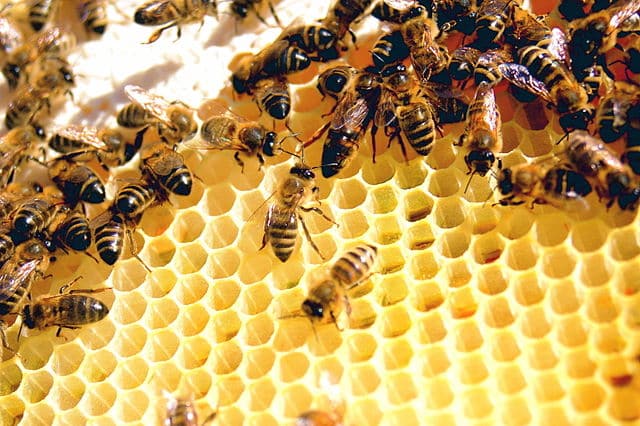
Bees are winged insects that are famous for their ability to pollinate ! While some bees are solitary, other bees are social insects that live in colonies.
Bees are social beings, Credit: Wikimedia/Todd Huffman
Within a colony, you can find three main kinds of adult bees: the queen, workers, and drones. Any one bee can’t make it on its own; it needs the help of the entire hive. While the queen bee’s primary function is reproduction, the drone bees (which are larger in number) mostly have the job of fertilizing the queen bee! Lastly, the worker bees set out to do labor around the hive, including finding food, guarding the colony, cleaning the cells of the hive, and feeding the brood !
Today, we’ll try to answer a common question about the humble honey bee, and it’s all about their rather painful stings! Do bees die after they sting?
The anatomy of a honey bee!
To begin answering the question, it helps to figure out the anatomy of our lovely pollinator friend! We’re especially interested in figuring out what exactly makes up the stinger.
There are two kinds of stingers, Credit: Wikimedia/tormentor4555
The stinger you see on the bee is a modification of an organ called the ovipositor , or the organ responsible for laying eggs. Since the ovipositor is part of the female reproductive system, it’s only the female bees, or the worker bees, that have stingers that sting.
The queen bee, the male bee counterparts, and other wasps and bee species have smooth stingers that allow them to poke and pierce multiple times. This means that these kinds of bees don’t worry about death when they sting you. This isn’t all that true for the worker bee. For these female honey bees, their stinger is made up of two little barbed lancets around a canal that terminates in a venom-filled bulb.
Hold on. What does it matter if the stinger is barbed or smooth? This tiny fact holds the answer to the question we asked in the beginning!
Death to the stinger
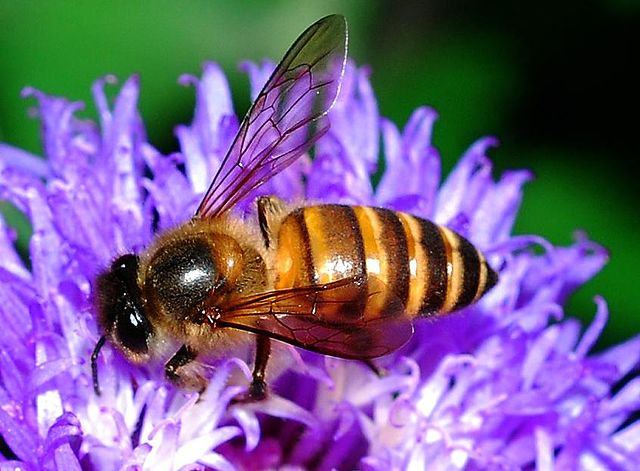
The common worker bee, Credit: Wikimedia/William Cho
The barbed stinger is deployed to protect and defend the hive. When not in use, the stinger retracts into a cavity for safekeeping. When the worker bee is set to defend its hive, she quickly thrusts her stinger at a right angle to the threat. When she does so, the barbed stinger can get lodged into the target’s skin and get pulled right out of the female bee’s body, tearing the abdomen in the process. Following the stinger’s amputation, the worker bee dies in minutes.
So, now we know! Turns out, not all bees die after they sting unless they have a barbed stinger.
Flesch Kincaid Grade Level: 7.7
Flesch Kincaid Reading Ease: 69.7
Glossary
Brood: a group of offspring or young that are born or cared for at the same time
Ovipositor: An organ through which some female insects lay their eggs
Pollinate: To transfer pollen from the anther (the male reproductive organ) to the stigma (the female reproductive organ) of a flower
Swarna Ramakrishnan has been fascinated by the natural world ever since she was a young girl! She graduated from Azim Premji University, India with a Bachelor’s in Biology and a minor in applied mathematics. During her research, she trekked through the beautiful forests of the Western Ghats in India to answer questions about stomata and climate change. Currently, she is pursuing her Master’s in Biophysics from Ulm University, Germany. Swarna writes for Smore magazine to spread stories of nature in hopes of inspiring the next generation of scientists!