At first glance, it is easy to mistake a hawk for a falcon or the other way around. Their similar silhouettes and shared habitats can make it tricky to tell them apart. However, the difference between hawks and falcons becomes clear when you look closer at the shape of their wings or beaks, the way they hunt and fly, and more.
Let’s learn about these distinctive features and behaviors so that you can confidently identify which raptor you are observing in the sky.
Top Differences between Hawks and Falcons
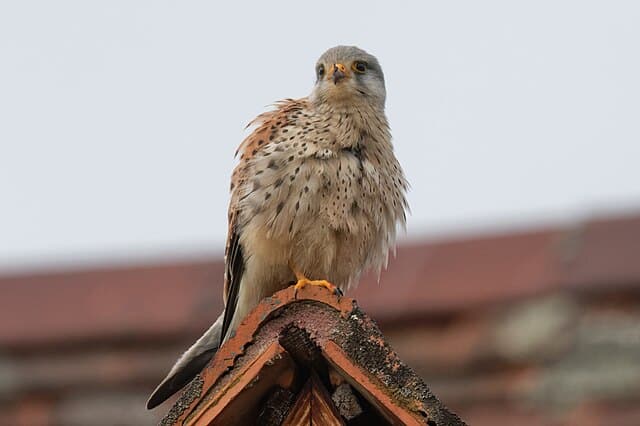
Fluffed-up male common kestrel on a roof in Auvergne, France. Credit: Wikimedia Commons/ Marie-Lan Taÿ Pamart
Size Comparison
Hawks and falcons differ in size. Hawks are the bigger birds, often stretching several inches longer than falcons. The adult red-tailed hawk is around 20 inches long, whereas the broad-winged Ferruginous hawk can reach an impressive 25 inches (from bill to tail).
On the other hand, falcons are generally smaller. The American kestrel (the smallest and most common falcon in North America) is only about 10 inches long, while the peregrine falcon measures around 17 inches.
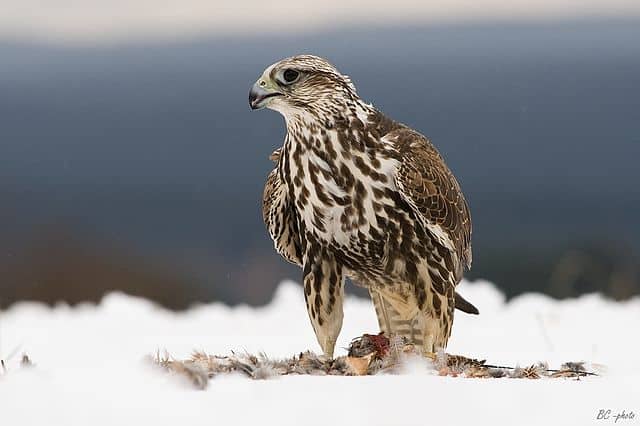
Molly the Brown Falcon Falco berigora, from Full Flight Conservation Centre Flemington, Victoria, taken at a raptor flight display in south-east Australia. Credit: Wikimedia Commons/ Benjamint444
Beak Structure
The beak shape is a major difference between hawks and falcons. Hawks have beaks that curve evenly from the base to the tip. Falcons have a unique feature: a sharp “tooth” near the tip of their beak, which is not found in hawks. This tooth allows falcons to sever their prey’s neck, delivering a quick kill.
Red-tailed hawk with wings outstretched in Central Park, Credit: Wikimedia Commons/ Rhododendrites
Wing Shape
One of the easiest ways to tell a hawk from a falcon is by the shape of their wings. Hawks have wings that are shorter and broader. Their rounded wingtips give them a smooth, stable glide. This makes hawks excellent at conserving energy while they scan the ground for prey.
Unlike hawks, falcons have long and narrow wings with pointed tips that cut through the air like knives. This wing design allows them to make sudden dives during hunting.
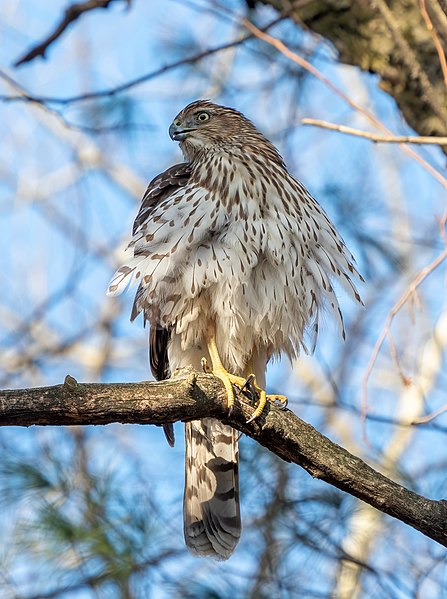
Juvenile cooper's hawk in Prospect Park, Credit: Wikimedia Commons/ Rhododendrites
Tail
Some hawks, like the red-tailed hawk, have broad and short tails. Other hawks, like Cooper’s hawk, have longer, more rounded tails. These longer tails are perfect for quick, sharp turns, especially when flying through forests and chasing prey in tight spaces.
In contrast, falcons have narrow and shorter tails. These tails help them fly very fast and make quick dives in open spaces.
Hawks and falcons have bodies perfectly suited to their different hunting patterns. Hawks are usually strong and sturdy, with muscular bodies and powerful legs. This build helps them catch and hold onto larger prey, using their strong legs and sharp talons to keep a firm grip on struggling animals.
The body of a falcon is designed for speed. Their streamlined shape and pointed wings help them move through the air quickly. While hawks use their strength to overpower prey, falcons rely on their speed to catch theirs.
A Brown Falcon in flight, Credit: Wikimedia Commons/ Gallpix
Speed
A big difference between hawks and falcons is their speed. A falcon is faster than a hawk. In fact, the peregrine falcon is the fastest bird on the planet. This falcon can reach up to 60 miles per hour on a regular flight and dive at an unbelievable 200 miles per hour.
Hawks take a slower, more energy-efficient approach while flying. They flap their wings leisurely and often glide in circles. Hawks usually fly at speeds under 40 mph, but when they dive, they can still reach up to 120 mph.
Hawks and falcons have different styles when it comes to catching and killing their prey. Hawks often hunt by soaring high and then swooping down to grab prey. They use their strong legs to hold onto their prey firmly and then use their talons to tear it apart.
Falcons catch their prey with high-speed chases and rapid dives. The peregrine falcon, for example, often captures its prey in the air. It might dismember it and eat it while flying or land in a safe spot to eat.
Falcons use a sharp tooth (tomial tooth) on the side of their beaks to sever the prey’s neck.
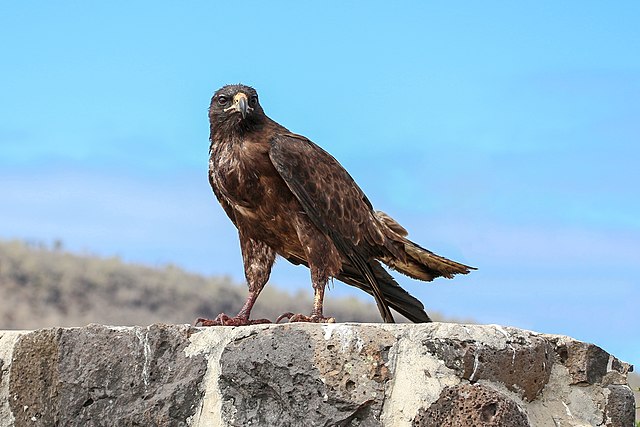
Galapagos hawk (Buteo galapagoensis) in Santa Fe Island, Galápagos National Park, Ecuador. Credit: Wikimedia Commons/ Bernard Gagnon
Nesting Habits
Hawks usually build their nests high up in tall trees. They use big sticks, twigs, bark, and their own feathers to make a nest. These nests are often reused year after year, and being high up keeps them safe from predators.
Falcons prefer to nest on ledges of cliffs but are also great at adapting to urban environments. They often use the ledges of tall buildings and bridges. The American kestrel can even be found making nests in artificial cavities like manmade nest boxes.
So, if you see a nest high up in a big tree, it is likely a hawk’s work. If it’s on a building ledge or cliff, it’s probably made by a falcon.