Are Narwhals Endangered?

With the ongoing climate crisis, are these native arctic mammals safe?

Table of Contents

Are the narwhals endangered?
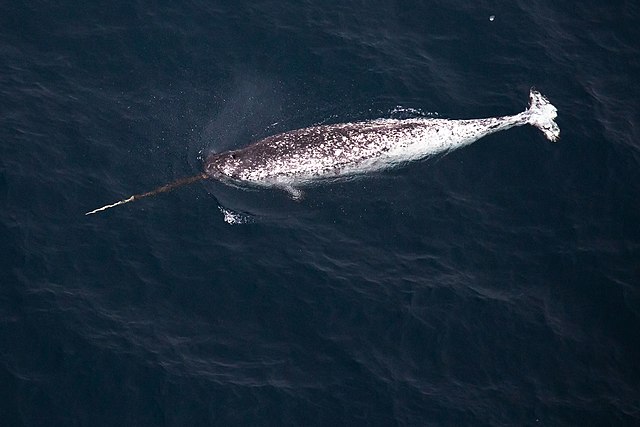
Are the narwhals endangered? Credit: Wikimedia/Dr. Kristin Laidre, Polar Science Center, UW NOAA/OAR/OER

Have you ever heard of a creature so intriguing that you thought you could have only dreamt it up? If you haven’t already, you’re about to. Meet the unicorns of the sea—the narwhals! From their mysterious existence to their very survival, these arctic giants have captured the interest of scientists for years!

Meet the narwhals

Meet the narwhals
Meet the narwhals, Credit: Wikimedia/пресс-служба ПАО "Газпром нефть"

Narwhals, or Monodon monoceros, are one of the top predators in the freezing arctic waters. They thrive in the cold because they’re made up of nearly 50% body fat. For context, their relatives only average about 30%! Who are these relatives, you ask? Narwhals are part of a group called porpoises, closely related to belugas, orcas, and even bottlenose dolphins.


Narwhals really are the stuff of legends—primarily because we don’t really know too much about them! These whales are famously tricky to study. They’re almost impossible to see in their native habitat since they’re usually off somewhere deep underwater.

Narwhals travel in groups
Narwhals travel in groups, Credit: Wikimedia/Dr. Kristin Laidre, Polar Science Center, UW NOAA/OAR/OER

So here’s what we do know about them. Narwhals are fully migratory mammals with populations across Greenland, Canada, and Russia. In the summer, narwhals travel to the ice-free fjords between Canada and Greenland. When it’s cold in the winter, narwhals go through another migration to deeper, off-shore habitats.


Even though they are constantly moving, they display a strong fidelity to their summering grounds. They’re built on a steady diet of halibut and arctic and polar cod!


Boasting a weight of 1.5 tons on average, narwhals make for a unique appearance in the northernmost oceans. They’re known for their beautiful twisted tusk—the “unicorn horn,” if you will!

The skull of a narwhal showing its tusk
The skull of a narwhal showing its tusk, Credit: Wikimedia/Marco Vinci

Jutting out of its head is a long, twisted tooth! Predominantly found in males, this tusk can grow up to 10 feet and is filled with nerve endings! There are debates across the scientific community on what they’re really there for and how they’ve evolved. One theory is that males use the tusks to attract and compete for mates. Another speculates that the sensitive tusks are used to sense changes in water quality that can lead to holes in ocean ice. Yet another says that the tusk may be used to strike fish during hunting !


These unique creatures are crucial to the Arctic ecosystem. For this reason, a lot of effort is put into determining if the narwhals are endangered.

Are the narwhals endangered?

Before we get to the question, it might help to know what we’re talking about. What does it mean to be endangered in the first place?

The global population of narwhals have a status of least concern
The global population of narwhals have a status of least concern, Credit: Wikimedia/пресс-служба ПАО "Газпром нефть"

When we say a species is endangered, what we really mean is that it’s at high risk of extinction . Until 2008, there wasn’t enough information on narwhals to make a decision! Now, after registering more than 170,000 narwhals worldwide, we know that the species is considered to be of “least concern” by the International Union for Conservation of Nature (IUCN). This means that they aren’t really endangered!


While the global population remains at “least concern” status, we aren’t sure about all the subpopulations of narwhals. The different subpopulations all contain different numbers of individuals, and, based on where they’re located, they experience different levels of threats.


While most populations of narwhals seem to either be stable or increasing, if we aren’t too careful with our actions, these numbers can quickly change.

The impact of climate change

Scientists found that narwhals are one of the three most sensitive arctic mammals to climate change . This is due to their habitat choice, site fidelity, and feeding patterns.

The fluke of a narwhal as it dives
The fluke of a narwhal as it dives, Credit: Wikimedia/Ansgar Walk

In the native habitats of narwhals, we find sea ice—a platform for narwhals to rest and mate. These ice platforms also act as havens against predators like orcas. With quick changes in weather conditions, the formation of sea ice can be disrupted, leaving narwhals vulnerable to a range of problems like ice entrapments and attacks from their predators. On top of that, temperature changes can mean a shift in the kind of prey available to them.

The impact of human activities

Human activities can also pose a real threat to narwhal populations
Human activities can also pose a real threat to narwhal populations, Credit: Wikimedia/Paul Gierszewski

Although they aren’t hunted like they used to be in the past, other human activities pose a real threat to narwhals. Areas that are explored for oil usually experience high levels of seismic surveys , drillings, and ice breaking. These activities also result in the accumulation of pollutants which can impact the health and reproductive abilities of a range of arctic animals, including our one-tusked friends.


Flesch Kincaid Grade Level: 8


Flesch Kincaid Reading Ease: 62.7

Glossary

Biodiversity – The variety of life forms on the planet


Climate change – The phenomenon of large shifts in temperature and weather patterns


Extinction – A species dies out and no longer exists


Fidelity – (In context) Tendency to return to the same near shore of their summering and wintering grounds


Habitat – The environment of an organism where it lives, grows, and survives


Pollutants – Substances that enter the environment and cause undesired effects


Subpopulation – a part of the whole population that shares some similarity


Seismic surveys – using sound waves to explore and measure what is under the earth’s surface

 Randall Reeves (IUCN SSC Cetacean Specialist Group), Kristin Laidre (Polar Science Center, A. of W., & Lloyd Lowry (Univeristy of Alaska Fairbanks). (2017, July 3). The IUCN Red List of Threatened Species. IUCN Red List of Threatened Species. https://www.iucnredlist.org/species/13704/50367651


Heide-Jørgensen, M. P., Nielsen, N. H., Hansen, R. G., Schmidt, H. C., Blackwell, S. B., & Jørgensen, O. A. (2015). The predictable narwhal: Satellite tracking shows behavioural similarities between isolated subpopulations. Journal of Zoology, 297(1), 54–65. https://doi.org/10.1111/jzo.12257


Magazine, S., & Tucker, A. (n.d.). In Search of the Mysterious Narwhal. Smithsonian Magazine. Retrieved May 21, 2023, from https://www.smithsonianmag.com/science-nature/in-search-of-the-mysterious-narwhal-124904726/


Narwhal, facts and photos. (2010, November 11). Animals. https://www.nationalgeographic.com/animals/mammals/facts/narwhal


Pedersen, L. (n.d.). Narwhals’ hungry summers as climate warms. Retrieved May 25, 2023, from https://phys.org/news/2023-02-narwhals-climate-vulnerable-winter-crucial-survival.html

Contributors

  • Swarna Ramakrishnan has been fascinated by the natural world ever since she was a young girl! She graduated from Azim Premji University, India with a Bachelor’s in Biology and a minor in applied mathematics. During her research, she trekked through the beautiful forests of the Western Ghats in India to answer questions about stomata and climate change. Currently, she is pursuing her Master’s in Biophysics from Ulm University, Germany. Swarna writes for Smore magazine to spread stories of nature in hopes of inspiring the next generation of scientists!

    View all posts

Copyright @smorescience. All rights reserved. Do not copy, cite, publish, or distribute this content without permission.


Join 20,000+ parents and educators
To get the FREE science newsletter in your inbox!