What happens in the brain when we look at art?
Art is one of the oldest human endeavors. From ancient maps to sculptures, engravings, and cave paintings, it seems that creating art is a uniquely human practice. If you doodle, write, or do arts and crafts, you might have experienced the peace that can come with creating. It might even feel calming, and neuroscientists agree. Art pushes us to use our imagination. Our brains are primed to recognize patterns and predict what might happen next. This is a skill that’s allowed humans to succeed.
Our brains use “information to make predictions about what we might do next—and more importantly what we need to do next to survive and thrive,” said professor Girija Kaimal for NPR. Her work at Drexel university tries to understand how art therapy can aid people suffering from trauma, from cancer survivors to military veterans.
Every process of creating art flexes the brain’s decision-making muscles. What colors should you use? What angles need to be created? The brain predicts what the final picture might look like each time the artist makes a choice.
And it’s not just creating art that soothes and grows the brain. Viewing art has a profound impact on the brain too. “Looking at art is good for your brain”, says independent brain scientist Erik Scherder for the online magazine of the Dutch Museum Maritshuis.
Examining art kicks off a chain reaction in many centers of the brain. The eyes send signals to the brain, which breaks a complex image down into colors, shapes, and movements. If you find the art beautiful or meaningful, the emotion and reward centers release feel-good chemicals. This can make the viewer feel happy or satisfied. The memory system connects the art to your own past experiences, suggesting what the artwork’s meaning could be. The thinking center decides what you like or don’t like. The brain even seeks out connection between the artist and viewer, allowing us to relate to the artist’s emotions and visions. That’s why art can make you feel happy, sad, inspired, or even excited to create your own!

Neuroscientists also think that looking at real paintings can make the brain react even more powerfully than looking at a poster copy. When a person sees art in real life, it’s in all three dimensions. This allows them to pick up on details like brushstrokes, depth and texture, all of which connect one more deeply to the artist. The environment of being in a museum, including lighting, scale, and even brief relationships between visitors, makes it feel more immersive. Scientists think that real artwork can create a response that’s ten times stronger than a poster! Dutch scientists examined this phenomenon with a focus on one painting: “The Girl with a Pearl Earring.”
What is the history of the “Girl with a Pearl Earring”?
In the 17th Century, artists around the Netherlands created what would become known as the Dutch Golden Age of Painting. It was an explosion of creativity, capturing the beauty of everything from dramatic seascapes and stunning portraits to everyday life. Maestros like Rembrandt, Clara Peeters, and Frans Hals mastered shadow, perspective, and detail. Even the most ordinary moments came alive. Johannes Vermeer was one of these masters, and “Girl with a Pearl Earring” is arguably his most famous work. He created only thirty-six works in his lifetime, each a masterpiece of detail.
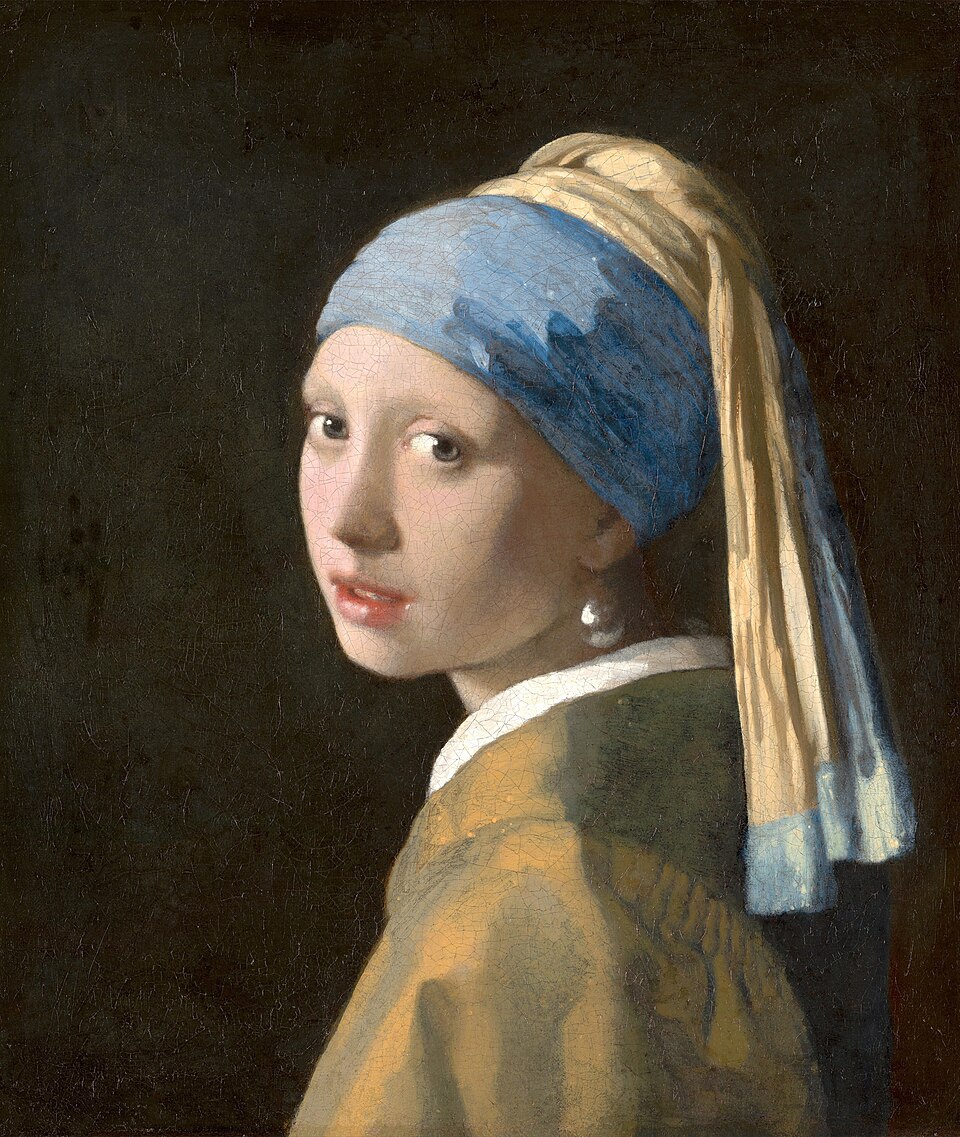
Till this day, historians don’t know who the mysterious figure in the painting is. An unknown but real woman, Vermeer’s daughter, or even a Biblical figure? It was most likely painted in 1665, though very little is known about its history until it was purchased by a collector in 1881. Since being donated to the Mauritshuis museum in 1902, the painting has travelled through many countries. It’s now considered one of the 10 most famous paintings in the world.
Why is this painting so special?
When Vermeer painted it in 1665, it’s unlikely he knew the neuroscience behind what makes the painting so captivating. He followed his artist’s instincts, making decisions and choices that he felt would work. Clearly, his instincts rang true—hundreds of thousands of people visit her every year.
Dutch researchers based in The Hague used an EEG to understand visitors’ responses. An EEG consists of many electrodes, which scientists attach all over a participant’s head to look at the electrical activity inside the brain. The frenzy of brain activity was much greater when participants looked at the real painting, versus a poster.

The subject of the poster has a tremendous effect, too. “You look at that pearl, you look at those eyes, you look at that mouth. A kind of triangle forms and it just grabs your attention,” commented neuroscientist Erik Scherder.
Humans are constantly seeking connection with other humans. A portrait has a similar, profound effect. A viewer can’t help but try to understand: what is this girl feeling? What is she thinking? Is that a slight smile? Evolutionarily, these types of thoughts are how we tried to understand whether a fellow human would be a safe person to be around.
Vermeer perhaps knew this intuitively, and exploited it to create what researchers are calling a Sustained Attention Loop. Participants in the study consistently looked at her eyes, then mouth, then the earring, and back again, several times in a row. Carefully placed cameras tracked these eye movements. The visual triangle entraps the viewers, encouraging them to look at the painting multiple times, and more deeply each time. The EEG also suggested that the painting wakes up a part of the brain responsible for consciousness, self-reflection, and personal life experiences.
Centuries ago, Vermeer was able to create a painting that was not only visually fascinating, but also invited deep reflection. Researchers today are just beginning to use neuroscience tools to understand just how clever artists of the past could be.
https://www.tandfonline.com/doi/abs/10.1080/07421656.2019.1667670?journalCode=uart20
https://www.kunstpuntgroningen.nl/en/blog/dit-gebeurt-er-in-je-brein-als-je-naar-kunst-kijkt/
https://www.bbc.com/culture/article/20140701-who-was-the-mysterious-girl
https://edition.cnn.com/style/article/most-famous-paintings/index.html
Copyright @smorescience. All rights reserved. Do not copy, cite, publish, or distribute this content without permission.
SUBSCRIBE TO OUR NEWSLETTER
.......... ..........Subscribe to our mailing list to get updates to your email inbox.
Monthly Newsletter