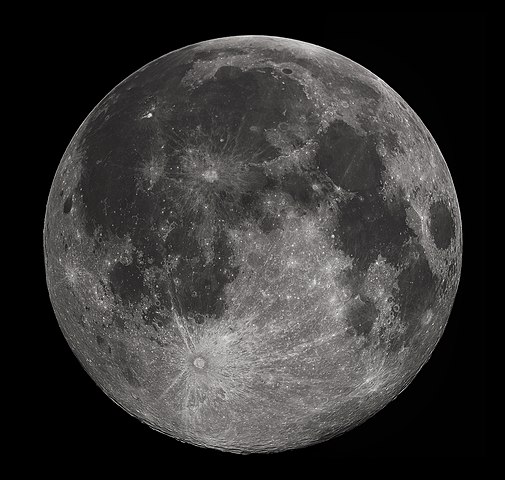
The Moon has been at the base of so many myths and beliefs. Even after landing on the surface of the moon, we hardly know about the Moon. The color of the moon, that itself is a mystery to us. We usually consider the color of the Moon to be white, but is the Moon white?
The actual color of the moon
(Drumrolls) The Moon isn’t genuinely white. If you were fortunate enough to step foot on the lunar surface, you’d observe a landscape that is predominantly gray, with tinges of tan and brown here and there.
The Moon’s surface is coated with a layer of regolith – a fine, powdery dust formed from minute fragments of rock and mineral. This regolith primarily comprises a type of rock known as basalt , which is naturally gray in color.
There are areas that have a plae blue color. Highlands have a pink or yellow tinge, something thay comes due to different amount of iron and titanium deposits present on the soil of moon.
Moon image, Credit: Wikimedia/Gregory H. Revera
The white appearance of the moon
So why does this gray body appear white when viewed from Earth? The answer lies in the interplay between our vision, the Earth’s atmosphere, and the Moon’s albedo – the measure of how much light that hits a surface is reflected back.
When the sun’s rays reach the Moon, the lunar regolith reflects the incoming light. Importantly, it doesn’t favor any particular color but reflects all colors of light more or less equally. Consequently, the light reflected back to us is a combination of all colors. Our brain, receiving this light, processes it as white.
Light spectrum, Credit: Wikimedia/Denelson83
The role of earth's atmosphere
At this point, we should introduce another significant factor influencing the Moon’s appearance – our Earth’s atmosphere. The atmosphere around us is more than just a layer of air. It acts as a prismatic lens that can scatter incoming sunlight. This scattering spreads the light in different directions, which can often intensify the whiteness of the Moon.
Moreover, when the Moon is closer to the horizon, its light needs to pass through a thicker slice of the Earth’s atmosphere. This atmospheric voyage can sometimes impart a reddish or yellowish hue to the Moon. If you’ve ever noticed a reddish or orange Sun during a sunrise or sunset, you’ve witnessed a similar effect – a beautiful manifestation of light’s interaction with the Earth’s atmosphere.
The combined effect of the Sun’s light, the Moon’s reflective properties, our perception of color, and the Earth’s atmosphere all contribute to the Moon’s ghostly white appearance in the night sky.
What we perceive is sometimes deceptive. The color of the moon is one bright example of this. Not as dull or bland, is it?
Moon near horizon, Credit: Wikimedia/Murray Foubister
Glossary
Regolith: A layer of loose, heterogeneous material covering solid rock. It includes dust, soil, broken rock, and other related materials and is present on Earth, the Moon, Mars, some asteroids, and other terrestrial planets and moons.
Basalt: A type of rock that forms from the rapid cooling of lava at the Earth’s surface.
Albedo: The measure of the diffusive reflection of solar radiation out of the total solar radiation and measured on a scale from 0, corresponding to a black body that absorbs all incident radiation, to 1, corresponding to a body that reflects all incident radiation.
Scattering: A general physical process where some forms of radiation, such as light, sound, or moving particles, are forced to deviate from a straight trajectory by one or more paths due to localized non-uniformities in the medium through which they pass.