Have you ever tried to make a bubble bath in plain water? That would be just a bubble-free bath! In order to make bubbles in a liquid, you have to be able to “stretch” its surface to trap a gas (like air) inside. When you blow up a balloon, you have to blow air hard enough to stretch the rubber. Water alone is too strong to stretch, because of what we call surface tension.
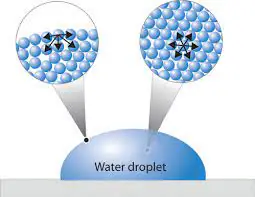
Water molecules tend to stick together, especially at the surface. Try this: Fill up a bowl with water, let it settle until it is flat, and then gently place a paperclip on the surface. It floats!
Water molecules tend to stick together, especially at the surface. (image credit: https://chem.libretexts.org/)
Fill up a bowl with water, let it settle until it is flat, and then gently place a paperclip on the surface. It floats! (image credit: usgs.gov)
How does soap affect the water's surface tension ?
Back to our bubble bath. If you want bubbles, you add soap. Soap is a surfactant: a molecular structure that looks like a tadpole, with a head that likes water and a tail that doesn’t. When you add soap to water, the heads will stick in the water at the surface and the tails will point out. This reduces the surface tension because they are going between the water molecules. Add a drop of soap to your bowl of water and try the paper clip again. It will immediately sink! Now if you want bubbles, take a whisk, and stir. Stirring introduces air in the soapy solution. Because the surface tension is weaker, the air gets trapped in bubbles. And thanks to the soap, you will get cleaner too.
When you add soap to water, the heads will stick in the water at the surface and the tails will point out. This reduces the surface tension because they are going between the water molecules. (image credit http://www.csun.edu/)