The computer is a mathematical device by definition. The creation of computers has thus been driven through generations, each doing better than its predecessor. Our lives are driven by computers. Whether it’s your smartphone, laptop, or even the microwave in your kitchen, you’re interacting with a computer. But who first invented the computer? The answer is quite a fascinating journey through history.
Charles Babbage: The father of computing
Charles Babbage, a British mathematician, is often called the ‘Father of Computing.’ He dreamt of creating a machine that could calculate complex mathematics. Babbage wanted to eliminate the errors that human computers—people who calculated mathematical tables —often made.
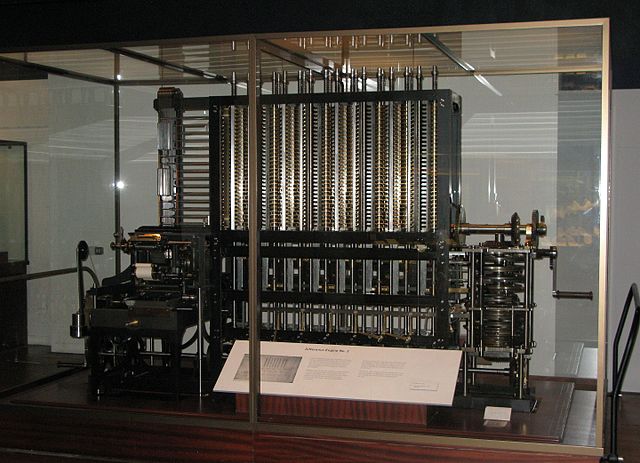
Charles Babbage's Difference Engine, Credit: Wikimedia/User:geni
The analytical engine
His dream led to the design of the Analytical Engine , a general-purpose computing machine . The Analytical Engine was a mechanical device that was intended to automatically perform mathematical operations. It used punch cards , similar to a player piano, to input data and instructions.
Babbage’s challenges
Despite Babbage’s brilliant idea, he faced many challenges in bringing his machine to life. The technology of his time was not advanced enough to build the complex parts the Analytical Engine required. Babbage passed away without seeing his dream become a reality.
Ada Lovelace: The world's first programmer
While Babbage never built his machine, his designs did inspire another key figure in the history of computers, Ada Lovelace.
Ada Lovelace, Credit: Wikimedia/Science Museum Group
Lovelace's contributions
Lovelace was an English mathematician who worked with Babbage on the Analytical Engine. She saw further than Babbage into the potential of the Engine. Lovelace wrote what are now recognized as the world’s first computer programs, hence she is often referred to as the first computer programmer .
The Harvard Mark I: A leap towards modern computers
Fast forward to the 20th century, and we see another major leap in computer technology. This is when the Harvard Mark I was born.
IBM and the Mark I
The Mark I was the first programmable computer that was not a calculator. It was built by IBM for Harvard University during World War II. This machine could store data, follow instructions, and even print results – all the basics of what we understand a computer to do today.
Alan Turing and the turing machine: A conceptual leap
The final character in our journey is Alan Turing, a British mathematician and logician .
Turing's impact
Turing is known for his work in creating the theoretical foundation for modern computers. He proposed a simple device, the Turing machine , that could simulate the logic of any computer algorithm . His work laid the foundation for the development of the digital computer .
Understanding the computer's humble origins
So, who first invented the computer? The answer isn’t straightforward. Instead of placing a name, we should recognize the tributes of every pioneer who tried to enhance computer technology. Babbage, Lovelace, the creators of Harvard Mark I, and Turing all played crucial roles in the creation of the computer. Their combined efforts, over many years, have resulted in the computers we rely on every day. As we use our computers, let’s not forget the humble beginnings that forged the digital age as we see it.
Glossary
Algorithm: A step-by-step process or set of rules to be followed in calculations or other problem-solving operations, especially by a computer.
Analytical Engine: An early mechanical general-purpose computer designed by Charles Babbage.
Computer Programmer: A person who writes computer software.
Digital Computer: A computer that performs calculations and logical operations with quantities represented as digits, usually in the binary number system.
General-Purpose Computing Machine: A machine designed to perform a variety of different tasks, rather than a single specific one.
Logician: A person whose topic of scholarly study is logic.
Mechanical Device: A device that uses mechanical movement to perform work.
Punch Cards: A piece of stiff paper that can be used to contain digital data represented by the presence or absence of holes in predefined positions.
Turing Machine: A hypothetical computing device invented by Alan Turing, which encapsulates the fundamental logical principles of digital computers.
Mathematical Tables: Tables of values of mathematical functions.