Imagine strolling through a dense forest, the air crisp and the leaves rustling underfoot when suddenly, a flash of white catches your eye. It’s not a ghost or a figment of your imagination but a rare and stunning white deer. These creatures are not just the stuff of fairy tales but a fascinating natural phenomenon. In this article, we will explore everything about these mystical animals – from their genetics to their cultural significance.
White deer can be found in various regions, but they’re not bound to any specific habitat. They thrive in forests, grasslands, and even in urban areas, adapting just like any other deer. However, their rarity makes each sighting a memorable event.
What makes a deer white? It's not always what you think
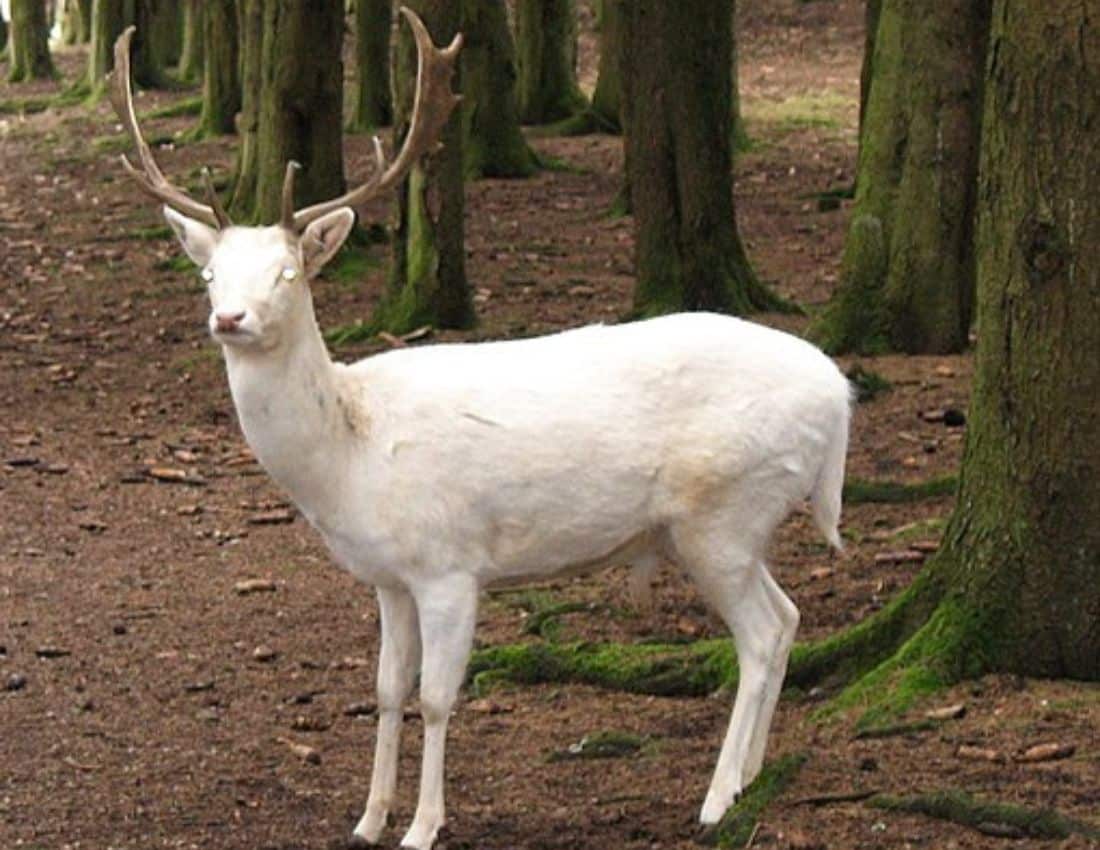
Let’s tackle a common misconception. Not all white deer are albinos. While albino deer do exist, many white deer are actually leucistic.
Albino Deer
– Albinism in deer, as in other animals, is caused by a mutation in genes that are responsible for the production of melanin, the pigment that colors skin, hair, and eyes. This mutation can occur in the TYR gene, which is critical for melanin synthesis. – Albino deer are known for their completely white coats and, most notably, their red or pink eyes. This eye color results from the lack of pigment in the iris, revealing the underlying blood vessels. – True albinism is rare in deer. It’s estimated that the occurrence of albinism in white-tailed deer is about 1 in 20,000 to 30,000.
Albino Chital, Credit: Wikimedia/Rsbandi
Leucistic Deer
– Leucism , unlike albinism, involves a partial loss of pigmentation, which may not affect all parts of the body equally. The exact genetic cause can vary, but it generally results from mutations affecting different genes than those responsible for albinism. These genes impact the distribution or deposition of melanin rather than its production. – Leucistic deer typically have a white or patchy coat but retain normal coloring in their eyes, hooves, and skin. This is because the melanin production in these areas remains unaffected. – Leucistic deer are less common than normal-colored deer but more frequent than albinos.
White deer are a rare sight, indeed. The genetic mutations that cause albinism or leucism are not common, and this rarity can make these deer more vulnerable in the wild. They lack the natural camouflage that their brown counterparts have, making them stand out to predators like a sore thumb.
A one year old leucistic Mule deer female, Credit: Wikimedia/Joe McDaniel
The future of white deer: Hope and uncertainty
Throughout history, white deer have held a special place in mythology and folklore. In many cultures, they’re seen as mystical creatures, often symbolizing purity, renewal, or spiritual enlightenment. Native American tribes, for instance, have revered them for centuries, seeing them as messengers from the spirit world.
Their standout coat makes them a target not just for predators but also for hunters. Moreover, their rarity can sometimes lead to health issues due to inbreeding , especially in isolated populations where the gene pool is limited.
With ongoing habitat loss and climate change, their survival, like many other wildlife species, hangs in the balance. But with increased awareness and conservation efforts, there’s hope that these mystical creatures will continue to grace our forests.
Conservationists and wildlife enthusiasts have long been advocating for the protection of white deer. In some areas, hunting laws have been adjusted to safeguard these rare animals. By promoting genetic diversity and protecting their habitats, we can help ensure that future generations get to witness these majestic creatures.
In conclusion, white deer are more than just a rare sight; they’re a symbol of nature’s endless wonders. Whether leucistic or albino, each white deer is a unique treasure, a living legend that continues to captivate and inspire us. As we strive to protect and understand them, they remind us of the magic that still exists in the natural world.
Glossary
Albinism: A genetic condition marked by the complete absence of pigmentation in the skin, hair, and eyes.
Leucism: A partial loss of pigmentation, which causes white, pale, or patchy coloration of the skin, hair, or feathers, but not the eyes.
Genetic Mutation: A change in the DNA sequence that makes up a gene, resulting in a variation that can be passed on to offspring.
Inbreeding: Breeding from closely related individuals, especially over many generations, leading to a reduced genetic diversity.
Conservation: The protection and preservation of the natural environment and wildlife.
Habitat: The natural home or environment of an animal, plant, or other organism.