“What is the first marker of civilization?” anthropologist Margaret Mead asked a class of students, according to a commonly shared story (which has wide resonance even though it may not be a true quote). The students would answer agriculture, irrigation, or transportation.
According to the anecdote, the answer was a healed broken bone.
It might be a surprising response. How can a healed bone signify more than building or creating something?
A healed broken bone is the sign of care. It’s a sign that another human is being provided for, and given time to heal. In 2024, scientists found an ancient skeleton with a healed hip fracture. That kind of injury might have even taken a year to heal! Protection and care to provide time to heal is just one of the many forms of early human medicine. There are many more.
The first forms of medicines probably came from trial and error. Early humans experimented with herbs, fruits, flowers, and even mushrooms. Communities would keep track of what worked and didn’t work, perhaps through stories and folk tales. Very little of this early knowledge is well preserved. Historians have to make educated guesses. There’s some evidence that ancient Egyptians, Mesopotamian, and Chinese cultures relied on herbal remedies.
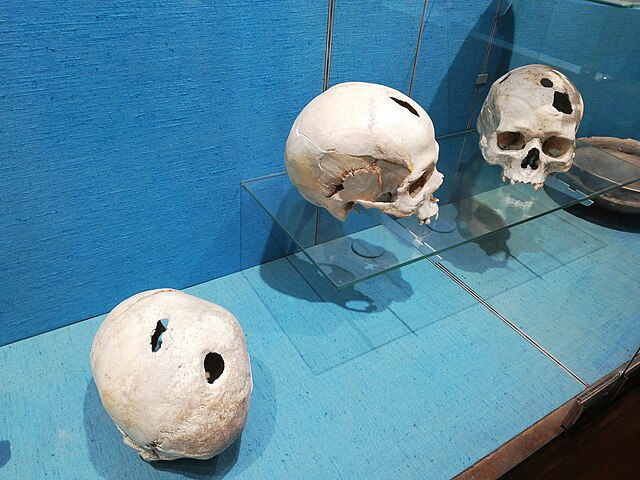
Religion and spirituality also played an important role in ancient human medicine. It’s possible that humans thought serious diseases were of supernatural origin: maybe a spell cast by an enemy, a curse from an offended god, or a visit by an evil demon. The treatment could be a counterspell, incantation, or herb. One particularly strange method involved making a small hole in the skull, with the intention that it would allow the disease to “escape” the body. Prehistoric skulls with these characteristic holes have been found in Britain, France, other parts of Europe, and in Peru. Some of these skulls show healing after the injury. This means the patients could have survived for years after the holes were made.
Three prehistoric skulls with small holes drilled into them , Credit; Wikipedia/Wisi eu
Medicine has come a long way, evolving beyond herbs and potions to pills with exact dosages and complex surgical procedures. What’s particularly interesting is that even ancient Greeks may have unlocked the secrets of antibiotics and fought off disease.
How do antibiotics work?
For most of human history, a cut, burn, fever, or cold could mean a death sentence. Bacterial infections were very often lethal. Vaccines and antibiotics have done a lot to change that.
Antibiotics are medicines that treat bacterial infections. Some antibiotics kill bacteria directly, eliminating an infection. Some slow down the bacterial growth instead, which makes it easier for the body to fight the infection with its own natural processes. Antibiotics are used commonly to treat illnesses like pneumonia, urinary infections, and strep throat. You’ve likely taken them at some point in your life.
As fantastic as they are, antibiotics are not a human creation. We’ve merely found ways to package them into pills and make them effective for our bodies. Antibiotics are actually chemicals produced by bacteria or fungi. Unlike the human body, microscopic organisms don’t have an immune system to take down an infection. Instead, they secrete chemicals to kill other bacteria. Humans have isolated these chemicals to fight bacteria ourselves.
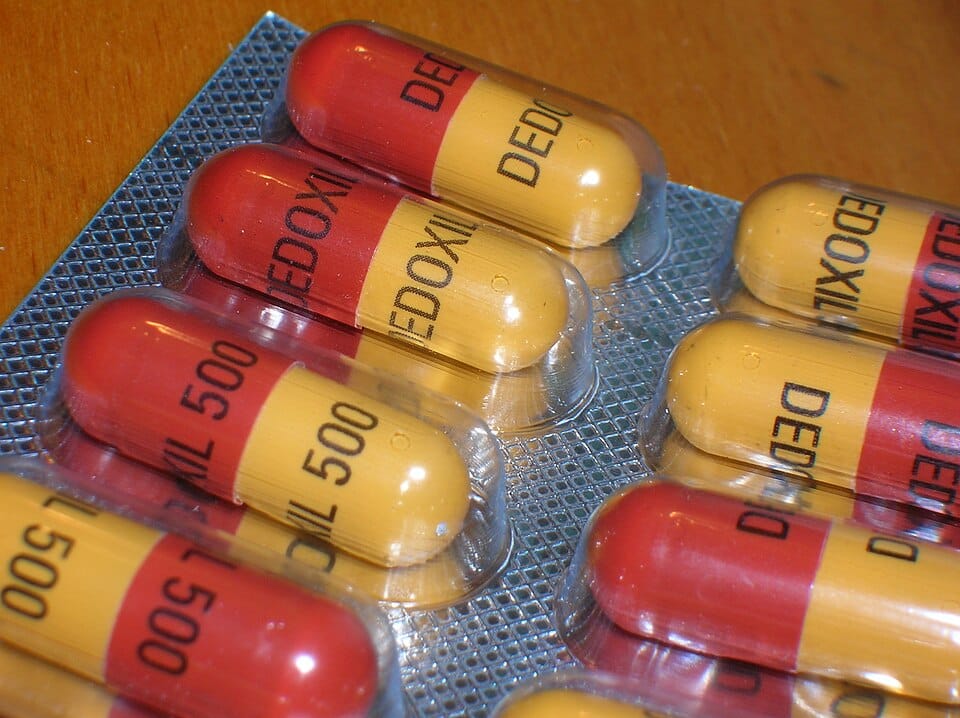
Antibiotics in capsules, similar to what a doctor might prescribe, Credit: Wikimedia/ Rob Brewer
At the same time, bacteria develop defenses against these chemicals, leading to infections we don’t have medicines to treat. Over time, antibiotics are leading to more complex diseases that doctors are struggling to treat. That’s why you should never take antibiotics for a viral infection.
Were there really antibiotics in Ancient Greece?
You now know that antibiotics are the human way of using chemicals produced by bacteria and molds. It doesn’t seem quite so impossible that ancient Egyptians were able to use them. But where were these antibiotics found? The answer lies in mud.
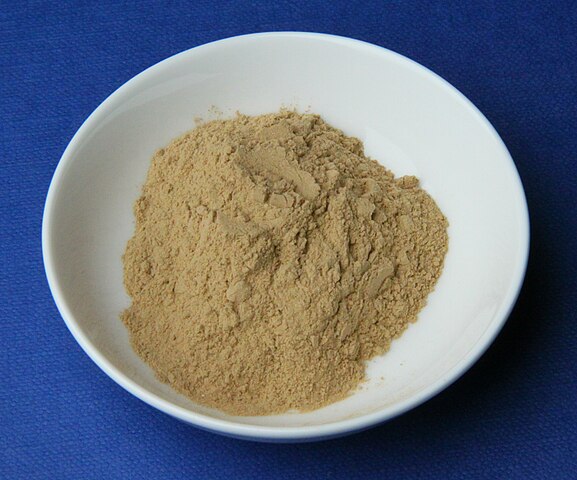
Lemnian Earth is a human remedy that’s been used for 2,500 years! It was first found on the Greek island of Lemnos. The mud had to be harvested with specific religious rituals. It was used for everything from snake bites to infection. Although it was occasionally made into a paste and applied on the body, it was usually ingested. It could be a powder, or mixed into wine or food.
Medicinal clay from a modern pharmaceutical company, Credit: Wikimedia/Morn the Gorn
When scientists tried to understand the potential of Lemnian Earth, they were faced with a problem. When they went back to Lemnos, collected mud, and tried to find its antibiotic properties, it didn’t seem to have any. Ancient samples from museums did.
The missing ingredient was fungus. Ancient samples of Lemnian Earth had a lot of one fungus named Penicillium purpurogenum. When they mixed the local samples of mud with this fungus, the magic began to happen again. All of a sudden, the mud had antibiotic properties.
But why were ancient Greeks eating this mud? When researchers fed this fungus-mud mixture to mice, they found out that their gut health improved significantly. This could improve heart and gut health, fight off disorders, and even serve as a treatment for lung infections. Although doctors in ancient Greece didn’t know exactly how the mud worked, they were able to see its positive effects. Without records, we don’t know how many people the mud healed. It’s an important reminder that traditional medicine might be more powerful than we think. Scientists can help unlock the secrets of these ancient remedies.