For decades, scientists have been trying to understand where humans originated and how we migrated across the world. Figuring out ancient history is a difficult task. Early humans weren’t exactly writing down their discoveries and movements. Most people didn’t even have an idea of what the entire world looked like until the late 1500s!
But in recent decades, an unlikely hero has emerged in the quest to map our ancient ancestry – mitochondrial DNA. Mitochondrial DNA allows scientists to trace maternal lineages back through time, converging on a single woman from whom all living humans descended. Meet “mitochondrial Eve” – not the first woman on Earth, but a key ancestor tying together the sprawling branches of our family tree.
This epic genetic quest has taken researchers from ancient fossil beds to remote modern tribes, unlocking groundbreaking discoveries about human migration and adaptation along the winding road of our history. Here we explore how mitochondria became a tiny genetic time machine carrying vital clues about our shared past and what it can tell us about the future of the family Homo sapiens.
How is the mitochondria inherited?
This unique, smaller DNA is what allows us to identify human lineages. New human embryos are formed when a sperm meets an egg. The sperm from one parent is little more than a ball of DNA with a tail. The egg is much more complex. It has its DNA and a ton of nutrients packed in for the long journey from embryo to baby. It also possesses many mitochondria to make the nutrients into energy. The mitochondria in the egg are more or less exact copies of the mother’s mitochondria. This same process also took place one generation ago. This means the mother’s mitochondria are an exact copy of her mother’s mitochondria! And her grandmothers, and great-grandmothers!
How do we know who “Mitochondrial eve” was?
Theoretically, you could follow this line of inheritance back if it was unbroken. Generation by generation, you could travel back in time until all lines converge on one woman. This woman would be the so-called “mitochondrial Eve” – the mother of all existing modern humans!
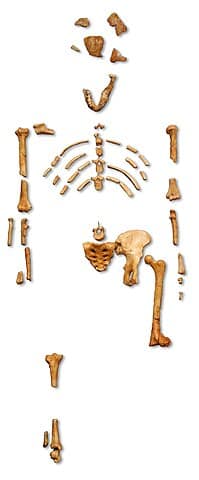
The fossil record is the first clue as to where mitochondrial Eve may have lived. Scientists compare “like to like” looking for similar fossils in different places across time. The Apidimia cave in Greece contains Homo sapiens fossils dating to around 210,000 years ago. These look similar to those found in Ethiopia around 250,000 years ago. This suggests that humans migrated from Ethiopia to Greece sometime in those 40,000 years.
We don’t yet have a complete picture of when humans migrated out of Africa, but it seems to have happened multiple times across different migratory routes. Scientists seem to agree that the Horn of Africa is the cradle of modern humanity. It’s most likely that mitochondrial Eve lived here.

Recent DNA evidence confirmed this. Humans from different geographic regions have been grouped into seven categories based on the similarities in their mitochondria. One group existed as is, staying in Africa. The other group left, traveling across the world, and gradually separated into six more lineages. Mitochondrial “eve” likely existed at the split between these two groups.
Although the idea of a single mother of all humanity is lovely, scientists stress that it’s more a philosophical idea than a real person who existed. Mitochondrial Eve was not the very first human being; rather, she was an ancestor to whom most modern humans can trace their lineage. Roger Bull, a senior scientist at the Canadian Museum of Nature, commented on this confusion for Smithsonian magazine. “The use of the term was a misinterpretation, given that the research was about the most recent common mitochondrial ancestor of all living humans … not about the first human woman ever,” said Bull.
Mitochondrial Eve likely wasn’t a real person. Still, the mitochondria remain a powerful tool to investigate the origins of species. Rebecca Cann, the lead author of the 1987 paper that put forth the theory, commented on the usefulness of mitochondrial DNA in an interview with PLOS Genetics. “I saw that [the mitochondria] was a potential tool to break open the question of human variation.
It’s not just humans that have a mitochondrial Eve! Recent research suggests that the Giant Squid had a mitochondrial Eve too. Sperm Whales have an “Eve” that lived about one hundred thousand years ago. Maternal lineages hold important answers about origins and places, and scientists are just beginning to find them.
Contributors