What makes up a human body? You might say cells of different types, like hair, skin, lungs, and liver. You’d be right; but there’s one huge category that you probably didn’t know about. There are as many bacterial cells in our bodies as human ones.
Bacteria sometimes gain an unfair reputation. Bacteria can cause diseases. However, the majority of bacteria living in the human body are good for us. Our bodies are like huge cities, with human cells making up the buildings and roads. Bacteria and other microorganisms are the hardworking citizens of this city. In the stomach, bacteria help break down food so the body can use it for energy. They also help protect you from harmful germs by acting like tiny bodyguards. Some bacteria are essential to the body’s operation, making vitamins and other important chemicals that keep you healthy. This combination of bacteria, viruses, and fungi that live in the body is known as the microbiome.
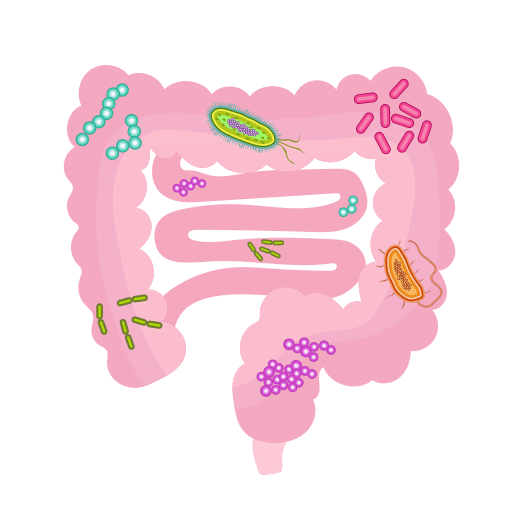
Much of the bacteria in our bodies lives in our guts, Credit: Wikimedia/DataBase Center for Life Science (DBCLS)
Microbiomes aren’t only found in the human body. Every living thing has its own microbiome. This includes trees, dogs, and cats. What makes this extra cool is that every living thing’s microbiome is unique, like a fingerprint. Scientists study the human microbiome because they think it plays a huge role in human health. If the microbiome is out of balance, we can get illnesses or stomachaches. By learning more about microbiomes, scientists can discover new ways to keep people and the planet healthy.
The microbiome even changes throughout our lifetimes depending on our age, where we live, and what we eat.
How does the food we eat affect our microbiome?
We are what we eat. Scientists have been trying to understand how the food we consume shapes our microbiomes. The search for answers has been on for more than a decade! The bacteria in the gut can help us digest our food. In return, the human body keeps these bacteria well fed. It also provides a comfortable and safe home. The bacteria rely on what we eat to survive.
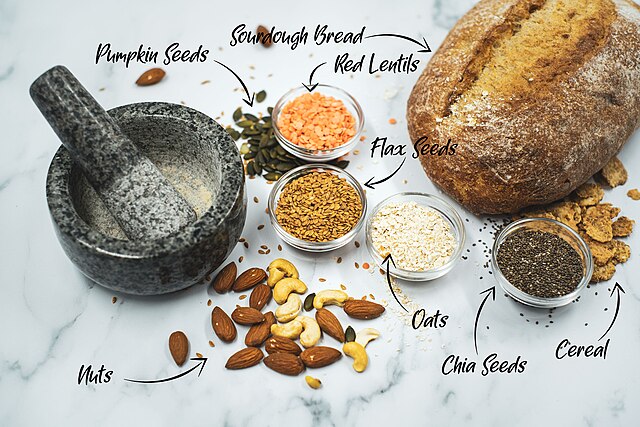
Fiber-rich foods like beans, vegetables, and fruits support the growth of helpful bacteria. The human body can’t actually digest fiber. Instead, fiber binds things together and helps food move through the gut regularly. A little fiber is also consumed by the gut bacteria. They break down fiber into different supernutrients which can boost your immunity and provide energy.
Common foods that are high in fiber, Credit; Wikimedia/formulatehealth
Processed foods with lots of sugar aren’t good for the gut bacteria. If a diet is mostly these foods, the diversity of the gut microbiome can reduce over time. One way to combat this is incorporating fermented foods into the diet. Foods like kimchi, yogurt, and kefir are fermented. Fermentation is a careful process that cultivates specific microbes. This means fermented foods have special fungi and bacteria growing on them. Some of these microbes get digested on their way through our stomachs. Others pass through to our guts, where they improve the diversity of the microbiome.
Good bacteria and bad bacteria are constantly competing with each other to survive. Having lots of types of good bacteria, and making sure there’s enough of them, is vital. It can help protect your body against infections from bad bacteria that can cause food poisoning. It can also influence digestion, energy levels, your immune system, and even your mood.
How does coffee affect the microbiome?
Coffee is one of the most consumed beverages in the world. Over 2.25 billion cups are drunk every single day! Approximately half of all Americans drink coffee every day. Each coffee drinker has an average of 14 ounces (417 ml). That’s almost two whole cups of coffee! Coffee is also something of a daily ritual. Most people have it first thing in the morning, or with breakfast. Since coffee is an essential part of people’s diets, scientists set out to identify how coffee influences the microbiome.
A painting of a royal enjoying coffee, dated to the 18th Century, Credit: Wikipedia/Google Cultural Institute
Scientists examined over 150 foods and found that coffee was the most important one affecting gut bacteria. It was a massive study, with over 22,000 participants from across the U.S. and the U.K. This large number of participants means that the results they found aren’t likely to be random. Participants told scientists how much coffee they drink daily. They tried to find out if any type of bacteria was linked to people who drank a lot of coffee. Scientists found one bacteria which seemed to love coffee over all others: Lawsonibacter asaccharolyticus.
But how did they find that specific bacteria? Researchers had to follow the poop. Everything that enters our body has one ultimate destination. As poop passes through the gut, it collects all the bacteria inside along the way. Examining poop informs researchers what bacteria are most common inside the participants’ bodies. It also tells researchers how many types of microbes are inside people. All the people who consumed coffee had Lawsonibacter. People who drank more coffee also had more of this bacteria in their poop!
If poop from 22,000 people wasn’t enough proof, scientists took it one step further. They tried to grow Lawsonibacter with and without coffee. Scientists grow bacteria on petri dishes that are filled with bacteria food. The idea is to remove the bacteria from everything else that could affect its growth and look at one effect alone. They tried a couple of combinations of different amounts of coffee and bacteria food. Regardless of the amount of coffee, Lawsonibacter grew much faster in petri dishes with coffee.
Scientists aren’t quite sure what it is about coffee that helps this bacteria grow. They’re also not sure what effect this bacteria might have on the body. What is clear is that bacteria play an important role. They sit in between the food we consume and the health benefits we might get from this food. This means that a healthy diet needs to prioritize our microbiome. Fiber, lots of water, minimal sugary foods, and probiotics can help keep gut bacteria healthy.