What Do Sea Turtles Eat?

Sea turtle’s jaws play a role in their diet

There are seven living species of sea turtles in the world’s oceans. Each species swims, sleeps, and eats in a different watery habitat. What do these ocean-dwelling reptiles eat when they’re foraging for food? The jaw structure of each turtle is the major factor in their diet. To understand what they eat, we must look at each species in detail.

Table of Contents

Herbivorous Sea Turtles

Green Sea turtles (Chelonia mydas)

Green Sea Turtle grazing seagrass at Akumal Bay, Mexico
Green Sea Turtle grazing seagrass at Akumal Bay, Mexico, Credit: Wikimedia/P.Lindgren

Jaw features:  The green sea turtle has  serrated jaws that are fit for their herbivorous diets.


What they eat: Their specialized jaw allows them to graze on algae on rocks. As a hatchling (baby turtle), they are omnivores and become herbivores as they mature.

Carnivorous Sea Turtles

Loggerhead turtles (Caretta caretta)

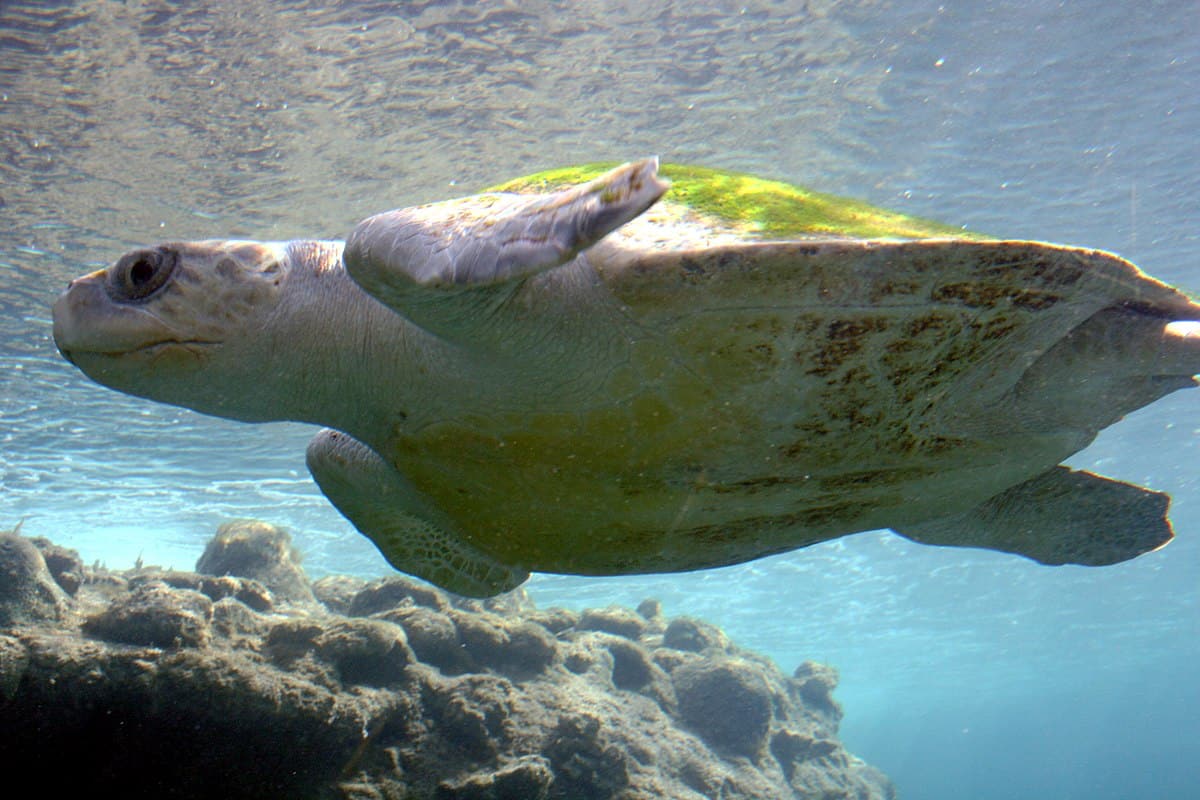
A young loggerhead sea turtle (Caretta caretta) near Panama City, Florida, Credit: Wikimedia/NOAA

Jaw Features: A loggerhead’s powerful jaws are intended to crush and chew prey.


What they eat: When living near the coast, these carnivorous turtles eat bottom dwellers such as whelks , mollusks , horseshoe crabs, and other species of crabs. Loggerheads (Caretta caretta) will eat plants, but not often. When they are living in the open ocean, they consume floating material. Unfortunately, they will eat floating plastic if they confuse it for food. This in turn will block their digestive system, and they can starve to death.

Leatherback turtles (Dermochelys coriacea)

Leatherback Turtles
Jaws of a leatherback are meant to grab and pierce their prey. Credit: Wikimedia Commons/Hannes Grobe/AWI

Jaw Features: Leatherback turtles have sharp-edged jaws and downward curving spines in their mouth and throat, which allows them to grab, pierce, and swallow prey.


What they eat: Considered to be gelatinivores (eating gelatinous prey), leatherbacks’ diets consist of jellyfish, tunicate , salp , and sea squirt , Leatherbacks are swift and can find and swallow a jellyfish in about 22 seconds. They will also eat seaweed and crustaceans.

Hawksbill turtles (Eretmochelys imbricata)

Hawksbill sea turtle
A sea hawk, with flippers instead of wings. Look at those hawk-like beaks! Credit: Wikimedia Commons/MinnieTheVet

Jaw features: The mouth of a hawksbill turtle is unusual as it is shaped like the beak of a hawk, hence its name. The beak-like mouth is formed perfectly for prodding into crevices of coral and rocks for a meal. They live off a diet of sea sponges that they find in the crevices.


What they eat:  The hawksbill turtle is crucial to the health and diversity of a coral reef, as it can eat 544 kg (1199.31 lbs.) of sponges a year. With the sponges removed, sunlight can reach the algae on the coral for photosynthesis. The algae provide energy for the coral polyps . Other favorite foods of the hawksbill are jellyfish, sea urchins, crustaceans, algae, and mollusks.

Flatback turtles (Natator depressus)

Flatback_hatchling
A flatback hatchling. They prey on soft-bodied animals. Credit: Wikimedia Commons/ Purpleturtle57

Jaw features: Their serrated jaws are suitable for preying on animals with soft, squishy bodies.


What they eat: Carnivorous flatback turtles search out and eat sea cucumbers, shrimp, jellyfish, and mollusks. They mainly eat soft-bodied prey that they find in shallow coastal waters.

Omnivorous Sea Turtles

Olive Ridley turtles (Lepidochelys olivacea)

An Olive Ridley turtle in action. Credit: Wikimedia Commons/ Thierry Caro

Jaw features: It is an omnivore with powerful jaws that can crush the exoskeleton of its food.


What they eat: The diet of the olive Ridley turtle consists of algae, fish, lobsters, crabs, and mollusks. The powerful jaws are also developed to rip up seaweed for food.

Kemp’s Ridley turtles

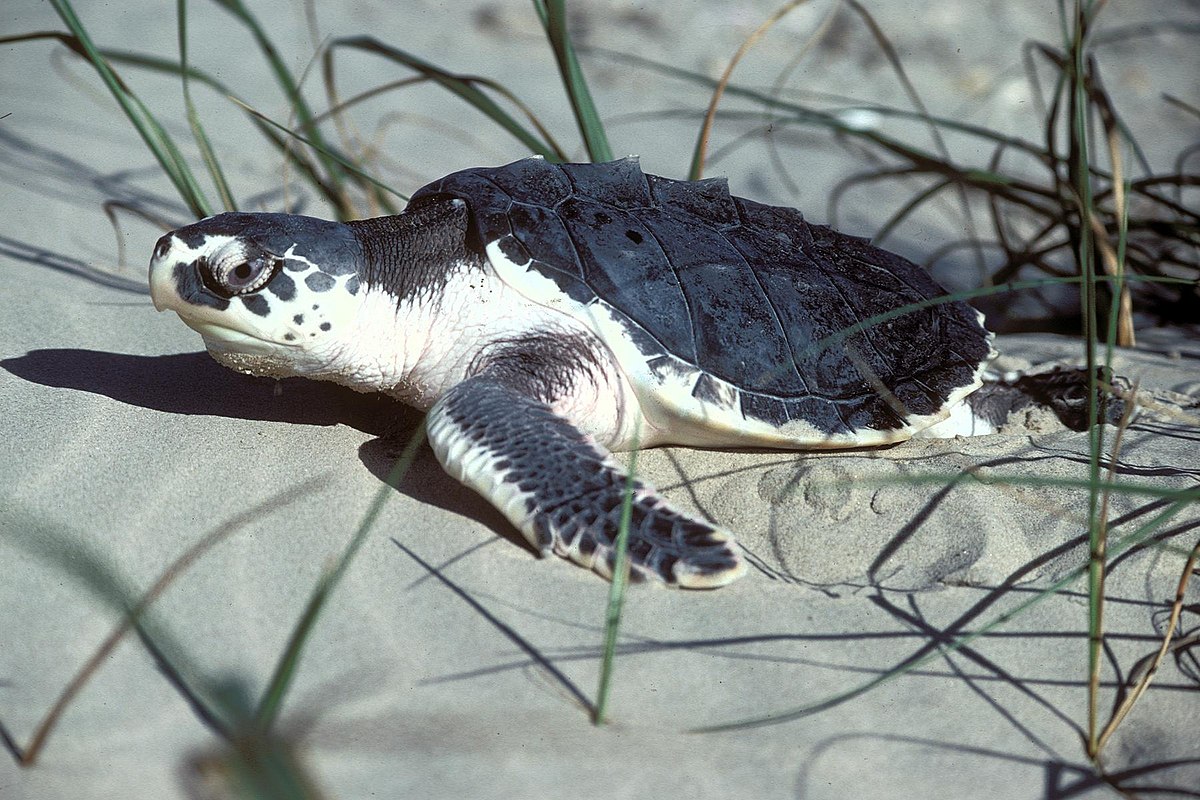
Kemp’s Ridley turtles have jaws that crush. Credit: Wikimedia Commons/USEPA Environmental-Protection-Agency

Jaw features:  Kemp’s Ridley turtles have hooked beaks and jaws that are suited for crushing.


What they eat: As a juvenile turtle, a Kemp’s Ridley turtle (Lepidochelys kempii) gets nourishment from small animals and algae. After it matures, it eats crabs in the coastal areas where it lives. It will eat bycatch that is discarded by the fishing industry .

Readability: 60.7


Flesch Kincaid Grade Level: 7.7

Glossary

Foraging: searching for wild food resources


Carnivorous: eats only meat or the flesh of animals


Whelks: snail-like creatures that are found in the sea near the shore. Whelks have hard shells and soft bodies


Mollusks: any of a large phylum (Mollusca) of invertebrate animals (such as snails, clams, or squids) with a soft unsegmented body usually enclosed in a calcareous shell


Serrated: having a notched edge or saw-like teeth, especially for cutting


Hatchling: to produce young; to break out from the egg


Gelatinivores: animals that eat gelatinous (consistency of jelly) prey


Tunicate: a marine invertebrate of a group which includes the sea squirts and salps. They have a rubbery or hard outer coat and two siphons to draw water into and out of the body.


Salp: a free-swimming marine invertebrate related to the sea squirts, with a transparent barrel-shaped body


Sea squirt: an organism shaped like a bag with holes through which water is sucked in and forced out, found attached to surfaces under the ocean


Omnivores: animals that eat both plants and animals


Herbivores: animals that eat only plants


Crevices: narrow cracks or gaps, especially in a rock


Coral polyps: tiny, soft-bodied organisms related to sea anemones and jellyfish. Reefs begin when a polyp attaches itself to a rock on the sea floor, then divides, or buds, into thousands of clones.


Bycatch: caught and discarded animals the fishing industry does not want, cannot sell, or are not allowed to keep. Bycatch can be fish, but also includes other animals such as dolphins, whales, sea turtles, and seabirds that become hooked or entangled in fishing gear.


Algae: plant-like organisms that conduct photosynthesis and do not have the structures of vascular plants (like distinct stems and leaves)


Sea sponges: simple, porous, sessile (not moving) marine animals

Ten Tremendous Turtle Facts. June 15, 2020.

https://www.fisheries.noaa.gov/feature-story/10-tremendous-turtle-facts


Sea Turtles: Diet and Eating Habits. https://seaworld.org/animals/all-about/sea-turtles/diet/


Lomas, Claire. Sea Turtle Diet-What Each Turtle Species Eats. January 27,2021. https://oliveridleyproject.org/sea-turtles/sea-turtle-diet-what-each-turtle-species-eat


4 Things Sea Turtles Like to Eat Most (Diet, Care and Feeding Tips) https://www.atshq.org/what-do-sea-turtles-eat/

Contributors

  • Lisa Endicott

    My passion for science is rooted in my love and curiosity for nature and animals. I have successfully taught biology, health and English as a Second Language classes for 27 years in Madison, Wisconsin. I earned degrees in Biology and Life Science education along with a Masters in reading education from the University of Wisconsin, La Crosse. I completed my English as a Second Language certificate at the University of Wisconsin, Madison. I find teaching most rewarding when students dig deeper into lessons to answer their own questions. I am excited to write for Smore Science to share the extraordinary world of science. Young women, you belong in STEM careers. We need your voices and your talents. Embrace risks and challenge yourselves.

    View all posts

Copyright @smorescience. All rights reserved. Do not copy, cite, publish, or distribute this content without permission.


Join 20,000+ parents and educators
To get the FREE science newsletter in your inbox!