A huge, bright flash of lightning’s branched electric show is a sight worth seeing . Lightning is caused by an accumulation of static charges in clouds. As you might have guessed, volcanic lightning occurs during a volcanic eruption, and is a rare sight. Volcanic lightning occurs in the smoke, dirt, and bits of rocks that ride on the back of hot air in the form of a huge tower called a plume. As the plume rises, water in it freezes to form ice crystals, which collide and generate static charges. Particles of rocks also collide to generate lightning, and even rocks that fracture release charged particles that contribute to volcanic lightning.
Volcanic lightning during the eruption of Taal Volcano, Philippines, Credit: Wikimedia/etrhamjr
2. Virga Precipitation
If the sky were to dress up for Halloween, virga precipitation would certainly be a most fitting costume. When rain falls from high clouds into a layer of dry and hot air below, the rain evaporates midway in the sky to form virga precipitation. Virga looks like grey wisps of cloud arising from underneath the clouds. One can find virga across the arid regions of the Western United States. Virga clouds are also known as jellyfish clouds, as the streaks of vaporized rain resemble the tentacles of a jellyfish.
Cloud or jellyfish? Virga precipitation will make you question, Credits: Wikimedia/Simon A. Eugster
3. Sprites
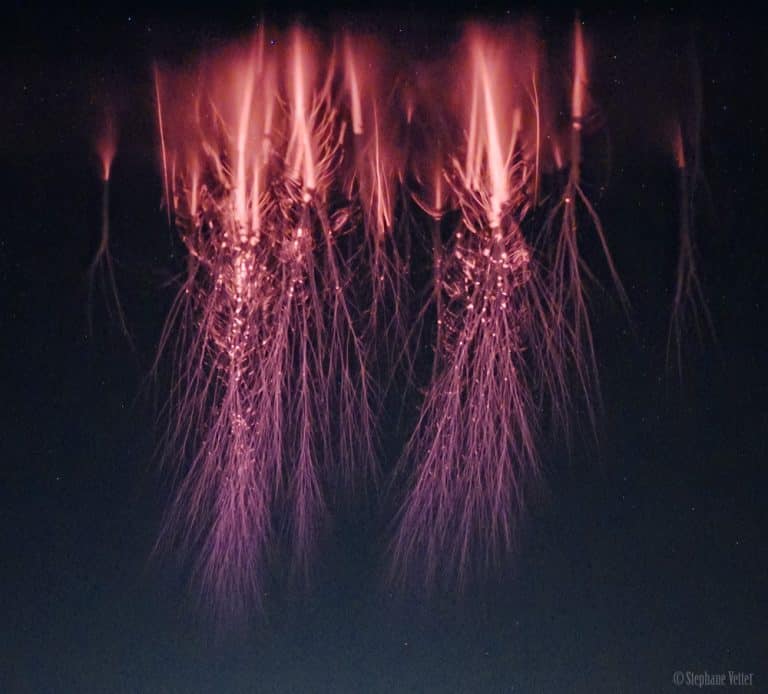
A magnificent but shy entry into this list, sprites last only for a tenth of a second. Blink, and you will miss it! Sprites occur in the mesosphere, higher than the troposphere in which thunderstorms occur, and are thought to dispense charges into clouds underneath. This balances out the charges in the clouds after a lightning strike. Although pilots long reported flashes above thunderstorms, it wasn’t until 1989 that the first sprite flash was captured on camera. Photographers capture sprites when the sky is dark and a clear view of a faraway thunderstorm is available.
Sprites are rarely captured on camera, but they are certainly photogenic Credits: apod.nasa.gov/ Stephane Vetter
4. The Morning Glory
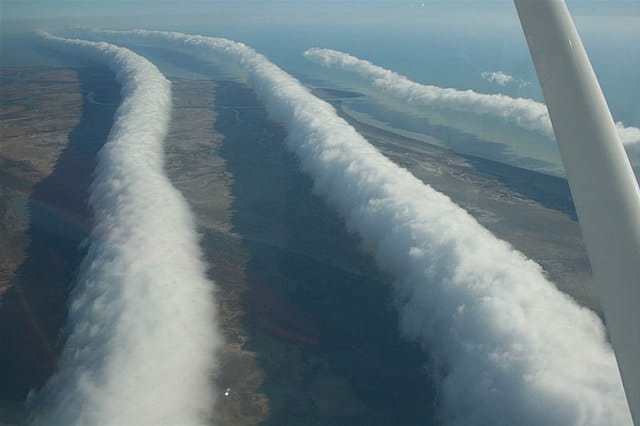
In Queensland province in Australia is a place called Burketown. From late September to early November, tube-like clouds that seem like they are rolling traverse over a hundred kilometers of the sky at a height of only 100–200m. The clouds originate in the Gulf of Carpentaria when moist air rises from the sea and meets the drier air above. As the cloud forms on its leading edge, the air coming down from the back of the cloud evaporates, so it looks like the clouds are rolling. Sometimes a series of these clouds form in the Outback sky, giving a visual treat for locals and tourists alike.
Morning Glory clouds snaking barely some hundred meters from the ground, Credits: Wikimedia/Mick Petroff
5. Light pillars
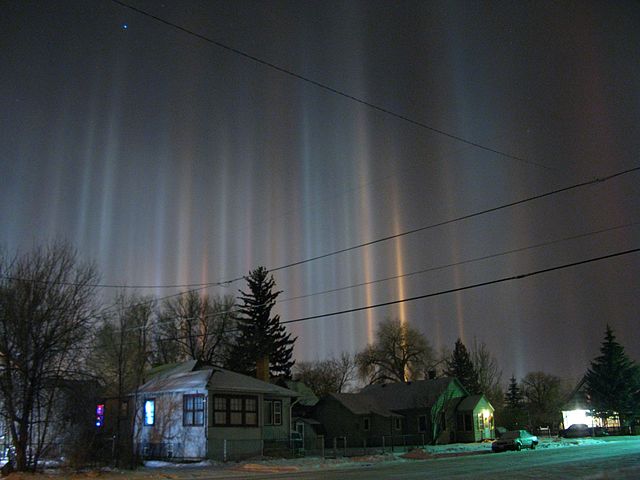
No, aliens from outer space aren’t attempting to steal cows! Light pillars might seem like aliens being mischievous, but in reality, these are optical wonders. On a humid, sub-zero winter night, with little to no wind, tiny ice crystals (about 0.02mm) are formed. These plate-like crystals of ice remain suspended close to the ground. When light from any source (like a street lamp) falls on these ice crystals, the light is reflected to form beautiful light pillars. These can form even in the absence of low-lying clouds.
Light pillars on a cold January night in Wyoming, U.S, Credit: Wikimedia/Christoph Geisler
6. Haboobs
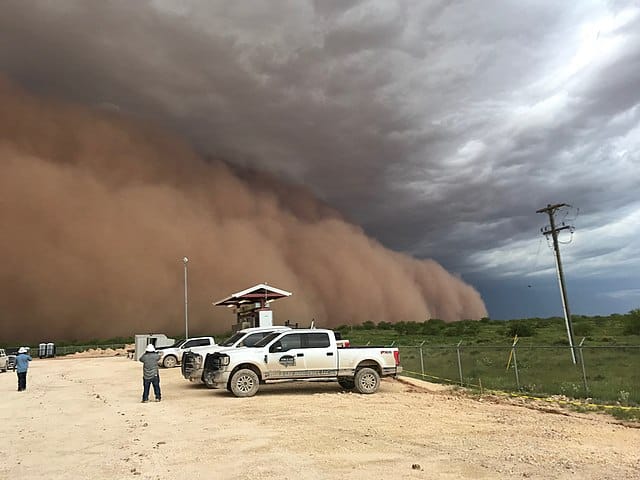
An avalanche of dust, haboobs are a kind of dust storm that can conjure night during the daytime by blocking off sunlight. When wind flows downwards and outwards from a thunderstorm (called a microburst), it lifts dust and sand with it, forming a wall of dust. In the U.S., these usually form in the desert in the southwest. Haboobs are visually appealing; however, they pose a significant amount of threat to motorists. Visibility can fall in a matter of seconds and this can cause accidents.
A blast of dusty disaster, haboobs are common in the southwest U.S. Credit: Wikimedia/Jakeorin