In the depths of our blue planet lies an amazing world of mystery, known as the deep sea. It’s a place where light fades to a dark abyss, and pressure increases a hundredfold. It’s a realm so unlike our own, filled with fascinating creatures that boggle the mind. Some say that we know more about space than our oceans. Deep sea is that mysterious!
The mysteries of the Deep Sea
The deep sea is often compared to outer space. Both are largely unexplored, and both hold secrets we’ve yet to uncover. The deep sea is a place of cold temperatures and crushing pressure. Yet, within these harsh conditions in the ocean, life thrives, adapted to the extreme in ways that seem impossible.
Take the anglerfish, for example. This predatory fish lives in the dark depths of the ocean, using a natural lantern—a piece of dorsal spine that protrudes above its mouth, aglow with light produced by bacteria. This light lures prey close enough for the anglerfish to snap it up in its wide mouth, showing a brilliant strategy of survival in the food-scarce depths.
The way they reproduce is interesting but horrific, too. During the initial days of discovery in the 1800s, only female anglerfish were found. Sometimes, the specimen would have a small lump of flesh that resembled a fish attached to its body, something that the researchers dismissed as a larva that fused with the body of the anglerfish at that time.
Further study led to a complete U-turn in understanding. Remember how only female anglerfish were discovered? Turns out, the male anglerfish likes a life of sedentary survival. The male fish bites down on the belly of a female anglerfish, and latches onto her until the body of the male fuses with the female. When I mean fuse, you can picture the female and male’s blood vessels joining, and essentially, the male fish becomes an appendage. Due to lack of usage, the male fish loses its eyes and other organs, and absorbs nutrients from the female anglerfish like a parasite. Ultimately, the two fish mate when they are ready.
The Giant Squid
The Giant Squid/ Credit: Wikimedia Commons/Mgiganteus
Then there’s the giant squid, a creature of legends and sailors’ tales. These enormous beings can reach lengths of up to 43 feet, with eyes the size of dinner plates to capture as much light as possible in the darkness. Using long, whip-like tentacles , they capture prey, demonstrating the awesome size life can reach in the abyss.
If you have seen the kraken in pirate movies, or have read about it in books, you have an image of it in your imagination. The origin of kraken stories was probably a giant squid that got very interested in checking out ships.
The Gulper Eel
Gulper Eel. Credit: Wikimedia Commons/Emőke Dénes
The gulper eel is another intriguing dweller of the depths. This creature possesses a massive, hinged jaw that can open wide enough to consume prey larger than itself, and a body that can stretch and expand to accommodate such meals. With a lantern-like structure at the end of its tail, it lures unsuspecting creatures to their doom.
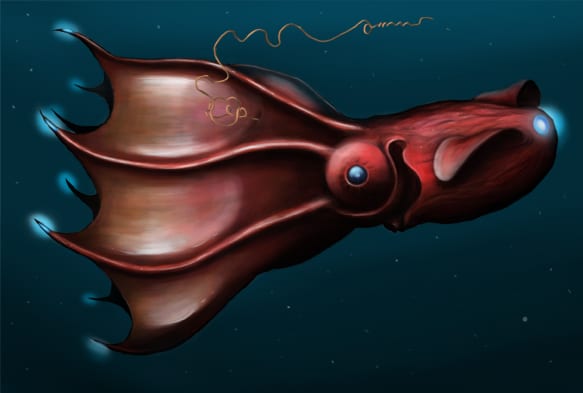
Finally, we have the vampire squid, a creature with a name as strange as its appearance. Its skin is dark as the night or pale red, and its eyes shine a brilliant red or blue, depending on the lighting. What sets it apart is its cape-like webbing connecting its eight arms, resembling a cloak fit for a vampire, hence its name.
The unseen challenges of deep sea life
These deep-sea creatures face unique and unseen challenges. Food is scarce, pressure is crushing, and light is nearly non-existent. Yet, they have evolved incredible strategies to survive. These adaptations can teach us a lot about resilience and the power of life to exist in even the harshest of conditions.
The importance of deep sea exploration
The deep sea is a hidden treasure trove of life. Despite the difficult conditions, life perseveres, showcasing incredible adaptability and willpower. The weird creatures of the deep sea represent the diversity of life on Earth. By exploring these depths, we not only uncover the mysteries of these strange beings but also learn about our own ability to adapt and survive in the face of adversity. The deep sea, with its weird and wonderful inhabitants, holds valuable lessons for us all.
Glossary
Predatory: Relating to or describing an animal or animals preying naturally on others.
Dorsal: Relating to the upper, back, or top side of an animal, plant, or organ (as opposed to ventral, which is the belly or underside).
Tentacles: A slender flexible limb of an animal, especially an invertebrate, used for grasping, moving about, or carrying sense organs.
Adaptations: The action or process of changing to become more suited to the environment.
Resilience: The ability to recover quickly from difficulties.