Virtual Reality , known commonly as VR, is a fascinating form of technology. At its core, VR is a simulated experience that can either be similar to or completely different from the real world. Rather than being an observer on the outside looking in, VR enables you to become an active participant in an immersive, computer-generated environment.
But where did this captivating technology originate? The seeds of VR were planted decades ago. The journey began with rudimentary simulators and sensorama machines in the 1950s, which tried to replicate reality by stimulating multiple senses. However, it wasn’t until the 1960s, with the creation of the first head-mounted displays , that we began to see a glimpse of the VR we know today. Despite the numerous trials and tribulations along the way, VR has managed to persevere and grow. Today, it has permeated numerous areas of life, with one of its most notable applications being in the realm of video games.
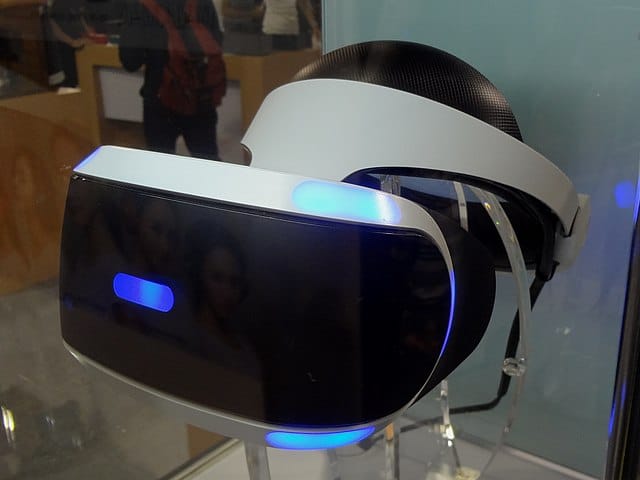
VR headset, Credit: Wikimedia/Official GDC
VR gaming: An exciting evolution
Have you ever desired to inhabit the world of a video game fully? To not just control a character but to become the character? That’s the unique allure of VR gaming. Unlike traditional video games that keep you at arm’s length, VR gaming offers an immersive, lifelike experience, providing an unparalleled level of engagement and entertainment.
Over the past few years, VR gaming has undergone numerous exciting advancements. With each new development, the immersion level of VR games has seen substantial enhancements. The visual aspect of games has seen a significant improvement, with graphics becoming sharper and more realistic. The tracking of player movements has become more accurate, enhancing the overall gaming experience. And while the hardware was initially bulky and cumbersome, ongoing innovations have led to more user-friendly, lightweight designs. All of these improvements combine to create a gaming experience that is more immersive and realistic than ever before.
VR game, Credit: Wikimedia/Solomon203
Taking VR gaming to mobile
Given the immense popularity and the immersive experience that VR gaming offers, it is no surprise that there’s a growing desire to make this experience more portable and accessible. Enter mobile VR games, a concept that merges the immersive world of VR with the convenience and portability of mobile devices.
Creating VR games for mobile, however, presents a unique set of challenges. Developers need to strike a balance between ensuring the game runs smoothly and avoiding quick battery depletion. The graphics and controls need to be simplified without compromising the immersive experience that VR is known for. Despite these challenges, successful mobile VR games offer an unparalleled combination of portability, convenience, and immersive gameplay. And with the ever-increasing capabilities of smartphones, the potential for mobile VR games is continually growing.
Unforgettable mobile VR games
Several mobile VR games have already carved out a niche for themselves, demonstrating the impressive potential of this medium. Games such as “VR Noir” and “Eclipse: Edge of Light” serve as shining examples of the immersive experiences that mobile VR games can provide.
“VR Noir” transports players into the shoes of a private detective, navigating a gritty cityscape and solving complex mysteries. The game has been lauded for its immersive narrative and the depth of its virtual world. “Eclipse: Edge of Light”, on the other hand, takes players on a journey to a mysterious alien planet, where they uncover ancient secrets and experience a compelling story. Both games have garnered widespread acclaim for their ability to provide a captivating VR experience on a mobile platform.
The future of mobile VR gaming
Looking to the future, the prospects for mobile VR gaming appear to be bright. With ongoing advancements in mobile technology, VR games could become even more immersive, accessible, and convenient.
In the years to come, we might see an increase in multiplayer mobile VR games, allowing users to explore virtual worlds together, regardless of their physical location. We could also witness a rise in games that incorporate augmented reality (AR) elements, blurring the lines between the real and virtual worlds in new and exciting ways.
In conclusion, mobile VR gaming stands poised to revolutionize the gaming industry. As technological advancements continue to reshape the landscape, we can only imagine the thrilling new experiences that await us in the world of mobile VR games.
Glossary
Virtual Reality (VR): A technology that generates a simulated environment, allowing users to interact with a 3D world.
Sensorama Machines: Early mechanical devices that provided stimuli to various senses, aiming to simulate reality.
Head-Mounted Displays: Devices, often worn like a helmet, that have a small display lens in front of each eye to create a virtual, immersive environment.
Immersive Experience: A perception of being physically present in a non-physical world. This perception is created by surrounding the user of the VR system in images, sound, or other stimuli.
Augmented Reality (AR): An interactive experience of a real-world environment where objects in the real world are enhanced by computer-generated perceptual information.