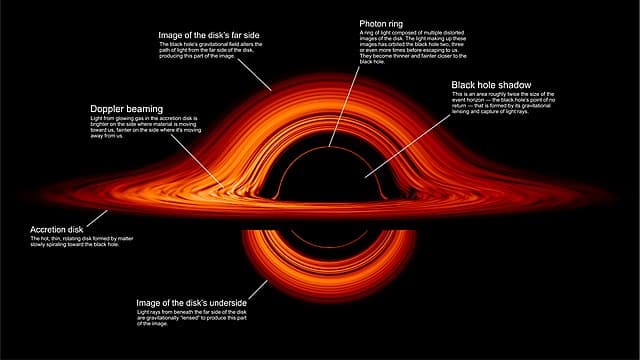
The black hole's intense gravity distorts space around it. Credit: Wikimedia/Jeremy Schnittman
Blackholesare mysterious cosmic bodies lurking within the cosmos. These cosmic phenomena are regions in space where gravity’sstrength is so intense that it distorts space-time and swallows light, making it impossible for anything to escape its pull. Some say that if a human fell into a blackhole, the person would be stretched into a noodle. Needless to say, blackholes pose a large number of questions. The notion of their existence, of regions of space devouring everything that dares to venture too close, has long been a subject of fascination and speculation among astronomers and the general public alike. But where did it all begin?
Historical perspectives on black holes
A view of the supermassive black hole. Credit: Wikimedia/Event Horizon Telescope
The intellectual journey that led to the discovery of black holes is a fascinating one, starting in the 18th century with the contemplation of “dark stars”. This was the name given to celestial bodies whose gravity was so strong that not even light could escape. However, the concept remained a fringe idea until Albert Einstein revolutionized our understanding of the universe.
Einstein’s General Theory of Relativity , published in 1915, reimagined gravity not as a force, but as a warping of space and time around massive objects. His groundbreaking insights brought credibility to the idea of supermassive objects capable of imprisoning light. While Einstein himself remained skeptical about the existence of black holes, his theory laid the foundation for further exploration of the concept.
John Michell and Pierre-Simon Laplace
Two scientists played a crucial role in the early theoretical development of black holes: John Michell in England and Pierre-Simon Laplace in France.
In 1783, John Michell, a natural philosopher and scientist, proposed the existence of “dark stars”. His innovative ideas suggested that a sufficiently dense and massive star could possess gravitational forces powerful enough to prevent light from escaping.
Meanwhile, French scientist Pierre-Simon Laplace, known for his keen mind and broad interests, independently arrived at a similar conclusion. He articulated the notion of such massive stars in his book, “Exposition du Système du Monde”. Both of their insights were visionary, but the technology of their time was not capable of validating their ideas.
Karl Schwarzschild's breakthrough
The mystery surrounding black holes began to clear with the work of Karl Schwarzschild, a German astronomer and mathematician. He found a solution to Einstein’s complex equations that governed the General Theory of Relativity, which outlined the circumstances under which dark stars could exist.
Schwarzschild’s work depicted a scenario where if an object was dense enough, it could create a ‘point of no return’ – a boundary now known as the event horizon. Beyond this event horizon, gravity would be so strong that nothing could escape, effectively creating a black hole. Unfortunately, Schwarzschild died shortly after making this breakthrough, but his work would go on to change the course of astrophysics.
Subrahmanyan Chandrasekhar and stellar black holes
Our understanding of black holes took another giant leap forward thanks to Subrahmanyan Chandrasekhar. This Indian astrophysicist further developed the concept of black holes in the 1930s through his research on the life cycles of stars.
Chandrasekhar’s work proposed that a star, upon depleting its nuclear fuel, might collapse under its own gravitational pull to form a point of nearly zero volume and infinite density – a concept known as a singularity. This pioneering work set the stage for the modern understanding of stellar black holes, leading to a wealth of research and discoveries in the field.
The ongoing voyage of discovery
The exploration of black holes, from their early theoretical beginnings to their eventual scientific confirmation, has greatly enriched our understanding of the universe. Each discovery has fueled further inquiry, and each answered question has given rise to a dozen more.
Today, black holes are at the forefront of astrophysics, captivating scientists with their exotic nature and the potential answers they hold about the universe’s fundamental laws. Our quest to unravel the mysteries of black holes continues unabated, as we push the boundaries of knowledge, standing on the brink of the event horizon, gazing into the great cosmic unknown.
Glossary
Black Hole: An area of space-time exhibiting gravitational acceleration so strong that nothing—no particles or even electromagnetic radiation such as light—can escape from it.
Gravity: A force that attracts a body toward the center of the earth, or toward any other physical body having mass.
Space-Time: The concept of four-dimensional space, combining the three dimensions of space with the fourth dimension of time, under Einstein’s theory of relativity.
General Theory of Relativity: Einstein’s theory that gravity is caused by the curvature of space and time by mass and energy. It generalizes special relativity and refines Newton’s law of universal gravitation.
Dark Stars: A theoretical concept for an astronomical object, similar to a star, which emits no radiation and consists of matter so collapsed that its escape velocity exceeds the speed of light.
Event Horizon: The boundary defining the region of space around a black hole from which nothing can escape its gravitational pull.
Singularity: A point in space-time at which gravitational forces cause matter to have an infinite density and zero volume. According to general relativity, the singularities are at the center of black holes.
Astrophysics: The branch of astronomy that deals with the physical properties of celestial bodies and with the interaction between matter and radiation in the interior of celestial bodies and in interstellar space.