Untangling The James Webb Telescope

On a clear night, you can see thousands of stars or constellations in the sky. Sometimes you can even spot a planet such as Venus looking like a bright, white light. Venus is the closest planet to the Earth, which makes it one of the easiest planets to see!


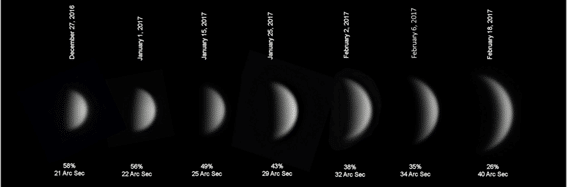
But your naked eyes are not enough to see the tiny details of these celestial objects. Like the Earth’s moon, Venus cycles through different phases as it orbits around the Sun. These phases show Venus gradually changing from a thin crescent to a glowing semicircle. Since Venus is so far away, seeing these phases requires a telescope .


Special telescopes are also used by scientists to discover new planets, stars, and galaxies! These “space telescopes” are much bigger than the telescopes you would use for casual stargazing. Occasionally, these telescopes may be deployed into Earth’s orbit or outer space.


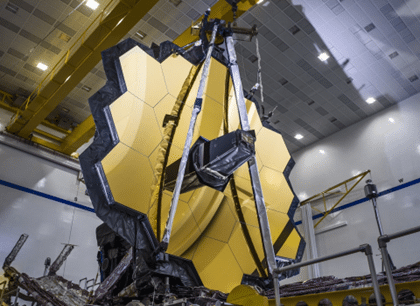
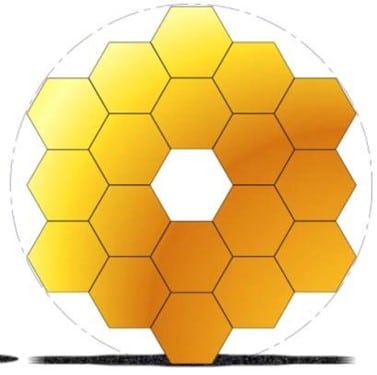
Recently, NASA launched the biggest telescope to ever be sent into space: The James Webb Telescope. The Webb’s massive, golden mirrors span a record-breaking diameter at 21.3 feet (6.5 meters). In fact, Webb’s mirrors are so large that they have to be divided into smaller, six-sided plates. The segmented plates are important because they can be folded up like origami, helping fit the telescope inside of a rocket.

Webb telescope mirrors

Astronomers are optimistic that this complex setup will be worth it. The colossal mirrors make it possible for the Webb to capture significant amounts of light. The more light a telescope collects, the farther away that it can “see.”


In astronomy, distance and time are also intertwined. This means that faraway objects seen through the Webb are images of the distant past. This is because light takes a certain amount of time to travel through space and reach the Webb’s mirrors.


As a result, the Webb can discover new information about the universe’s origin and timeline. Astronomers even predict that the Webb will be able to reveal the universe’s very first stars and galaxies in a period known as “ cosmic dawn .”

mirror

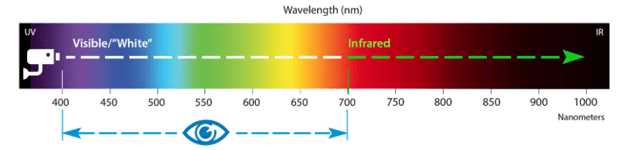
In addition to its enormous size, the Webb is different from typical telescopes because of the type of light it collects. The light that you see with your naked eyes is visible light , but there are many other categories of light that you cannot see! This happens when light is in a lower or higher wavelength than the wavelengths that your eyes can recognize.


If an object in space is very far away, the wavelengths of its light become stretched out. Eventually, wavelengths may be so long that they become invisible!


The Webb telescope is designed with this “light problem” in mind. Instead of visible light, the Webb collects infrared light , which includes wavelengths longer than the visible light spectrum. Astronomers will be able to obtain visuals of remote, historical space.

Light spectrum
Light spectrum (visible vs infrared light)

You will have to wait several months before seeing any of these ground-breaking images though. Because of the Webb’s delicate equipment, it is important that each of its parts and mirrors are unfolded and aligned properly. The Webb is also deep enough into space that NASA is unable to send any astronauts to fix unforeseen malfunctions.


Still, NASA is hopeful that the Webb will expand our knowledge of the universe. With its vast mirrors and infrared detection, the Webb is breaking the boundaries of telescope engineering. In the words of astronomy assistant professor and Webb enthusiast Caitlin Casey, “It’s wild.”

Venus phases
Venus phases

Flesch Kincaid Grade Level: 8.5


Flesch Kincaid Reading Ease: 61.3

Glossary

Constellation: a group of stars


Telescope: a tool that uses mirrors to make faraway objects seem bigger and clearer


Diameter: the distance of a circle from one side to the other


Cosmic Dawn: the period when the first stars formed


Visible Light: light that you can see naturally, without using special equipment


Wavelength: a measurement of light that describes the distance between two light waves


Infrared Light: a range of invisible light

Gohd, C. (2021, December 19). James Webb Space Telescope vs. Hubble: How will their images compare? Space.com. Retrieved January 11, 2022, from https://www.space.com/james-webb-space-telescope-hubble-images-comparison


Love the Night Sky. (n.d.). How to see Venus Through a Telescope. Love the Night Sky. Retrieved January 11, 2022, from https://lovethenightsky.com/how-to-see-venus/


NASA. (n.d.). Webb vs Hubble Telescope. NASA. Retrieved January 11, 2022, from https://www.jwst.nasa.gov/content/about/comparisonWebbVsHubble.html


Resnick, B. (2022, January 4). The largest space telescope in history is about to blow our minds. Vox. Retrieved January 11, 2022, from https://www.vox.com/science-and-health/22664709/james-webb-space-telescope-launch-date-december-science-hubble


Royal Museums Greenwich. (n.d.). What can the James Webb Space Telescope do? Royal Museums Greenwich. Retrieved January 11, 2022, from https://www.rmg.co.uk/stories/topics/james-webb-space-telescope-vs-hubble-space-telescope
Contributors

Copyright @smorescience. All rights reserved. Do not copy, cite, publish, or distribute this content without permission.


Join 20,000+ parents and educators
To get the FREE science newsletter in your inbox!