From tiny insects orchestrating complex societies to giants roaming the savannahs with surprising emotional depth, this list highlights the top 10 smartest animals, showcasing their cognitive abilities, social intricacies, and scientific insights that reveal their fascinating minds.
10- The Astute Chimpanzees: Masters of Use and Social Tools
A close-up of a chimpanzee's face showing a thoughtful expression, Credit; depositphotos.com/EBFoto
Geographic Location: Chimpanzees are primarily found in the rainforests of West and Central Africa.
Intelligence: Chimpanzees are our closest living relatives, sharing about 98.7% of our DNA. Previous studies highlight their ability to use fishing probes to extract termites from their earthen nests and rocks to crack nuts, demonstrating an understanding of tool use rivaling humans. Chimpanzees have complex social structures capable of deceit, cooperation, and empathy. Their use of symbolic communication and ability to learn sign language have provided some information about cognitive bridges between humans and animals.
Scientific Insights: Studies on chimpanzee cognition have illuminated aspects of human evolution, including the development of culture, language, and tool use. Observations of their learning processes, memory, and social interactions offer valuable insights into the origins of human social behavior and intelligence.
9- The Ingenious Dolphins: Conversationalists of the Sea
A group of dolphins swimming in the ocean, Credit; Wikimedia/Mark Gunn
Geographic Location: Dolphins are widespread and found in all oceans.
Intelligence: Dolphins are highly social animals, known for their playful nature and learning capacity. For example, Dolphins engage in cooperative hunting, use tools, and recognize themselves in mirrors, demonstrating their exceptional self-awareness and cognitive abilities.
Some studies demonstrated that these animals can use tools, including sponges, to protect their snouts while foraging, a behavior that seems to be passed on from mother to daughter dolphin.
Intelligence:Elephants are known for their exceptional memory, social complexity, and emotional intelligence. Studies have shown they exhibit behaviors associated with grief, compassion, and self-awareness. Cognitive studies have shown that elephants are capable of visual symbol discrimination, relative quantity judgment, mirror self-recognition, tool use, and an understanding of cooperation. Furthermore, these animals have a remarkable memory, often cited as “an elephant never forgets”.
Scientific Insights: Studies have revealed elephants have a highly developed hippocampus, a brain region associated with emotion and memory. Research into elephant cognition provides relevant information about the evolution of intelligence and social behavior, highlighting these majestic animals’ emotional connections and complex societies.
7- The Canny Crows and Ravens: Avian Architects of the Sky
A crow using tools to retrieve food, Credit; Wikimedia/Dan Davison
Geographic Location: Crows and ravens are found in nearly every habitat worldwide, from remote forests to urban areas.
Intelligence: Known for their problem-solving skills and use of tools, crows, and ravens are among the most intelligent birds. A study published in 2017 in the “Science Journal” revealed that ravens even pre-plan tasks—a behavior long believed to be unique to humans and their relatives. For example, in a simple experiment, these scientists taught the birds how a tool can help them access a piece of food. When offered a selection of objects almost 24 hours later, the ravens selected that specific tool again—and performed the task to get their treat.
Scientific Insights: Some studies showed that crows have bent wires to retrieve food from tubes, demonstrating their ability to use tools to plan and solve novel problems. Their social intelligence, including recognizing human faces, exhibits their advanced cognitive capabilities. Their ability to understand demonstrates a level of cognitive sophistication that rivals that of many mammals.
6- The Ingenious Octopuses: Masters of Camouflage and Escape
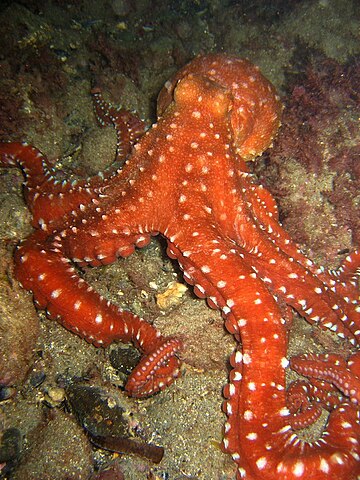
An octopus displaying its camouflage ability, Credit; Wikimedia/SUBnormali Team
Intelligence: Octopuses are reported to be exploratory and attracted by novel objects, opportunistic feeders, and forage large territories. Their solitary nature belies a problem-solving capability that rivals much larger and more social animals. Their mastery of camouflage and shape-shifting is unparalleled, allowing them to avoid predators or ambush prey.
Scientific Insights: The octopus’s brain and nervous system are subjects of fascination, with two-thirds of its neurons located in its arms, allowing for incredible control and sensory perception. This unique neural architecture provides insights into alternative models of cognition and consciousness in the animal kingdom.
5- The Observant Dogs: Loyal Companions with a Keen Intellect
A dog engaging in play, showing intelligence and obedience, Credit: Wikimedia/Dirk Vorderstraße
Geographic Location: Dogs are ubiquitous, sharing environments with humans across the globe, from cities to rural areas.
Intelligence: Dogs have been bred for various tasks, leading to various intelligence types across breeds. Their ability to understand human gestures, facial expressions, and commands underscores their deep bond with humans. Dogs show empathy, can learn complex commands, and, in some cases, can predict human emotional states or health issues.
Scientific Insights: Studies on dogs’ brains show they process spoken words, intonation, and emotional content similarly to humans, suggesting a sophisticated understanding of our communication methods. Therefore, studies like this can help increase our acknowledgment of cross-species cognition and communication.
4- The Perspicacious Pigs: Smart and Cunning
Pig, Credit; Wikimedia/Amy Stephenson
Geographic Location: Pigs are found worldwide, with domesticated breeds and wild species such as the boar inhabiting diverse environments from farms to forests.
Intelligence: Pigs are not just intelligent; they’re cunning. Studies have shown that pigs can manipulate levers and switches to control their environment, solve mazes, and exhibit long-term memory.
Scientific Insights: Their social intelligence, seen in how they form complex social networks and their ability to learn from one another, place them high on the list of intelligent animals. Recently, it has been described that pigs also can use tools. An ecologist observed how Visayan warty pigs built their nests to prepare for incoming piglets. These researchers noticed that one clever pig had picked up a piece of bark in her mouth and started using it to dig and move soil for the nest.
3- The Scheming Parrots: Feathered Geniuses with a Gift for Gab
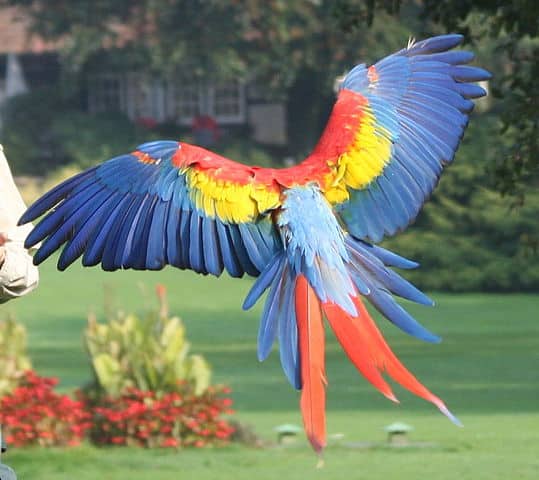
A parrot engaging in complex behavior, Credit: Wikimedia/Robert01
Geographic Location: Parrots are predominantly found in tropical and subtropical regions, particularly Australia, South America, and Central Africa.
Intelligence: Parrots are renowned for their vocal abilities, capable of mimicking human speech with remarkable accuracy. Studies indicate they understand concepts like same and different, categorize objects like humans, and solve complex problems. Their social nature and ability to communicate complex ideas to one another are hallmarks of their intelligence.
Scientific Insights: Studies have shown parrots possess a level of intelligence comparable to that of young children, such as problem-solving and the understanding of concepts like shape, color, and number. The African Grey Parrot, in particular, has been extensively studied, revealing insights into avian intelligence and the neural basis of language and learning.
2- The Wily Rats: Navigators of Mazes and Solvers of Puzzles
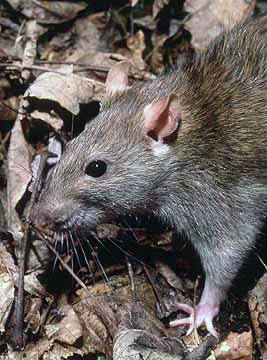
Rat, Credit: Wikimedia/National Park Service
Geographic Location: Rats are highly adaptable and are found worldwide, particularly close to human settlements.
Intelligence: Rats have been used in psychological studies due to their intelligence. They can navigate mazes, remember routes, and solve puzzles to obtain food. Their ability to learn and adapt to new situations demonstrates a level of cognitive flexibility that’s impressive for their size.
Scientific Insights: Recently, a new study revealed that rats can imagine and navigate virtual environments using only their thoughts. These researchers used a brain-machine interface to translate hippocampal activity into virtual movement. These findings open potential avenues for neurological developments that could aid human cognitive and motor functions.
1- The Insightful Bees: Tiny Insects with a Hive Mind
Bees performing the waggle dance or working on a hive, Credit; Wikimedia/ Muhammad Mahdi Karim
Geographic Location: Bees are found on every continent except Antarctica, thriving in environments ranging from tropical rainforests to temperate forests.
Intelligence: Bees, though small, have a complex social structure and communication system. They can communicate locations of food sources through the waggle dance, solve complex problems that require understanding patterns, and even exhibit a form of democratic decision-making when choosing new hive locations. Furthermore, bees demonstrate impressive memory capabilities, recognizing and remembering floral patterns and locations.
Scientific Insights: Research has shown that bees can understand the concept of zero, a rare cognitive ability among animals. A recent study described that bees perform at a level consistent with non-human primates in recognizing that zero is lower than one, despite bee brains being much smaller and with fewer neurons than human brains. All these observations challenge our understanding of brain size and its correlation with intelligence.
This exploration through the minds of the animal kingdom highlights the sheer breadth of intelligence across species and prompts a great appreciation for the cognitive capabilities beyond humanity. These top 10 smartest animals provides a unique window into the complexity of the mind, challenging our understanding of intelligence, consciousness, and the many forms they take.
Copyright @smorescience. All rights reserved. Do not copy, cite, publish, or distribute this content without permission.
Join 20,000+ parents and educators
To get the FREE science newsletter in your inbox!
SUBSCRIBE TO OUR NEWSLETTER
.......... ..........
Subscribe to our mailing list to get updates to your email inbox.