Geographic Location: Canaries are native to the Canary Islands, Azores, and Madeira but have been introduced worldwide as domesticated pets.
Hearing Skills: Canaries are renowned for their musical abilities, which are underpinned by their acute sense of hearing. This keen hearing allows them to distinguish and replicate complex sounds and melodies, making them popular among bird enthusiasts. Their hearing is crucial for social communication within flocks, enabling them to respond to calls and warnings from other birds.
Scientific Insights: Research into canary hearing has provided insights into how birds process sounds and the role of auditory perception in bird song learning. Canaries can adjust their songs based on their auditory experiences, highlighting the plasticity of their auditory system and its importance in their social interactions and mating rituals.
9- Cats
Cats, Credit: Wikimedia/Alvesgaspar
Geographic Location: Cats are found worldwide in almost every environment as domestic pets or feral populations.
Hearing Skills: Cats possess extraordinary hearing capabilities, detecting frequencies between 48 Hz and 85 kHz. This range allows them to hear sounds beyond human capabilities, including the high-pitched frequencies of small rodents, their primary prey. Their ability to hunt, avoid predators and oncoming motor vehicles, and interact with their owners depends on their hearing.
Scientific Insights: The cat’s outer ear, or pinna, can rotate independently up to 180 degrees, helping them precisely locate the source of a sound. This ability and a highly developed auditory system make cats exceptional hunters. Studies on cat hearing have contributed to understanding how mammals perceive and localize sound, with potential applications in improving human acoustic technology.
8- Horses
Horses, Credit: Wikimedia/Eatcha
Geographic Location: Horses are found worldwide, with populations in the wild, on farms, and as domesticated animals in various environments.
Scientific Insights: The study of horse hearing has implications for animal welfare and training. Understanding horses’ auditory range and sensitivity helps create better environments for them, reducing stress caused by loud or high-frequency sounds. This knowledge also aids in developing training methods that align with their natural responses to auditory cues.
7- Rats
Rats, Credit: Wikimedia/Laëtitia Dudous
Geographic Location: Rats are ubiquitous, found in nearly all parts of the world, thriving in urban, rural, and wild environments.
Hearing Skills: Rats can hear a frequency range of approximately 250 Hz to 80 kHz, with the most significant sensitivity occurring between 8 and 38 kHz, much higher than in humans. Ultrasonic vocalizations in rats are signals associated with social and emotional information. These vocalizations can be divided into two predominant categories, characterized by the spectral peak frequency range (around 22 or 50 kHz). For example, higher frequency sounds can be observed when the rat is in pleasant situations (social approaching, engaging in rough-and-tumble play, or being tickled). However, these animals can emit lower frequencies when they are in distress situations (including in the presence of a predator). On the other hand, males who are socially defeated after a same-sex confrontation also emit these calls with a defensive posture and freezing behavior.
Scientific Insights: The auditory system of rats has been extensively studied, revealing their ability to differentiate between a wide range of frequencies and intensities. This research has provided insights into rodents’ sensory capabilities and served as a model for understanding human auditory disorders and developing potential treatments.
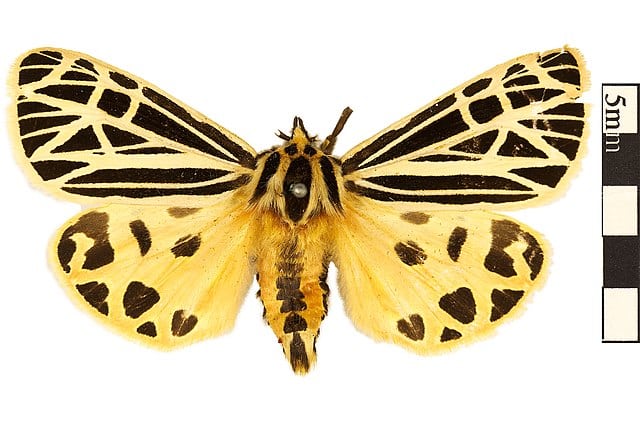
6- Moths (certain species for evading bat predation)
Moths, Credit: Wikimedia
Geographic Location: Moths are found worldwide, with 160000 species found until now.
Hearing Skills: Some species of moths have developed sophisticated hearing organs capable of detecting the ultrasonic echolocation calls of bats, their main predators. Some studies demonstrated that moths can hear ultrasonic frequencies approaching 300 kHz, the highest frequency sensitivity of any animal. This arms race between bats and moths showcases a remarkable example of coevolution, with moths evolving auditory systems sensitive enough to pick up the ultrasonic pulses emitted by hunting bats.
Scientific Insights: The study of moth hearing has significantly contributed to understanding sensory evolution and predator-prey dynamics. Besides the escape movements after detecting predators, studies have shown that moths have other strategies that prevent them from being eaten, contributing to their survival. Some moth species developed sound-producing organs, tymbals, which are used to communicate with other individuals, reproduce, and agitate/ irritate attacking bats. To confuse bats, these animals respond to bats’ echolocation calls by emitting several click calls in the ultrasonic range.
5- Dogs (certain breeds)
Dogs, Credit: Wikimedia/Crusier
Geographic Location: Dogs are found worldwide in association with humans and in various habitats, including temperate, tropical, polar, and terrestrial.
Hearing Skills: Dogs have a broad hearing range and can hear frequencies from about 40 Hz to 60 kHz. This range surpasses that of humans and is essential for their communication, hunting, and social interaction. Certain breeds, such as German Shepherds and Labrador Retrievers, are known for their exceptional auditory abilities, making them valuable for roles in search and rescue, law enforcement, and service animals.
Scientific Insights: Studies on dog hearing have led to a better understanding of the domestication process and how selective breeding can enhance specific sensory capabilities.
Studies on dogs’ brains show they process spoken words, intonation, and emotional content similarly to humans, suggesting a sophisticated understanding of our communication methods. Therefore, studies like this can help increase our acknowledgment of cross-species cognition and communication.
4- Dolphins
Dolphins, Credit: Wikimedia/טל שמע
Geographic Location: Dolphins are found in oceans and seas worldwide, from polar to tropical waters.
Hearing Skills: Dolphins possess one of the most sophisticated auditory systems in the animal kingdom, capable of hearing frequencies from 75 Hz to 150 kHz. This exceptional hearing supports their use of echolocation for navigation, hunting, and communication in the aquatic environment. Their auditory system is highly adapted to the underwater environment, where sound travels faster and longer distances than in the air. Researchers have shown how dolphins can process complex acoustic signals. Most species of dolphins produce two types of sounds, which possibly play the role of communication signals in their social relationships. These are packs of broadband pulses and whistles. Some reports demonstrated that the repertoire of whistles can change according to the situation or animal activity.
Scientific Insights: The dolphin’s auditory system has been a subject of intense study, providing insights into the evolution of hearing in marine mammals. Furthermore, these animals are also famous for their intelligence. For example, dolphins engage in cooperative hunting, use tools, and recognize themselves in mirrors, demonstrating their exceptional self-awareness and cognitive abilities.
Hearing Skills: Elephants have a wide range of hearing, from low frequencies around 16 Hz to 12 kHz. They use this ability to communicate over long distances through infrasound, sounds below the human hearing range. The use of infrasonic communication by these animals was first discovered in the 1980s when a zoologist noticed an unusual vibration in the air while observing Asian elephants at a zoo in the United States. Although elephants use many vocal and auditory signals for communication, the ability to produce low-frequency and infrasonic sounds provides them several advantages when communicating over long distances. Some examples of these are avoiding rival herds and predators, coordinating herd movements to improve resource availability, and facilitating mate finding for individuals in reproductive conditions.
Scientific Insights: Research into how elephants use infrasound has implications for conservation efforts, helping to design strategies that minimize human-elephant conflicts and enhance the protection of their habitats. In addition to this excellent skill, elephants are known for their exceptional memory, social complexity, and emotional intelligence. Studies have shown they exhibit behaviors associated with grief, compassion, and self-awareness. Cognitive studies have shown that elephants are capable of visual symbol discrimination, relative quantity judgment, mirror self-recognition, tool use, and an understanding of cooperation. Furthermore, these animals have a remarkable memory, often cited as “an elephant never forgets”.
2- Owls
Owl, Credit: Wikimedia/Mdf
Geographic Location: Owls are found globally, except in Antarctica, inhabiting various environments, from dense forests to open prairies.
Scientific Insights: Research into owl hearing has provided valuable insights into the mechanics of sound localization and the evolutionary adaptations for nocturnal hunting. In addition to hearing capacities, these animals can rotate their heads 270 degrees without damaging blood vessels in the neck. Researchers described that owls are more flexible than humans because their head is only connected by one socket pivot. Humans have two, which limits our ability to twist. Furthermore, owls also have multiple vertebrae, the small bones that make up the neck and spine, helping them achieve a wide range of motion.
1- Bats
Bats, Credit: Wikimedia/MathKnight
Geographic Location: Bats are found worldwide, except in extreme desert and polar environments.
Hearing Skills: Bats possess one of the most advanced auditory systems in the animal kingdom, enabling them to navigate and hunt using echolocation. Bats can produce ultrasonic vocalizations and understand their environment by processing information by returning echoes of their calls. This echolocation is achieved through a sophisticated audio-vocal system that allows bats to emit and detect frequencies ranging from 10 to 100kHz. This ability allows them to fly precisely in complete darkness, avoiding obstacles and capturing prey.
Scientific Insights: Besides these fantastic hearing abilities, these animals have a crucial impact on humans and the environment. Insect-eating microbats consume millions of bugs a night, acting as a natural pest control for plants. Therefore, this can lead to a reduction in the use of pesticides in farms, which cost them millions of dollars each year and have a prejudicial impact on the environment.
Copyright @smorescience. All rights reserved. Do not copy, cite, publish, or distribute this content without permission.
Join 20,000+ parents and educators
To get the FREE science newsletter in your inbox!
SUBSCRIBE TO OUR NEWSLETTER
.......... ..........
Subscribe to our mailing list to get updates to your email inbox.