There are over 20,000 species of fish that we know of today. Some of these fish live in salty ocean water. Others live in freshwater, like lakes and ponds. Salmon actually spend some time in freshwater and some time in saltwater, making their life cycle unique. Normally, fish can only survive in salt or freshwater, but not both. So how does the salmon do it? It starts with an egg.
Where do salmon lay their eggs?
Many types of fish, including salmon, lay eggs. Female salmon travel upstream to freshwater and lay a nest full of eggs, which is called a redd . These nests can contain thousands of eggs. These eggs are fertilized and grow baby salmon called alevins. It takes about three months for the eggs to grow and hatch. Alevins are not mature salmon yet. In fact, they do not have mouths! They rely on yolk from the eggs they grew in for nutrients during their first few months of life. Once they grow strong enough, they leave the redd and move into the next part of their life cycle.
Salmon fry. Credit: Flickr/by U. S. Fish and Wildlife Service – Northeast Region
From alevin to fry.
Once alevins are ready to leave the redd, they enter the fry stage. This is when the fish start eating plankton and plants, but it is also when they are most in danger of being eaten! At this stage, salmon fry become camouflaged with parr marks so that they can hide from bigger fish and even birds. They also spend time near large logs and in the shade to hide and protect themselves. After a few years, these fish are ready to enter their next, salty stage.
Salmon Fry with parr marks. Credit: Wikimedia Commons/WhitehorseFish
The smolt switch—how do salmon become saltwater fish?
Once a fry is ready to swim to the ocean, it needs to go through another stage. The fry becomes a smolt . Salmon need to go through the smolt phase so that their bodies can adapt to salty water. Similar to how caterpillars can turn into butterflies, a fry can turn into a smolt and become able to swim in the ocean. These small fish lose their parr stripes and become silver in color. They like to travel in groups as they head toward the ocean.
Salmon smolt. Credit: Flickr/jkbrooks85
What do salmon do once they are adults?
After the smolt stage, salmon are adults. They can swim in the ocean for years, where they find new foods. Their new homes span the North Atlantic and Pacific Oceans. Once the salmon fully mature, they become more colorful and their faces change shape. At this point, the salmon are ready to reproduce and make more baby alevins.
Spawning salmon. Credit: Flicker/BLM Oregon & Washington
Do salmon ever return to freshwater?
Salmon reproduction is called spawning , and it is a complicated journey. Unlike other fish and animals who can lay eggs with ease, salmon must take a long trip back to freshwater when they are ready to spawn. These adult salmon have a homing instinct , which acts like a built-in GPS in their bodies to guide them back to the freshwater, where they will lay eggs. Some scientists think that salmon follow visuals like sunlight and smells. But this journey is not easy. Only the strongest salmon make it back to their freshwater nesting areas. By the end of the journey, only about three out of ten salmon spawn new eggs.
You might think the salmon would be hungry after that long trip. However, adult salmon stop eating once they arrive in the freshwater. The female salmon become focused on building her nest. She gets to work by turning on her side and using her tail to dig a nest into the gravel on the river bottom. While this is happening, males fight one another to get the attention of the female salmon. The winning male becomes her mate.
The last step is laying the eggs and fertilizing the eggs. When the redd is built, the female salmon lays her eggs, and the male fertilizes them right away. The female salmon covers up the eggs with gravel to protect them while they grow new alevins. Just a few months later, the cycle starts up again. Thousands of eggs result in a few, very strong salmon who will continue to reproduce.
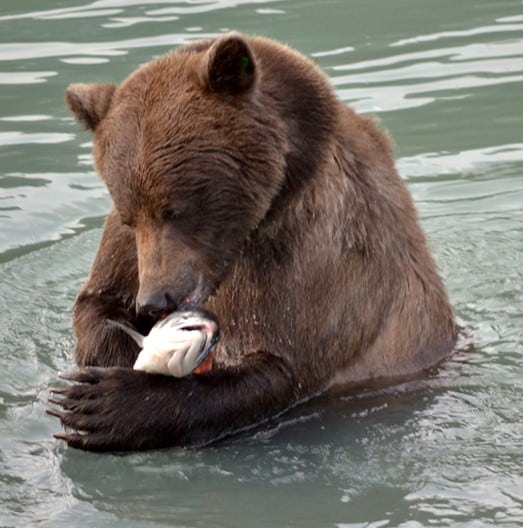
Grizzly Bear with Salmon. Credit: Wikimedia Commons/Jonathan Chase
Are there different types of salmon?
There are seven different species of salmon, and they can range from 20 inches to almost five feet long. They live in many places throughout the world, from East Asia to Alaska. In these unique habitats, they encounter a variety of predators. Some salmon can be eaten by larger fish, like swordfish and striped bass. Sharks, whales, and dolphins can also eat salmon. Larger animals, like seals, bears, otters, and even bald eagles can swoop into the water to eat salmon. With all of these predators, it is a wonder that salmon survive to spawn more baby alevins.
Of course, we cannot forget that human beings eat salmon too. We fish for them, and even have fish farms to grow salmon away from the dangers of other wild predators. Humans need to be careful so that we do not overfish for salmon, leaving too few salmon in the water to reproduce. To prevent this, there are rules about how many salmon we can catch in the wild. Some species of salmon are considered endangered, meaning they should be protected from too much fishing. We can also help endangered animals by rebuilding their habitats, making it easier for them to survive and thrive. Sometimes, salmon habitats are threatened by dams and blockage around their nesting grounds. When we help clean up their habitats, we give salmon a better chance to spawn.
Flesch Kincaid Score: 75.1
Flesch Kincaid Reading Level: 7th grade
Glossary
Redd – a nest for salmon eggs
Alevin – the first stage of salmon life, when salmon have just hatched
Fry – baby salmon with camouflage that still live in freshwater
Parr marks – stripes on fry salmon
Smolt – the stage of life when salmon transition from fresh to saltwater
Reproduce – to make offspring
Spawning – laying and fertilizing eggs
Homing instinct – the way that adult salmon find their way back to freshwater
Tess Taggart Bub has a bachelor’s degree in biochemistry and a minor in data science from Houghton College. During her undergraduate studies, she conducted research in the areas of climate science, ecology, and muscle biology. She is currently a PhD candidate at the University of Tennessee Health Science Center studying host cellular response to viral infection. She is a strong believer that science can change the world, especially when it’s shared. In her free time, she loves communicating science, playing guitar and piano, and running. Writing for smore gives Tess the opportunity to help inspire a new generation of women in STEM.