Vera Rubin was the American astronomer who changed the way we think of the universe.
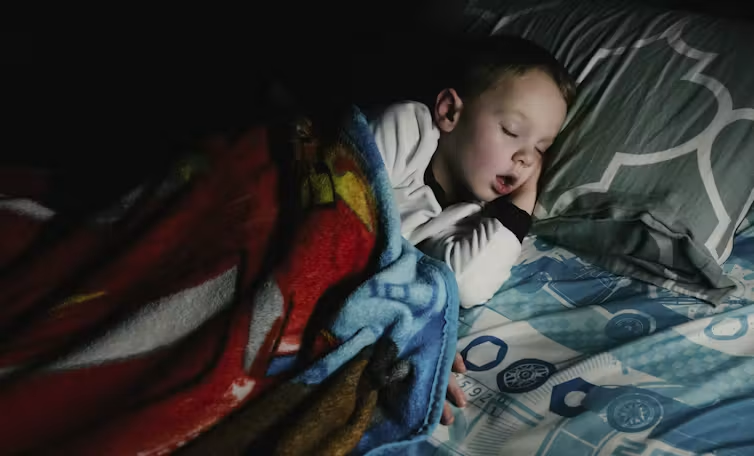
Vera Cooper shared a bedroom with her sister in a small house in Washington, D.C. It was the early 1940s, so cars were less common, street lights were dimmer, high-rise buildings weren’t quite so high, and the night sky was free from much of the light pollution that now pours from every block. With her bed pushed against the window, Vera had a beautiful, clear view of the stars. They fascinated her, and she often preferred stargazing to sleep.
On one drive home from her grandmother’s house, Vera noticed something strange as the trees faded into the distance. The Moon stayed in the same place, seeming to watch over their car on the dark road home. She wondered how the moon could know where they were going.
Vera also had lots of other questions. Why did the pictures on her bedroom wall seem to jump from side to side when she closed one eye and then the other? How did the water in a stream decide which side of a rock to pass?
Vera’s questions got bigger as she got a bit older, so she found ways to answer them herself. In 1942, when she was 14 years old, Vera and her father built her first telescope. They used a small lens from Edmund Scientific Co. and a large cardboard tube from a floor covering company, which she had carried home on the bus. She used this telescope to photograph movements of the stars. She’d soon move onto working with much bigger and better telescopes.
After high school, Vera went to the all-women’s Vassar College with a scholarship. Along with her studies, Vera assisted the astronomy professor Dr. Maud Makemson. She wound clocks, graded papers, and – most importantly – helped with the telescope. She finished her college education three years later and started working at the Naval Research Laboratory (NRL) where she met Robert Rubin, her future husband. Three months later, the couple wrote to their parents about getting married and changing Vera’s last name to Rubin.
Vera was just 19, but she already had her bachelor’s degree and dreamed of going to Cornell University with Robert. When she arrived at the physics department, she was amazed by the facilities. She completed her master’s degree over the next few years.
In the late 1960s, Vera began studying the movements of Andromeda, our neighboring galaxy. What she found was incredible.
Vera noticed that gas and dust moved in unexpected ways. The stars on the outside of the galaxies moved just as fast as those on the inside. According to scientists at the time, this went against the laws of physics. At such speeds, something must be holding the galaxies together. What was stopping the dust and gas from flinging out into the universe? Could something invisible hold the bits together? Vera Rubin had taken the first step towards understanding dark matter.
While matter refers to the stuff we can see, taste, hear, smell, or feel around us, dark matter is as mysterious as it sounds. Scientists today still haven’t figured out how it works. They can’t actually see it, but they can see the effect it has on light. That’s because dark matter’s gravitational pull causes light to bend. It’s a captivating puzzle that we’re a long way from solving, but Vera Rubin discovered the first big piece.
Even though it led to some tough times, Vera never stopped questioning things other people took for granted. She faced such challenges with determination and optimism. Vera had once been told that, as a woman, she could not work with California’s Palomar telescope – there were no women’s toilets. She solved that problem by pasting a drawing of a skirted figure on the door her first day.
Vera Rubin’s passion for science and belief in herself changed scientific history, and she believed that everyone has the power to do the same. “Each one of you can change the world,” she said, “for you are made of star stuff, and you are connected to the universe.”