Bohadschia argus, also called the leopard sea cucumber or tigerfish, is a type of sea creature that lives in the warm waters of the Western Indo-Pacific area. Mercier, A., Hamel, J. F., Suhrbier, A., & Pearce, C. (Eds.). (2023). The World of Sea Cucumbers: Challenges, Advances, and Innovations. Elsevier.
What do you know about sea cucumbers?
Sea cucumbers are unique ocean creatures that have been around for millions of years. People in different parts of the world enjoy eating them, and they are important for many fishermen. They got their name because they look like cucumbers but don’t taste anything like them. In China, they’re used a lot in fancy cooking. Many people eat sea cucumbers because they’re good for you, and lots of people rely on them for their jobs all around the world.
You can find sea cucumbers in oceans everywhere, from really shallow water to the deepest parts, and in all kinds of habitats from super cold to really warm places. They usually hang out in sandy or muddy areas near coral, rocks, or seagrass.
Did you know there are around 1,770 different kinds of sea cucumbers? And scientists keep finding new ones all the time! Sea cucumbers are part of a group of animals called echinoderms, which also include starfish and sea urchins.
Sea cucumbers look kind of funny — they don’t have eyes, and they feel rough or slimy. These creatures usually have a tube-shaped body and may have tentacles or bumps. Some of them can actually eject their insides as a way to protect themselves. They come in all different sizes, too. Some are really small, like just a few millimeters, while others can be over a meter long and weigh almost 10 kilograms. Even though they seem soft, sea cucumbers actually have skeletons made of tiny, chalky bones. The ones people usually see are black, brown, or gray, but there are also some that are really colorful, like yellow, red, blue, green, or even rainbow-colored. Some sea cucumbers are see-through, and some have this really cool ability to glow in the dark, making them shine green, blue, or yellow!

Different species of sea cucumbers exhibiting a variety of colors and textures. https://iucn.org/our-union/commissions/group/iucn-ssc-sea-cucumber-specialist-group
Sea cucumbers: Protectors of the coral reefs
The condition of coral reefs is worsening, mainly because there’s too much organic matter in the sand and mud around them. A recent study found that diseases in the sediment are hurting the coral. A scientific article talked about how sea cucumbers are helpful because they eat the sediment and stop diseases from spreading. This is important because it helps the coral reefs stay healthy and maintain the balance of life in the sea.
Sea cucumbers crawl on the seafloor and eat tiny bits of algae and tiny sea creatures using tube feet around their mouths. The stuff they eat gets broken down and then recycled into the ocean. Just like how worms help soil in a garden, sea cucumbers help the ocean. And get this – they actually poop out the sand in big spirals! It’s pretty amazing to watch!
Sea cucumbers are really important for the ocean. They help to keep the ocean floor clean and support the life of coral reefs. Studies have shown that the waste products produced by sea cucumbers can help protect the water around them from becoming too acidic, which is good for many ocean creatures. Sea cucumbers also release substances that help coral to grow.
Sea cucumbers overharvesting and coral reefs in danger
Sea cucumbers are in danger of being caught too much all around the world, which is causing their numbers to go down. When sea cucumbers are harder to find, they become more valuable, so more people start catching them illegally. In Kochi, Kerala, India, a research institute found that the number of sea cucumbers in the shallow parts of the water is getting very low. This has led divers to start catching the sea cucumbers in the deeper parts of the water. This is dangerous, and it’s not just a problem in India but also in other places. For example, in Yucatán, at least 40 divers have died while catching sea cucumbers, mostly because of a sickness called decompression sickness.
People are working to save sea cucumbers, but they are still being caught illegally because they are becoming rarer and more costly. Some big drug companies are also interested in sea cucumbers because they think the substances in them could help treat cancer and joint pain. It’s not clear if all this interest will ultimately help or hurt sea cucumbers in the future.
It’s important to remember that sea cucumbers are not just strange-looking creatures but important members of the ocean community that need our help to survive.
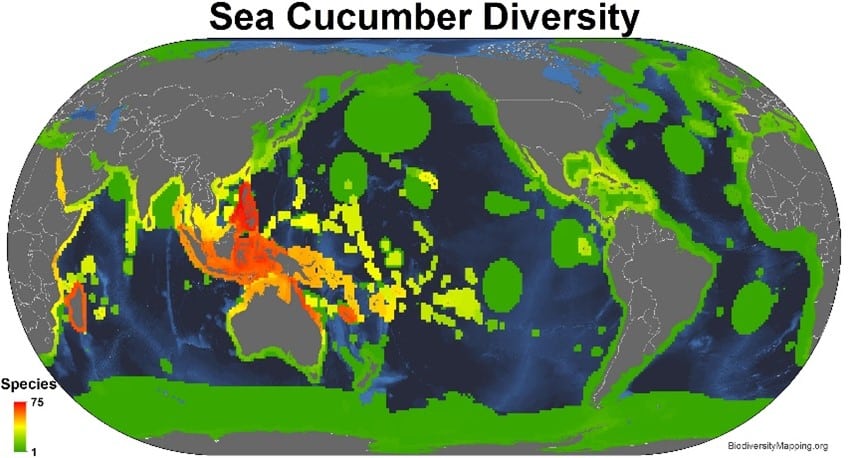
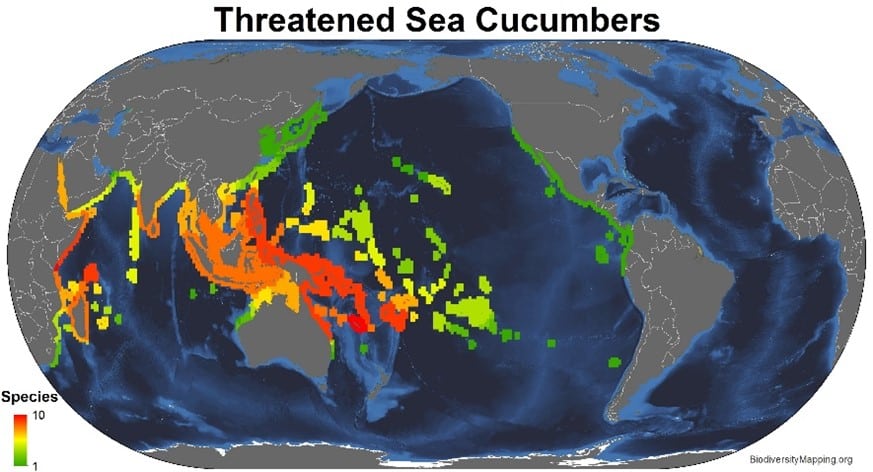
Maps of sea cucumber diversity including the total species richness (upper) and threatened species (lower). Maps are based on data from the International Union for Conservation of Nature (IUCN), August 2014 update. Data were originally published in the article Jenkins, C.N. & K. Van Houtan. (2016). Global and regional priorities for marine biodiversity protection. Biological Conservation. https://biodiversitymapping.org/index.php/sea-cucumbers/
References
https://biodiversitymapping.org/index.php/sea-cucumbers/
https://www.nature.com/articles/s41467-024-45730-0#Abs1
https://www.livescience.com/63169-pooping-sea-cucumber-video.html
https://www.youtube.com/watch?v=wXf_YodWw40
https://agupubs.onlinelibrary.wiley.com/doi/10.1029/2011JG001755
https://www.nationalgeographic.com/animals/article/sea-cucumber-eaten-to-death
Copyright @smorescience. All rights reserved. Do not copy, cite, publish, or distribute this content without permission.
SUBSCRIBE TO OUR NEWSLETTER
.......... ..........Subscribe to our mailing list to get updates to your email inbox.
Monthly Newsletter