Silicon chips have been the mother of the computing revolution for more than 50 years now. However, silicon means business in biology, too, with its uses ranging from monitoring large groups of neurons to DNA sequencing. Now, Harvard scientists have added a new streak of amazing to silicon chips by turning them into DNA factories. The chip can write DNA using electricity and water, making the process cleaner for biotechnology and, surprisingly, helping make data centers greener.
A Printer for DNA
The Harvard-led research team simultaneously synthesized 64 different DNA sequences using their silicon chip. The work, published in Nature Electronics, replaces the cumbersome, solvent-heavy chemistry used in custom DNA production with an enzymatic method that occurs in water.
Most synthetic DNA is produced through phosphoramidite chemistry. A nucleotide is enclosed by a protective group that prevents unwanted reactions and a phosphoramidite group that joins the nucleotide with the preceding one to assemble a custom-made DNA sequence. Enzymatic DNA synthesis is a far gentler procedure that closely resembles how living cells assemble DNA. However, enzymatic methods couldn’t replicate the number of DNA sequences that can be produced simultaneously with conventional chemistry.
Previous systems have created no more than a dozen sequences at once, so the scientists improved the enzymatic method. Instead of controlling DNA synthesis with a barrage of laboratory equipment, the team applied controlled electric currents to activate chemical reactions at specific locations across the chip’s surface. The Harvard team produced 64 unique sequences, each one reaching a length of 39 nucleotides, setting a record for parallel enzymatic DNA synthesis.
How does the Chip Control DNA Growth
DNA is built one nucleotide at a time, much like a LEGO build. After each nucleotide is added, a temporary group blocks further strand growth. To attach the next nucleotide, scientists perform deprotection— a process to remove the blocking group. It can be initiated in water by creating an acidic environment with low pH.
Controlling exactly where and when the acidity appears is the difficulty of parallel DNA synthesis. Only sites ready for the next nucleotide should experience a pH drop during each cycle, a problem the Harvard chip solves using electricity. Its surface contains 64 DNA synthesis sites, with two concentric platinum ring electrodes surrounding DNA strands fixed at the center.
When a site is ready to receive a nucleotide, the chip sends current into the inner ring. The pH immediately lowers around the DNA strands due to proton production, driving enzymatic growth. At the same time, the outer ring draws current and absorbs the protons before they spread away from the site. In other words, an acidic bubble forms at the targeted site. By activating different sites during each synthesis cycle, the chip creates a dynamic pattern of low-pH zones, which produce localized reactions over repeated cycles to build 64 separate DNA sequences.
The Chip Used to Record Neurons
When former PhD student Jeffrey Abbott built the silicon chip in Donhee Ham’s (the lead researcher) lab, he intended to use it for large-scale intracellular recording from neurons. The system recorded activity from thousands of neurons and mapped synaptic connections in thousands. Ham’s team adapted the chip to suit their purpose by redesigning the electrodes on the chip’s surface to direct DNA synthesis.
“A defining feature of the chip was precision current injection, which we used to permeabilize neuronal membranes for intracellular access,” Ham said. “At a certain point, we wondered whether that same current control could be redirected from cells to molecules – replacing the neuron-facing electrodes with ring-electrode pairs that could localize pH for DNA synthesis. It worked.”
After demonstrating 64-sequence synthesis, the researchers plan to enhance the technology to support even more DNA strands packed into a smaller area. However, a denser design didn’t work despite the electronics maintaining an acidic environment. Further experiments showed that the problem was in the deprotection chemistry rather than the chip. Those molecules drifted into nearby sites, escaping tightly controlled pH zones and causing unwanted reactions.
Data Centers and the Water Crisis
A recent Gallup poll revealed that 7 out of every 10 Americans oppose building more data centers, raising concerns over water scarcity. Tech giants are scrambling to assure the public that they are addressing the issue and, in fact, have seen mixed success in their efforts. Water is mainly used to cool data center systems. The water removed post-cooling, or blowdown water, is released back into the environment. Concerns regarding blowdown water’s safety and quality are also a talking point.
A single AI query requires 16oz of freshwater, and ChatGPT alone receives 10 million queries per day. A medium-sized data center uses 300,000 gallons of water per day for cooling, which can satisfy the needs of a 1,000 households. The amount of water required for optimal data center operation could quadruple by 2028 compared with 2023 levels.
In January, the US federal legislation introduced the Data Center Transparency Act (H.R. 6984). The bill prevents any government authority from using non-disclosure agreements (NDAs) to conceal the impact of data centers on water and air quality and electricity consumption. Notably, Google funded the lawsuit filed by a town in Oregon against a local news outlet to avoid disclosing how much water the company plans to use for its data centers, claiming it as a ‘trade secret’. Ultimately, the news outlet won the case.
“We were able to get that information and saw just how much water they were using, which was a quarter of all the water in the entire city and triple what they’d been using just a few years earlier. And they have two more data centers planned,” said reporter Mike Rogoway.
The tech company started revealing its water usage reports for select data centers from 2023.
DNA for the Green
The researchers demonstrated a futuristic policy of using the 64 DNA sequences to encode 169-byte text. Research shows enzymatic DNA production reduces GHG emissions, water, and energy consumption over chemical methods. In addition, DNA archiving has a lower impact on resources than HDDs and tapes.
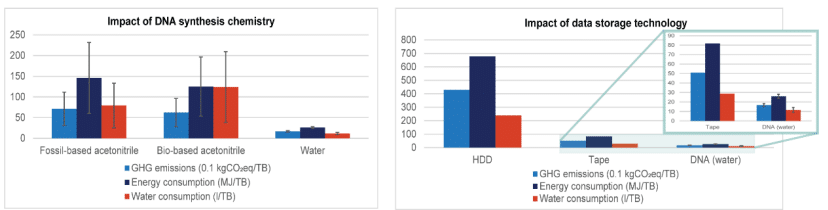
DNA data centers can drive a greener and more sustainable tomorrow. In fact, the Library of Congress awarded a grant to write 1.5GB of information in DNA. Development must go hand in hand with sustainable approaches, and this new tech can help achieve that.
For now, we have a Plan B, but no Planet B.
Copyright @smorescience. All rights reserved. Do not copy, cite, publish, or distribute this content without permission.
SUBSCRIBE TO OUR NEWSLETTER
.......... ..........Subscribe to our mailing list to get updates to your email inbox.
Monthly Newsletter