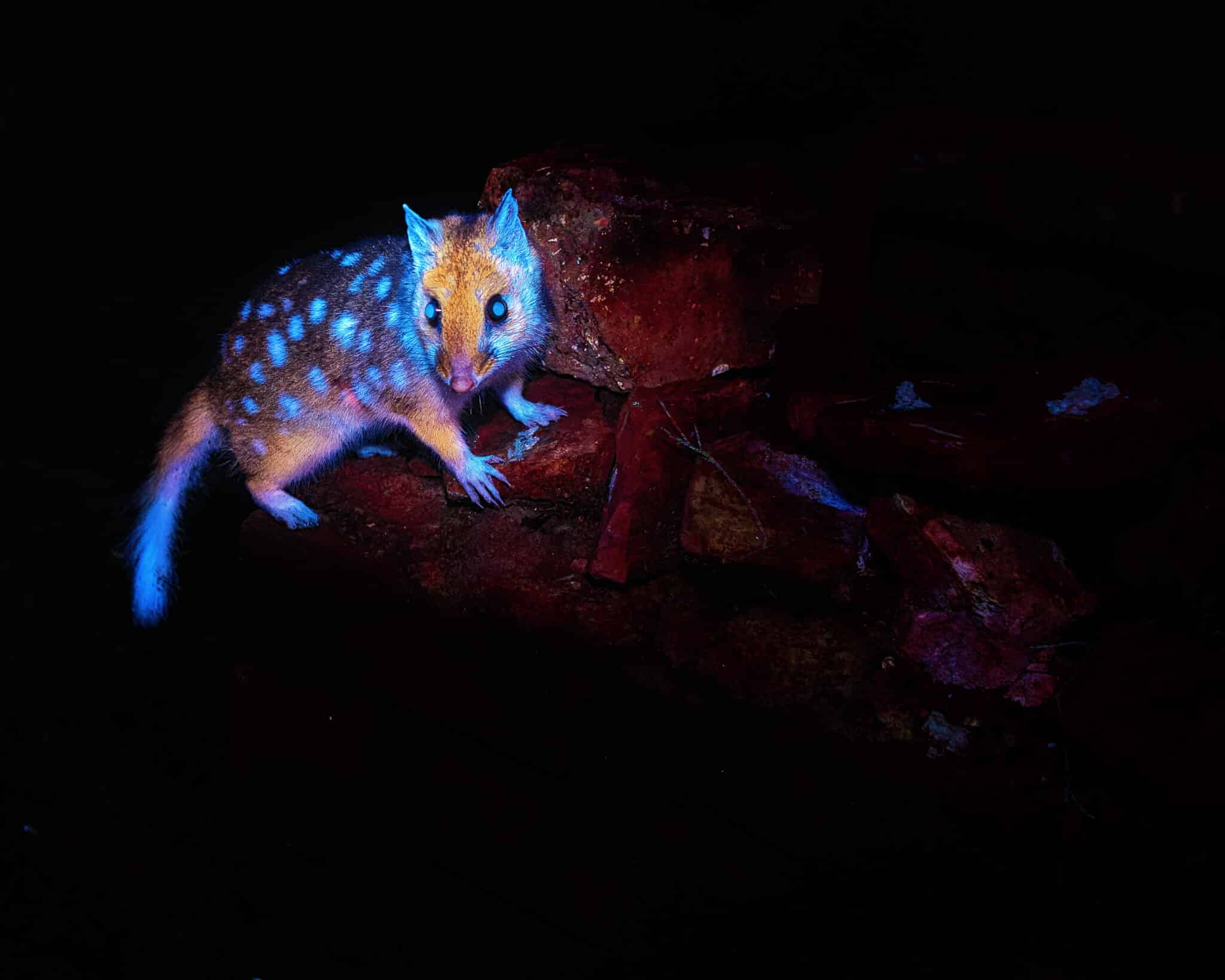
Imagine walking through the Tasmanian wilderness with a UV light and suddenly spotting a small marsupial, glowing like a neon sign. That’s exactly what happened when photographer Ben Alldridge snapped a wild eastern quoll (Dasyurus viverrinus) shimmering with a bright blue glow.
Glow-in-the-dark marsupial shows off its luminous furs. Credit: Nature
The animal, normally dressed in earthy browns or blacks with white spots, revealed a hidden side of itself when exposed to ultraviolet light. Parts of its fur absorbed the UV rays and re-emitted them as a dazzling blue, a phenomenon called biofluorescence.
This is the first time a wild marsupial has ever been photographed glowing in this way. And it’s not just a neat party trick; scientists are still puzzling over why some animals have this hidden glow at all. Is it for communication? Camouflage? Or simply an evolutionary quirk? The mystery keeps researchers intrigued.
Glowing creatures aren’t new; scorpions, some fish, and even a few mammals have been known to light up under UV. But seeing it in a wild marsupial like the quoll adds a whole new twist to how we think about Australia’s already eccentric wildlife.
Next time you hear about glow sticks at a party, remember: some animals come with their own natural version built in.
Curious about the science behind this glow? Certain materials can soak up light and slowly release it back, creating that eerie green shine we all love. Want to know how it really works (and why green glows best)?