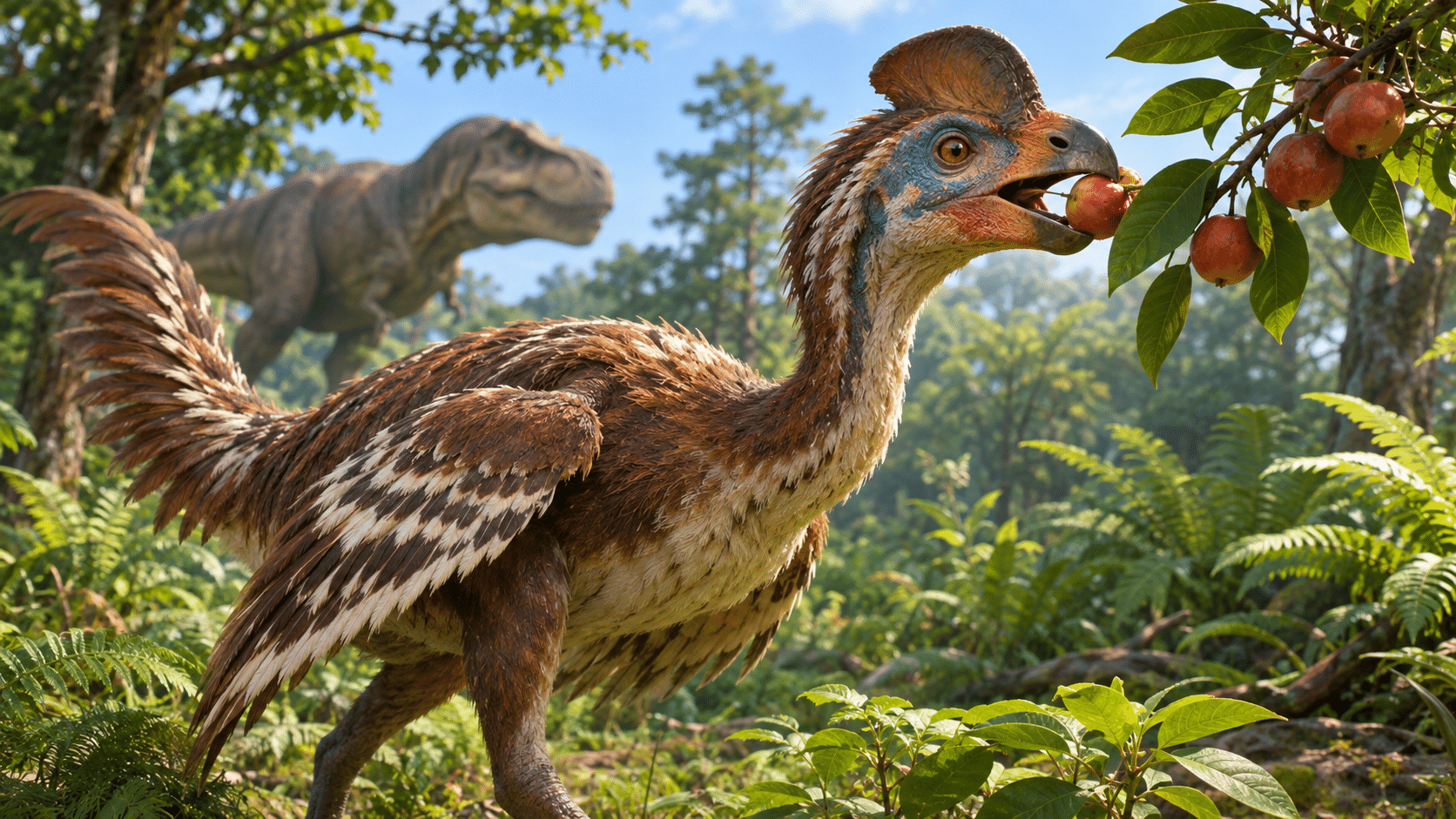
Scientists have discovered a dinosaur that may have been specially adapted to eat fruit. Its unusual name? Infernogallus jamesi, nicknamed the “Hell Chicken”!
This discovery is giving scientists a new understanding of what dinosaurs ate and how they lived millions of years ago.
A Dinosaur Unlike the Others
Infernogallus jamesi lived during the Late Cretaceous Period, around the same time as famous dinosaurs such as Tyrannosaurus rex and Triceratops.
Despite its dramatic nickname, this dinosaur was not particularly huge or terrifying. It was roughly the size of a turkey and weighed about 12 kilograms (25 pounds).
It belonged to a group of feathered dinosaurs called oviraptorosaurs. These dinosaurs had beaks instead of teeth.
But what made this particular dinosaur special was its unusual skull and powerful chewing muscles.
How Did Scientists Discover Its Favorite Food?
The secret was hidden inside its skull!
Scientists examined a remarkably preserved fossil, including an almost complete skull. They used advanced CT scanning technology to study its internal structure and understand how its jaw muscles worked.
They discovered something surprising.
Unlike many dinosaurs that mainly bit down with an up-and-down movement, Infernogallus could move its beak backward and forward while chewing.
This movement helped it mash soft foods, especially fruit.
Interestingly, a similar arrangement of chewing muscles can be found in some modern fruit-eating parrots and even humans!
By studying these unusual skull features, scientists concluded that this dinosaur was specially adapted to eat fruit.
Why Would a Dinosaur Eat Fruit?
Fruit-eating might sound ordinary today, but it was an interesting development in the dinosaur world.
During the Cretaceous Period, flowering plants were becoming more common across the planet. These plants produced fruits that provided food for animals.
Scientists believe that Infernogallus may have helped spread flowering plants.
How?
When animals eat fruit, they sometimes swallow the seeds too. Later, they release those seeds in different places through their droppings. This helps new plants grow in locations far from the original plant.
This process is called seed dispersal.
Today, birds, reptiles and mammals help spread seeds in this way. Scientists now think that some dinosaurs may have played a similar role millions of years ago.
What Makes This Discovery Important?
The discovery of Infernogallus jamesi reminds scientists that dinosaurs were much more diverse than we once imagined.
Not every dinosaur was a giant predator like T. rex or a massive plant-eater like Triceratops. Some were small, feathered animals with highly specialized diets.
It also gives scientists clues about how dinosaurs adapted as flowering plants became more widespread.
And perhaps the biggest lesson is that there are still many dinosaur mysteries waiting to be discovered!
Test Your Dinosaur Knowledge!
Have you been paying attention? Try this quick quiz to see how much you learned about the fruit-eating dinosaur.
Quiz Answers
Ready to check your answers? Here are the correct answers with explanations.
- A turkey – Infernogallus was approximately turkey-sized and weighed around 12 kg.
- Fruit – Its specialized jaw muscles helped it mash soft fruits.
- CT scanning – Scientists used CT scans to examine the internal structure of its skull.
- Moving seeds to new places – Animals spread seeds through their droppings, helping new plants grow in different locations.
How did you do?
- 4/4 – Dinosaur Expert!
- 3/4 – Great job!
- 2/4 – Good effort!
- 0–1/4 – Time to explore dinosaurs again!
Source:
Royal Ontario Museum – Rare fossil discovery reveals new dinosaur species that were specialized fruit-eaters.
Fruit-eating adaptations in a Late Cretaceous oviraptorosaur (Theropoda), published in Nature Communications. DOI: doi.org/10.1038/s41467-026-78343-w