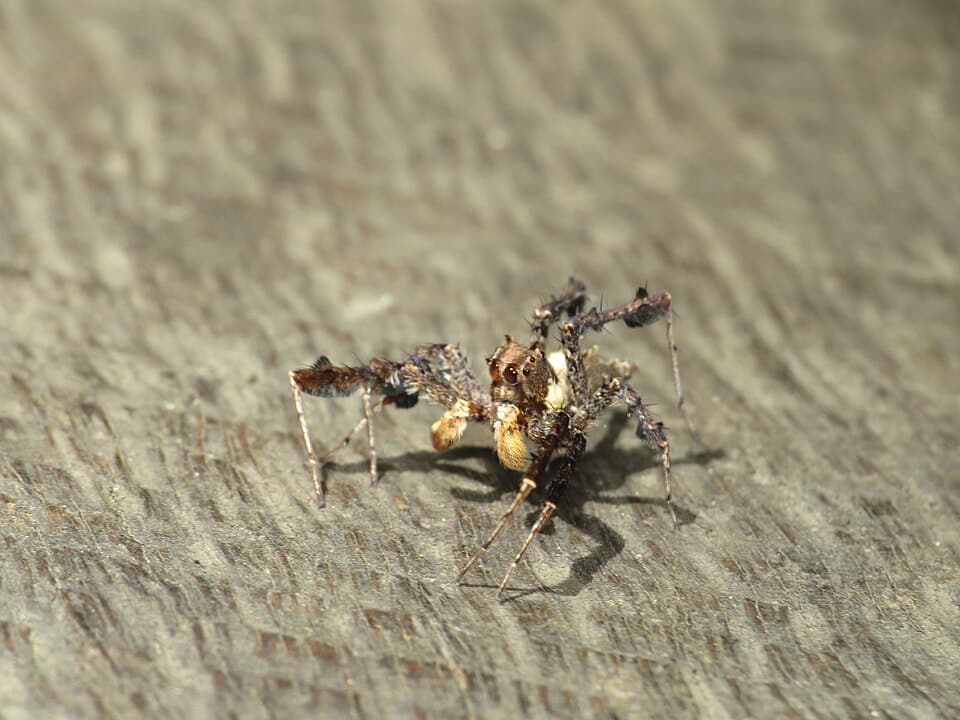
An Australian jumping spider does more than sit still at bedtime. Scientists led by the University of Bonn found that Portia fimbriata has regulated sleep with two distinct stages, including one marked by eye movements and muscle twitches. The findings provide experimental evidence that these spiders truly sleep.
The study, published in PNAS, goes beyond spotting a sleepy-looking spider. The team tested whether the animals became harder to disturb and made up for interrupted sleep—key clues that distinguish sleep from ordinary rest.
A quiet stage and a twitchy stage
At night, Portia settles upside down beneath a small silk platform. It becomes almost motionless in a characteristic resting posture.
But that stillness does not last all night. Quiet periods alternate with active episodes in which the spider’s eyes move and its legs twitch or curl. These episodes resemble REM sleep, named for the rapid eye movements seen during that stage in humans and other animals.
The important word is “resemble.” Similar movements do not establish that spider sleep works exactly like human sleep. They do, however, give scientists a way to identify and test two different sleep states.
How to tell whether a spider is asleep
A motionless animal might simply be resting. To establish sleep, researchers need evidence that its behavior changes in consistent, measurable ways.
The team filmed spiders over several days and nights under different lighting conditions. Each animal occupied a plastic dish 12 centimeters across. Infrared cameras captured nighttime behavior, allowing the researchers to track resting positions and bouts of movement.
They also used a sound stimulus to test the spiders’ responses. Sleeping spiders were less responsive, especially during the active, REM-like stage.
Another test involved disrupting sleep. Afterward, the spiders compensated by sleeping longer and showing more REM-like episodes. This response, called sleep rebound, suggests that their need for sleep builds when it is interrupted. Together, the results support a structured sleep pattern rather than simple nighttime inactivity.
Much of sleep research focuses on animals with backbones. Studying a spider gives scientists a chance to compare sleep across animals with very different nervous systems.
The result raises questions about how sleep evolved and which features different animals share. It also establishes Portia as a useful subject for studying those questions. The experiments show organized sleep behavior; they do not yet explain what each stage does for the spider.
What scientists still don’t know
The team measured behavior, without recording brain activity. That leaves an important gap: scientists still need to investigate what happens inside the spider’s nervous system during each stage.
They also want to compare sleep across spider species and between laboratory and wild settings. Whether sleep helps spiders learn and whether their REM-like state involves anything resembling dreams remains unresolved. Eye movements and twitching alone cannot answer those questions.