In a groundbreaking new study, researchers discovered that a common yellow food dye can make living mouse skin transparent. This technique could offer a potential non-invasive way to do medical imaging.
The research was led by Dr. Zihao Ou, an assistant professor of physics at the University of Texas at Dallas and the study was published in the journal Science
The research team used tartrazine, also known as FD&C Yellow #5. This is a common food dye found in brightly colored candies, including M&Ms, Starbursts, chips like Doritos, and drinks like Moutain Dew and Sunny D.
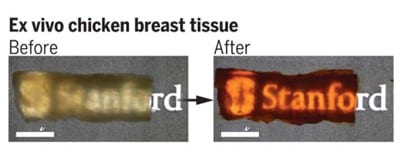
Living skin is opaque because of its diverse composition of proteins, fats, and liquids, which scatter incoming light and do not allow it to pass through. However, when the researchers applied a mixture of water and tartrazine to the skin on the skulls and abdomens of the mice, the result was striking.
In the abdomen, the internal organs and digestive tract muscle contractions became visible.
The process works by altering the tissues’ refractive indices. The tartrazine solution matched the refractive indices of the tissue components, reducing the scattering of light from the skin and allowing it to pass through, rendering the skin transparent.
Achieving optical transparency in live mice with absorbing dye molecules. Credit: https://www.science.org/doi/10.1126/science.adm6869
The skin remained transparent for about 10-20 minutes before returning to its original state. It’s also worth noting that the process is reversible, and the dye can be washed off or metabolized by the body.
Applications of transparent skin
While it remains to be tested on humans, this discovery could be helpful in medical imaging. Dr. Ou and colleagues envision many useful applications:
This technique could make blood draws easier by making veins more visible
It could improve tattoo removal procedures
It could be used to help detect early skin cancers.
But, the researchers caution that more work is needed to get there. The human skin is about ten times thicker than mouse skin, which could affect the absorption of the dye and the amounts required to work effectively for humans.
Disclaimer: This technique is experimental and not approved for use on humans. Dyes can be dangerous if misused. Handle dyes responsibly – avoid ingestion, skin contact, or application to living beings. Follow proper safety protocols when working with dyes.
Copyright @smorescience. All rights reserved. Do not copy, cite, publish, or distribute this content without permission.
Join 20,000+ parents and educators
To get the FREE science newsletter in your inbox!
SUBSCRIBE TO OUR NEWSLETTER
.......... ..........
Subscribe to our mailing list to get updates to your email inbox.