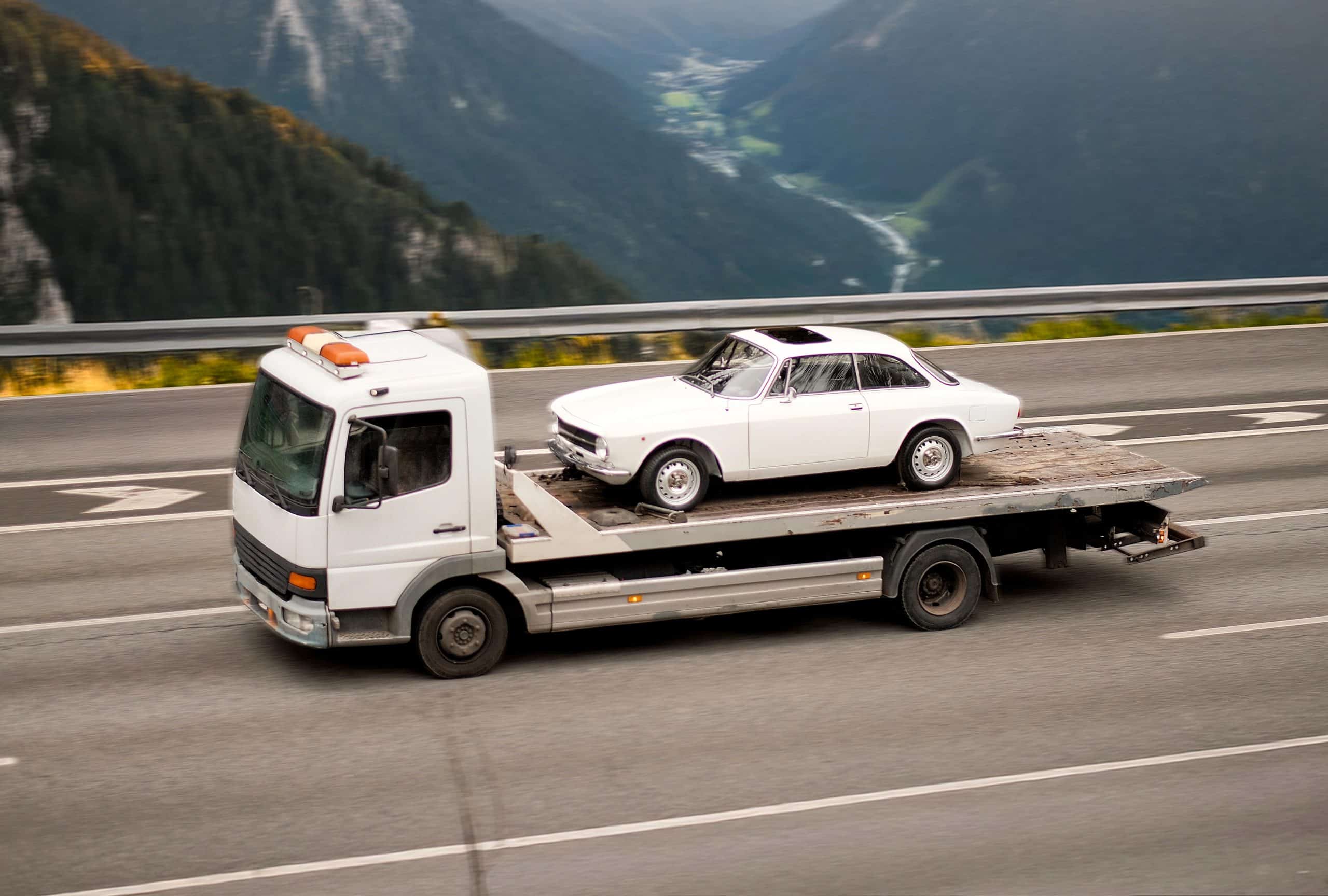
How do you stack nine cars onto a single truck, drive them 2,000 miles across mountains and interstates, and deliver every one of them without a scratch? It sounds like a packing puzzle, but it’s really a working demonstration of materials science, physics, and one of the hardest math problems in computer science all happening quietly on the highway beside you. Here’s the science that makes it possible.
Steel That Bends But Doesn't Break
A car carrier can hold well over 20 tons of vehicles, so the trailer beneath them can’t simply be strong it has to be strong in the right directions. Engineers build these frames from high-tensile steel chosen to resist torsion, the twisting force a trailer experiences when one wheel climbs a bump while another dips into a pothole. Without that resistance, the frame would flex like a wet noodle and warp over time.
The joints matter just as much as the metal. Many carriers are assembled using submerged-arc welding, a technique where the weld forms beneath a blanket of powdered flux. That blanket shields the molten metal from oxygen, producing deep, clean, exceptionally strong joints ideal for the thick structural beams that carry the load.
The Physics of a Balanced Load
Loading a multi-car trailer is an exercise in managing center of gravity. Place the weight wrong and the whole rig becomes unstable at speed. That’s why the heaviest vehicles go forward, near the cab, and lighter ones ride at the rear keeping the combined center of mass low and forward for stability.
Get it wrong and you invite resonance. Every trailer has a natural frequency at which it likes to sway; hit the right combination of speed, road texture, and poor weight distribution, and small vibrations reinforce each other into a dangerous oscillation the same physics that lets a singer shatter a wine glass. Skilled drivers train for years to arrange loads that never let those vibrations build. Loading order is planned like a game of three-dimensional Tetris, with tall vehicles slotted where ramps and upper decks won’t interfere.
Why the Straps Grip the Tires, Not the Car
Here’s a counterintuitive detail: vehicles are almost never tied down by the body. Instead, wide straps loop over the circumference of each tire.
The reason is friction and force distribution. A car’s suspension is a system of springs strap the frame down tight and every bump yanks against those springs, stressing the body. Anchoring at the tire lets the suspension keep doing its job while the strap simply stops the wheel from rolling. Spreading the force across the broad, flexible rubber also means no single point takes a damaging load. Stop the wheels, and you’ve stopped the car safely.
The Math of the Empty Mile
Now the part that surprises people most. The biggest cost in auto transport isn’t fuel or labor it’s the empty mile. The industry calls unused trailer space deadhead, and every empty slot is money and time lost.
Minimizing it is a version of one of the most famous unsolved-in-practice problems in mathematics: the Vehicle Routing Problem, a cousin of the classic “traveling salesman.” Ask a computer to find the single best route through a handful of stops and it’s easy. Ask it to route a truck through fifteen pickups and drop-offs, in the ideal order, while keeping the trailer full and the cars in loading sequence, and the number of possible combinations explodes so fast that checking them all would take longer than a human lifetime.
This is why modern logistics runs on optimization software and, increasingly, artificial intelligence. Algorithms weigh distance, demand, and load order to squeeze deadhead toward zero the same class of math that routes your food delivery and packs warehouse robots. It’s operations research quietly saving fuel on every trip.
Open vs. Enclosed: An Engineering Trade-Off
Finally, the choice between open and enclosed trailers is a clean example of engineering trade-offs. Open carriers are lighter, cheaper, and hold more cars but they expose vehicles to road debris and the sun’s UV radiation, which slowly degrades paint and plastics. Enclosed carriers wrap each vehicle in a protective shell, some even climate-controlled to shield sensitive materials like carbon fiber. You trade capacity and cost for protection the kind of decision engineers make in every field, from aircraft to phone design.
The Takeaway
The next time a car carrier rolls past you, look again. That truck is a rolling lesson in high-strength materials, the physics of balance and resonance, the mechanics of friction, and some genuinely hard mathematics all coordinated so that ordinary cars arrive exactly as they left. Logistics rarely gets called a science, but moving a vehicle safely across a continent depends on all of it at once.
Curious how these principles play out at scale across whole fleets and thousands of routes? That’s exactly the kind of applied science that keeps the modern transport world moving.
Copyright @smorescience. All rights reserved. Do not copy, cite, publish, or distribute this content without permission.
SUBSCRIBE TO OUR NEWSLETTER
.......... ..........Subscribe to our mailing list to get updates to your email inbox.
Monthly Newsletter