Northern Lights Forecast

Tools and techniques for predicting the qurora borealis

Table of Contents

One of the most popular things on a to-do bucket list is to watch the northern lights . Northern lights are also called aurora borealis . A fascinating display of nature’s beauty, northern lights are commonly observed in countries like Norway, Sweden, and Canada.

A captivating phenomenon

Have you ever wondered how auroras occur?

The sun releases particles including electrons and protons . The collision of these particles with the Earth’s atmosphere leads to light emission. This is what we see as green, red, and pink light. The Earth’s magnetic field deflects the particles toward the Earth’s poles. This is why the phenomenon of aurora is commonly observed near the poles.

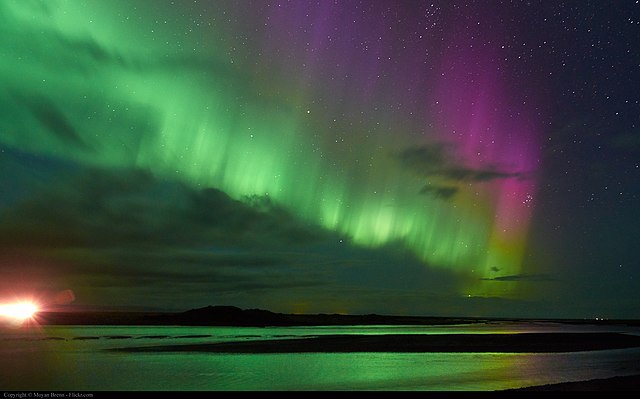
Northern Lights
Northern Lights, Credit: Wikimedia/Moyan Brenn

The Space Weather Prediction Centre (SWPC)

No single tool can provide an accurate prediction. Scientists use a variety of tools to predict aurora activity. The Space Weather Prediction Center (SWPC), which is a part of the National Oceanic and Atmospheric Administration (NOAA) is one such tool. The SWPC monitors the activity of the Sun. It records events like solar flares, solar winds, and coronal mass ejections (CME). Coronal mass ejections are explosions of particles from the Sun’s outermost atmosphere. All these events can lead to disturbances in the Earth’s magnetic field. These disturbances are called geomagnetic storms . Geomagnetic storms can cause northern lights to appear. In fact, they are responsible for the red-shaded auroras we see.


Satellites are the reason we can watch our favorite television and cartoon shows. But some of them are used for more than TV. They can help scientists predict the activity of northern lights. The SWPC has in its capacity one such satellite. It’s called the Advanced Composition Explorer (ACE) satellite. This is the satellite that monitors and records the activity of the Sun. Its observations can be used to get the forecast for a northern lights event.

An artist’s depiction of the Advanced Composition Explorer Satellite in space
An artist’s depiction of the Advanced Composition Explorer Satellite in space, Credit: Wikimedia/Andrzej Mirecki

The Kp index

An important tool to predict the occurrence of northern lights is the Kp index . It is a scale that measures the strength of the Earth’s magnetic field. It ranges from 0 to 9. A higher Kp index value suggests a higher possibility of the occurrence of northern lights. If the Kp index value lies from 0 to 2, the aurora will mostly be restricted to the poles. It will also be dimmer in intensity. If the value is from 3 to 5, the aurora may also be visible in regions that are slightly further from the north. As the value increases, the brightness of the aurora increases. There may even be variations in the color observed.


As the Kp index depends on the Earth’s magnetic field, instruments called magnetometers are used to measure the strength of the Earth’s magnetic field. The observations it produces are used to calculate the Kp index.

Magnetometers

Magnetometers are used to measure the strength of the Earth’s magnetic field. Hence, they can also indicate changes in the field. Certain solar events like solar winds and solar flares emit particles that interact with the Earth’s magnetic field, changing it.


The magnetometers can use this information to create maps of the Earth’s magnetic field. These maps serve as good indicators of geomagnetic storms and can help generate a forecast of the northern lights. 


It can be difficult to predict the exact time or place of occurrence of northern lights. A combination of tools is needed. Ground-based cameras, observatories, satellites, and telescopes can also be used. Some factors on the Earth, like clear skies, can affect the visibility of northern lights. Do take that into consideration if you plan on packing your bags and heading off to Sweden!

Flesch Kincaid Reading Ease: 60.1


Flesch Kincaid Grade Level: 8

Glossary

Northern lights: Colorful display of undulating light across the sky.


Aurora borealis: Another name for northern lights.


Magnetic field: The force around a magnet.


Electrons: Negatively-charged particles of an atom.


Protons: Positively-charged particles of an atom.


Geomagnetic storms: Disturbances in the Earth’s magnetic field.


Kp index: A measure of the strength of the Earth’s magnetic field.


Magnetometers: Instruments used to measure the Earth’s magnetic field.

Cárdenas, F., Sánchez, S., & Domínguez, S. V. (2016). The grand aurorae borealis seen in Colombia in 1859. Advances in Space Research, 57(1), 257–267. https://doi.org/10.1016/j.asr.2015.08.026


Jóhannesson, G. T., & Lund, K. A. (2017). Aurora Borealis: Choreographies of darkness and light. Annals of Tourism Research, 63, 183–190. https://doi.org/10.1016/j.annals.2017.02.001


Gonzalez, W. D., Joselyn, J. A., Kamide, Y., Kroehl, H. W., Rostoker, G., Tsurutani, B. T., & Vasyliunas, V. M. (1994i). What is a geomagnetic storm? Journal of Geophysical Research, 99(A4), 5771. https://doi.org/10.1029/93ja02867


Moore, R. L., Sterling, A. C., Hudson, H. S., & Lemen, J. R. (2001). Onset of the Magnetic Explosion in Solar Flares and Coronal Mass Ejections. The Astrophysical Journal, 552(2), 833–848. https://doi.org/10.1086/320559


Ripka, P. (2002). Magnetic Sensors and Magnetometers. Measurement Science and Technology, 13(4), 645. https://doi.org/10.1088/0957-0233/13/4/707
Contributors

Copyright @smorescience. All rights reserved. Do not copy, cite, publish, or distribute this content without permission.


Join 20,000+ parents and educators
To get the FREE science newsletter in your inbox!